7:28 in the morning Your calendar is politely blinking “Workout” at you, your gym bag is by the door, and your membership card is in your wallet. You look out the window. The sidewalk is calling louder than the squat rack, and it’s cool and bright outside. You say to yourself, “I’ll just go for a walk instead; it’s almost the same thing.” Ten minutes later, you’re sitting by a café window with a latte in one hand and your phone in the other, forgetting about your steps. Does this sound familiar? We like the idea that walking is exercise. It sounds soft, real, and almost romantic. But when doctors and scientists say that walking can take the place of going to the gym, they mean something very specific. A speed. A length of time. A kind of focus we don’t often use when we put one foot in front of the other.
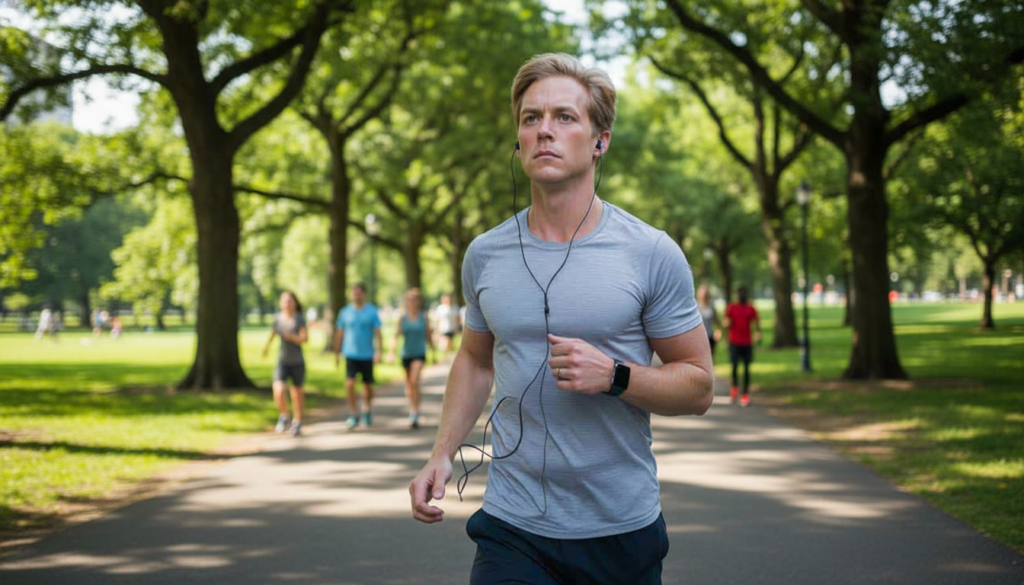
The truth is that walking only works as a workout if you treat it like one.
Why this strange 30 minutes at 5 km/h really works
Imagine a moving walkway in an airport. In real life, that’s about 5 km/h. It’s not a lazy walk or a jog; it’s a determined, heads-up stride. Your arms naturally swing, your breath gets deeper, and small talk gets a little more broken up at that speed.

That’s when the magic starts to happen after thirty minutes. Below that, you’re mostly just “getting some air.” Above that, your heart, lungs, and muscles start to work like they would during a beginner-friendly cardio session. It’s still walking, but all of a sudden it turns into real training.
Researchers in public health did a big study on adults who walked quickly for about half an hour most days of the week. The pattern kept coming back: **about 30 minutes of steady, moderate-paced walking** was linked to a lower risk of heart disease, better blood sugar control, and even fewer signs of depression. Not a brave marathon. A steady, firm walk.
A 42-year-old office worker I talked to said she “hated the gym atmosphere,” but she started walking home every night at a steady pace. Same path, same speed, and headphones on. Three months later, her smartwatch said her resting heart rate had dropped by six beats, and she was able to climb stairs without feeling like she was going to die. She hadn’t “started a program.” She had just stopped thinking of walking as background noise.
Why the rule about not stopping? Your body needs a steady signal. Your heart and blood vessels adapt when your heart rate rises to a moderate level and stays there. Your blood vessels become more flexible, your muscles use oxygen more efficiently, and your metabolism gets a small but real boost.
The signal gets less clear when you break those 30 minutes up into small parts throughout the day. You still get benefits, but they’re more like “normal activity” than a real training effect. Walking at a steady 5 km/h without stopping is a clear signal to your body that it’s time to exercise, not just waste time between tasks.
How to really walk like it replaces your workout
First, change 5 km/h into something you can feel. That’s about 12 minutes for every kilometre and 19 minutes for every mile. If that sounds like numbers on a treadmill screen, think of it this way: you can talk, but you’d rather not give a TED Talk. Your breathing is loud, your legs are moving, and your body is gently telling you that this is not a leisurely window-shopping trip.
This is an easy way to do it: start with 3 to 5 minutes of easy walking to warm up, then pick up the pace so that your arms swing, your stride shortens a little, and your feet land under your hips instead of miles in front. Keep that pace up for 30 minutes without stopping. That’s all. You don’t need to do lunges, burpees, or wear neon leggings.
Most of us make the mistake of turning the “walk” into a chore. You start off strong, but then you have to stop to answer messages, look in shop windows, wait at traffic lights, or even run into a neighbour. Before you know it, your 30-minute session has 10 minutes of breaks. The beat goes away.
We’ve all had that moment when you tell yourself, “I’ve walked a lot today,” and then you look at your phone and see a lot of steps but not much sustained effort. Let’s be honest: no one really does this every day. Things happen in life. You don’t have to be perfect; you just need to take a few brisk, non-stop walks a week and protect those 30 minutes like you would a doctor’s appointment.
One sports doctor I talked to said it all in one sentence:
“If you walk like you’re late, your body knows.”
To make it easier, create a small “protocol” for walking:
Choose a flat, low-stop path that you can walk for 15 minutes in each direction.
Don’t worry about how far you have to go; just set a timer or look at your watch.
Start with two brisk walks a week, and then add a third or fourth walk as you feel ready.
Don’t use your phone and think of the walk as an appointment, not a commute.
Finish with 2 to 3 minutes of slower walking and some gentle stretches for your hips and calves.
 Spanish scientists reveal mammoths and dinosaurs may have moved more slowly than previously believed
These little guardrails are what make “I walk a lot” into “I really get a training effect.”
What this kind of walking really does to your life
When your walks go from “nice” to “non-stop at a steady pace,” something small happens. Your day gets a clear point of reference. You know that for 30 minutes, your body will be in charge and your brain will follow. For a lot of people, that changes more than just their cholesterol levels.
Stress gets a release. Ideas get clearer. Some people know that they sleep better on days when they walk with a purpose, not just to get from one place to another. Some people find that their cravings go down a little when they get regular exercise. You don’t need gear, youth, or even motivation to walk like this every time. All it wants is for you to make a choice: these 30 minutes matter today.
Once you know the difference between a casual stroll and a steady 5 km/h walk, you can’t forget it. You can tell when your body is coasting and when it’s slowly speeding up. And that awareness often stays with you even when you don’t walk at all.
| Key point | Detail | Value for the reader |
|---|---|---|
| Non-stop 30 minutes | Continuous effort keeps the heart rate in a training zone | Maximizes health benefits in a short, doable window |
| Steady 5 km/h pace | Brisk but comfortable, “you can talk, but not sing” intensity | Makes walking a true workout without feeling extreme |
| Structured routine | Chosen route, fixed time, minimal stops or distractions | Turns vague “I walk a lot” into a reliable, trackable habit |
FAQ:
Does walking 30 minutes really replace a gym workout?
For basic cardio health, a non-stop 30-minute walk at about 5 km/h gives benefits similar to a light to moderate gym session. It won’t replace heavy strength training, but it absolutely counts as real exercise.
How do I know if I’m actually at 5 km/h?
You can use a walking app or smartwatch for a while, but the talk test works well: you can speak in short sentences, yet singing or long monologues feel uncomfortable.
Can I split the 30 minutes into two 15-minute walks?
You’ll still get benefits from splitting, especially for general movement and blood sugar. For a true cardio-training effect, one continuous 30-minute block is more effective.
Is it okay if I walk faster than 5 km/h?
Yes, as long as it stays sustainable for the full 30 minutes and your joints feel good. Faster isn’t required, consistency is.
How many days a week should I do this?
Public health guidelines point to at least 150 minutes of moderate activity per week, so 30 minutes, five days a week is a solid target. Starting with two or three sessions is already a meaningful step.