Around 4:45 p.m., the first big flakes start to fall. They move slowly, like they’re deciding whether or not to commit. The sky above the parking lot of the supermarket is already a flat, heavy grey. People are rushing out with groceries, one hand on the cart and the other on their phones, where they are reading weather alerts and group chats. A city worker in a bright vest is putting up a new sign near the exit that says, “Travel strongly discouraged after 9 p.m.” A chalkboard sign at the café ten steps away still says, “Open late tonight!”
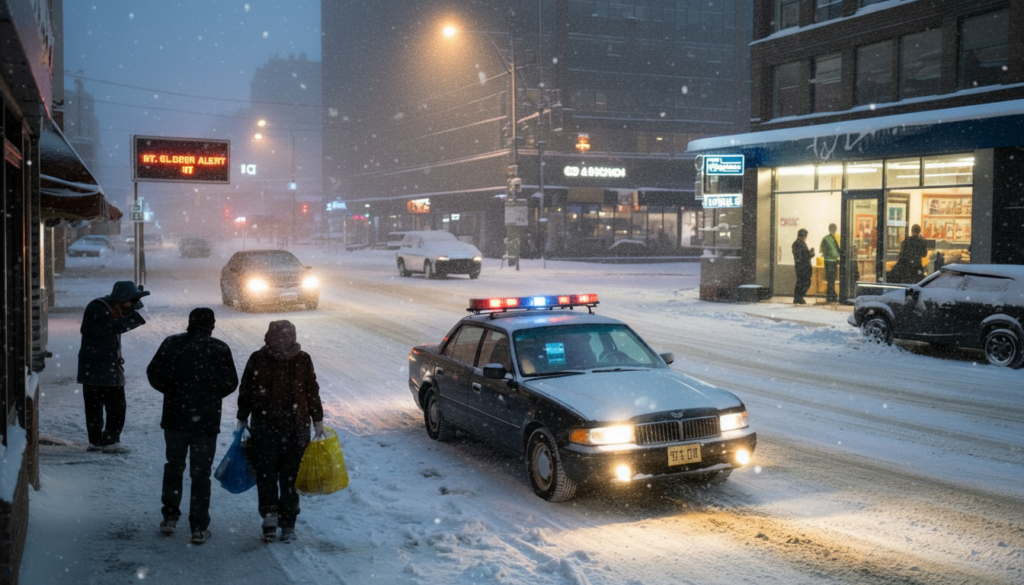
Storm warnings and normal business pressure are at odds with each other.
By early evening, the warnings are everywhere. Push notifications, billboards on the highway, and local TV crawls all say that heavy snow is expected tonight and that driving will be dangerous. Stay off the roads unless you really have to. Officials’ words are blunt and very direct.
At the same time, a different kind of message is filling up inboxes. Emails from companies promising “regular hours,” managers reminding employees that they still need to come in, and restaurants gently begging locals not to cancel reservations. Two truths, both of which sound urgent in their own way.

People are trying to figure out what to do with their car keys in between those notifications.
Mariah, a delivery driver, is finishing her sixth stop of the afternoon on the north side of the city. She pulls up a picture from last winter. Her car is sideways in a snowbank, with its hazard lights on and pizza boxes on the passenger seat. She got home at 2 a.m. that night, tired and shaking.
She promised herself that things would be different this year. But her app is lighting up, orders are piling up, and a bonus for “high demand weather conditions” is flashing on the screen. A small gym across town posted on social media, “Snow or shine, your goals don’t stop.” Someone writes below, “Buses will stop running after 8.” How are we supposed to get there?
It’s not just about how much snow there is. It’s about who gets to say no.
City leaders talk about “non-essential travel,” but that phrase means different things to people who work for a salary, an hourly wage, or themselves. For a commuter who can work from home, staying home seems like the right thing to do. For a barista whose rent depends on how much they make in tips tonight, the moral line gets blurry.
Authorities are working to cut down on accidents, traffic jams, and emergency calls. After years of economic shocks, businesses are focused on staying alive. Both arguments are true. Both can be right and still crash into each other on the same icy road.
How to deal with the “stay home” message when you can’t just stay home
If your phone is screaming “Don’t drive” and your boss is texting “We still need you,” the first thing you should do is figure out what your real options are. Not the ones you want. The ones you really have between now and midnight.
Begin with the basics: distance, timing, and backup. Could you move your shift up so you can leave before the heaviest band hits? Can you share a ride with a coworker who has a safer car? Is there still a bus or train that goes along part of your route?
Then, in your mind, walk down the street by street. Where does it usually flood, freeze, or get stuck on a normal day? Those are the places you should stay away from tonight.
We’ve all been there: that time when you feel bad just thinking about calling out. You don’t want to be the “difficult” person or the person who “can’t handle a little snow.” When times are tough, the pressure to stay loyal to a job can make you ignore your own judgement.

This is where small, boring prep work comes in. Keep a winter kit in your car with a scraper, a blanket, a charger, snacks, and a shovel if you can. Before the first storm of the year, not after you’ve already slid through a red light, check your tires. Let’s be honest: no one really does this every day. But doing it once now could change how things go tonight.
Sometimes being safe isn’t about being brave; it’s about making small, boring decisions an hour earlier.
Local paramedic Jon Keller says, “People think of storms as acts of nature, but what we see on the road is mostly acts of habit.” People are driving like it’s any other Tuesday because their boss told them to and they didn’t feel like they had a choice.
Before you say yes, ask directly if you can work from home, start late, or leave early, even if your job’s culture is to “tough it out.” Sometimes, just one honest question can change the whole schedule.
When you have to drive: Even if they take longer, stick to main roads that are ploughed more often. Before you get to an intersection, slow down and double the distance you usually keep between you and the car in front of you.
When you say no, be clear and not dramatic. See official warnings: “Authorities are telling drivers to stay off the road.” There are side streets on my route that haven’t been ploughed. I can’t get in safely.
For owners and managers: Don’t just see storms as a bother; see them as a real operational risk. Write down a plan that says who can work from home, who needs to be on site, and who can cancel without penalty first.
If you’re stuck in the middle, talk to each other. Group texts with coworkers, chats with neighbours, and community threads can all lead to carpools, shared rides, or pressure for better rules.
There is more to the storm than just the amount of snow.
The forecast for tonight might be about inches and wind speed, but what we’re really feeling is the pull between safety and duty. The mayor says on TV, “Please stay home.” Ten minutes later, your scheduling app sends you a message that says, “Your shift starts at 7.” Both messages hit the same anxious stomach.
A lot of people who read this quietly check how powerful they are. Can you say, “I’m not driving in this,” and have people listen? Or are you the person who is still digging their car out at 10 p.m. because you can’t leave work? That gap, not the snow itself, is what makes a storm different in a city.
Every big snowfall is a test of how much we really care about each other’s lives when they get in the way of business as usual. It makes you think about some uncomfortable things: What jobs are really important, and what jobs are just treated that way? Who gets to take it easy and who gets in trouble?
The flakes get thicker and the roads get slick, but those questions don’t go away. They show up in the light of brake lights, the empty bar stools, the tired nurse driving a small car and the café that decided to close early and lose money.
If you can hear the radar loops in the background while you read this, you’re already doing something small but real: stopping. Take a moment before you decide whether to drive, cancel, or keep going. That little pause might be the most radical thing you can do on a night when alarms are going off all around you.
| Key point | Detail | Value for the reader |
|---|---|---|
| Balancing safety and work pressure | Officials urge people off the roads while many workplaces insist on normal hours | Helps you recognize the mixed messages you’re receiving and trust your own risk assessment |
| Practical choices on storm nights | Adjusting shifts, routes, and basic car prep to reduce danger | Gives you concrete, realistic steps you can use tonight, not just ideal-world advice |
| Power and permission | Who can safely refuse to drive and who feels forced onto icy roads | Invites you to reflect on your own leverage and maybe push for fairer policies at work |