When you open the wardrobe, you smell something old and faint. A leather bag that suddenly feels a little sticky. A white shirt with a shadowy line along the collar that wasn’t there last month. You shrug, spray some perfume, and shut the door. Life goes on.
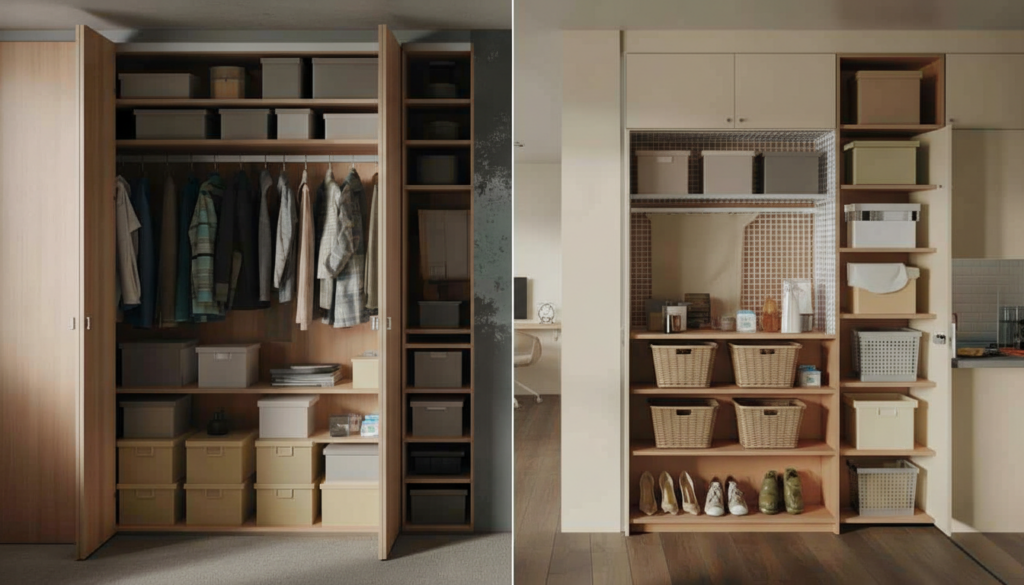
Then, on a wet morning, the smell hits you in the face. There is a little bit of green along the seam of your favourite jacket. The back corner of the cabinet looks darker than the rest, as if the paint is sweating. When you touch the shelf, your finger feels a little cold and almost sticky.
You start to think that the house might be the problem. If it’s you. If you aren’t “clean enough” in some way. But the real culprit is right there in front of you, stacked up and perfectly organised. And it’s not what you think it is.

The quiet part of how you store things
If you look inside any Pinterest-perfect closet, you’ll probably see the same thing: shelves that are full to the brim, storage boxes lined up like soldiers, and doors that close with a satisfying click. It looks neat, organised, and safe. It also happens to be the best way to keep moisture in the wrong place.
Most of the time, leaks or visible floods don’t cause moisture problems in closets and cabinets. They sneak in quietly through daily life. Steam coming from a shower. A coat that was brought in from the rain. A dishwasher cycle that runs all night. The air brings that moisture right into the darkest, tightest parts of the house. Once it gets into a sealed, overfilled space, it can’t go anywhere.
The first signs are easy to miss, which makes the situation hard to deal with. A wooden shelf that is a little bit swollen. A cardboard box that feels softer than it should. A label on a jar that is starting to curl. The habit that caused the problem is already deeply ingrained by the time mould spots show up or clothes start to smell “old.” That habit has nothing to do with cleaning; it has everything to do with how you store things.
A young couple in Manchester thought they were doing everything right on a rainy Tuesday. They had just moved into a small flat that only had one built-in wardrobe and two kitchen cabinets. Space was tight. So they bought plastic boxes with lids, hoover bags and closed containers. Every inch of every shelf was used to its fullest. It seemed like a small win over chaos.
Three months later, every time they opened the wardrobe, they smelt something strange. They first blamed the old carpet. Then, one night, they took out a box of winter sweaters. There was a thin layer of fuzz on the edges of the fabric. There were dark halos in the corners of the cardboard shoe boxes under the hanging rail. Their ‘organised’ wardrobe had become a private sauna.
Similar things happen quietly in homes all over the place. In a 2022 UK survey on indoor air quality, almost one in three people said they smelt mould or musty smells in storage areas, even in homes that didn’t seem to have any structural problems. Even though the rest of the house seemed dry, the moisture levels in closets and cabinets were higher than in the main rooms. The same thing happened over and over: storage was too full, air flow was bad, and doors stayed closed for days.
What is happening is just physics mixed with everyday habits. Water vapour is a natural part of air. Cool air holds less than warm air. When wet air gets stuck in a small, closed space, it stops moving. The insides, like clothes, wood, cardboard and even plastic, are a little cooler. When the humidity in that small area goes up, condensation can form where warm, trapped air meets cooler surfaces.
Mould can grow without a flood. It needs three things: moisture, a food source, and time. Closets and cabinets quietly give you all three. Dust, fabric, paper, glue from labels, and even tiny pieces of skin make up the “food.” The air and things that were stored while still slightly damp can both cause moisture. You can count on time, because those doors stay closed for days or weeks.
The sad truth is that our natural urge to seal, stack, and pack everything tightly makes a small greenhouse. The more we stop air from getting in, the more problems we create that we only notice when they are hard to fix.
The easy change to storage that stops the cycle of moisture
A simple change, not a fancy gadget or cleaning routine, can stop a lot of moisture problems in their tracks. In short, keep things so that air can move around them. Not completely sealed. Not all the way around. There is just enough room for the air to move around, come in, and go out.
That means leaving spaces that can be seen. A few centimetres of space between piles of clothes. There is a small space between the boxes and the cabinet’s back wall. For things that don’t really need to be sealed, switch from airtight plastic bins to baskets or containers with holes in them. It sounds almost too easy to be true. But this small change makes the air in your storage go from “trapped humidity” to “air that can actually dry out.”
Every item in a closet or cabinet either helps or stops air from moving. When solid boxes are pushed tightly against walls, they make hidden pockets where moisture can get stuck. You can make the same space into a slow, quiet, natural ventilation system by using open shelves, slatted racks, and bins made of breathable fabric. No technology. Just better gaps.
Everyone agrees that things should “breathe” on paper. In real life, daily life wins. You get home with a bag of groceries, throw them into the bottom cabinet “for now,” and then close the door. Before you leave, you squeeze one more jacket into the closet. You put the laundry in a sealed basket because it looks better that way. Soyons honnêtes : personne ne fait vraiment ça tous les jours.
That’s why the best changes are the ones that work even when you’re tired and not paying attention. For example, you could replace a solid shoe rack with a metal grid shelf that lets air flow under the soles. Instead of stacked, lidded tubs, you can use wire baskets to store things under the sink. Instead of cramming the rail full, hang heavy coats with a finger’s width between the hangers. These are choices you make once that keep working in the background, even when things are bad.
One woman in Lisbon was sick of the mould that kept growing on the back of her kitchen cabinet. To fix the problem, she did something very small: she moved everything 2 cm away from the wall and drilled three thumb-sized holes in the back of the cabinet. She made the bottom shelf less full by taking out two closed boxes and putting in one open basket. The mould didn’t come back the next winter. Nothing special. Just more air flow and less dampness that gets stuck.
Mark Jensen, a building biologist, says that “the breakthrough for most homes isn’t a dehumidifier.” “It’s the time when people stop thinking of closets and cabinets as vacuum-packed boxes and start thinking of them as small rooms that need to breathe.”
Next time you open a closet door, think of a simple checklist:
Can you see parts of the wall or back panel, or is everything hidden?
Are there dark, tight areas, or does most of the space get light from lamps or the sun?
Are some of the containers breathable (woven, perforated, or made of fabric) instead of all being sealed plastic?
Are the clothes hanging from each other in a small space, or do they make one big block of fabric?
Is the door sometimes slightly open, or is it always closed for weeks?
*If you said “no” to most of these, the space is probably holding more moisture than you think.* One small change at a time changes the balance from old and sticky to quietly stable.

Living with drier closets without making your home a project
When you open a cabinet and it smells like nothing, you feel a quiet sense of relief. No perfume trying to hide something, no chemical “freshness,” and no faint smell of dust and old paint. Just air that isn’t charged and things that feel like themselves. You don’t get that feeling from buying ten things. It comes from changing how the area works.
Start with the part that bothers you the most. The closet where you think twice before taking a deep breath. The cabinet under the sink that is always a little damp. Take everything out and do one useful thing: put back only the things that really need to be there, and make sure there is space around each one. Leave space on the sides and back. Even though it goes against your “using every inch” philosophy, leave some shelf space empty.
This one small thing lowers the humidity in that area because any damp air that comes in can now move around and dry instead of being trapped in a maze of things.
The search for a single miracle solution is what usually gets people stuck. A strong moisture absorber. Closet sprays that are extra strong. Fancy organisers that say they can hold the most things. These can help a little, but they usually don’t fix the main problem if your storage is still full and sealed. The real change comes when you realise that a less full wardrobe is often a healthier one.
There’s also the emotional side. Clothes hold memories, and kitchen items hold “just in case” stories. Sometimes, letting the space breathe means getting rid of some things or moving things around. That can hurt more than any technical advice about humidity on a personal level. In real life, it’s what stops the cycle that causes mould, bad smells, and broken things.
A lot of people also don’t realise how much dampness they get every day. A coat was hung up a little wet “for later” and then forgotten. A towel is hanging over the door to the wardrobe so guests can’t see it. A pan that was still warm went back to a tight cabinet. Every little thing adds vapour to a space that is already having trouble getting rid of it. It’s important to be nice to yourself here because no one is perfect. The goal isn’t to be perfect; it’s to be more aware and have a storage system that lets you make small mistakes.
| Point clé | Détail | Intérêt pour le lecteur |
|---|---|---|
| Let air circulate | Leave gaps between items, walls and shelves | Reduces trapped humidity and mold risk without effort |
| Use breathable storage | Favor open racks, woven baskets, fabric bins | Keeps belongings drier while still looking organized |
| Treat closets like mini-rooms | Occasionally open doors, avoid overfilling | Prevents smells and damage with simple everyday habits |
FAQ :
How do I know if my closet has a moisture problem?
Trust your nose and your hands. Musty or “old” smells, slightly tacky surfaces, rust on metal parts or faint spots on fabrics all signal excess humidity.
Are plastic storage boxes always bad for closets?
No, they can be useful for items that truly need sealing, but using only closed boxes and packing them tightly creates moisture traps. Mix them with open or perforated storage.
Will leaving closet doors open really make a difference?
Yes, even cracking them open for a few hours most days helps equalize temperature and humidity with the rest of the room, which slows mold growth.
Do I need a dehumidifier inside every cabinet?
Usually not. Most people see big improvements just by decluttering a little, improving airflow and avoiding storing slightly damp items.
What can I do in a very small apartment with almost no storage?
Prioritize vertical, open storage, rotate seasonal items, and keep a few intentional gaps on each shelf so air can move freely around what you own.