More and more families are quietly replacing harsh chemicals with a bottle of cheap white vinegar to keep spiders away from windows, balconies, and outdoor corners. The method sounds almost too easy, but it really does seem to work because spiders don’t like strong smells and a little bit of roughness under their tiny feet.
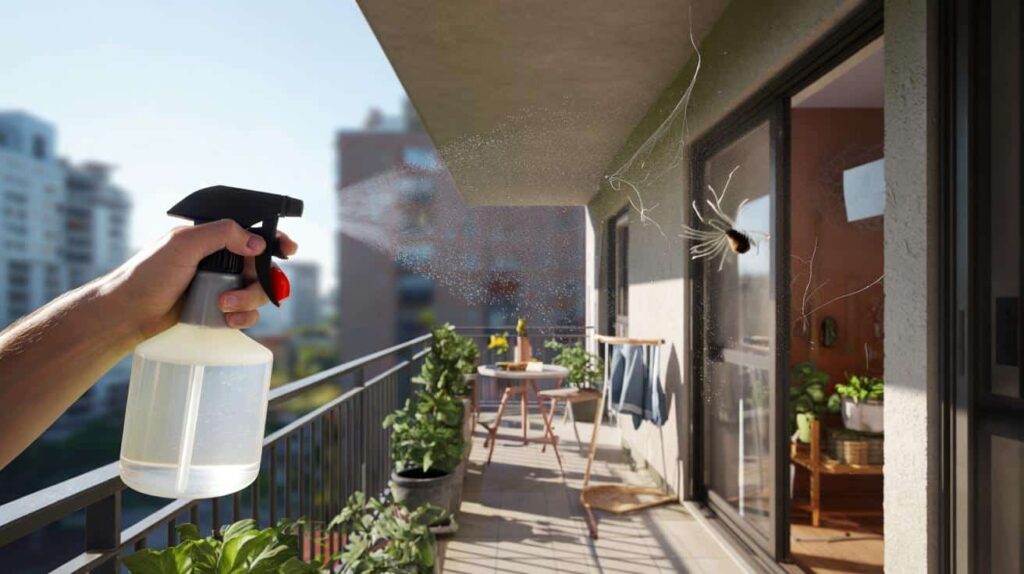
Why people are spraying vinegar on their balconies
People keep talking about the same low-tech trick on social media and home forums: fill a spray bottle with diluted white vinegar and spray the corners of the balcony, railings, and door frames.
The point is not to kill spiders. It’s about getting them to go somewhere else.

White vinegar works more like a natural “keep out” sign for spiders than a pesticide. It makes some areas less inviting.
Acetic acid is what gives vinegar its sour taste and strong smell. This acidity can change the micro-environment that spiders use to move, rest, and build webs when it is more concentrated and on some surfaces.
The strong smell also seems to bother a lot of arthropods. There isn’t a lot of scientific research on this, but pest control experts often agree that strong smells, like vinegar, can make it harder for spiders to find their way around and choose where to hide.
What vinegar really does to spiders
Spiders don’t smell like people do, but they can sense chemicals in the air with tiny hairs and receptors on their legs and body. When a strong substance like vinegar saturates a surface and the air around it, the way it feels changes.
That seems to make the spot less appealing to a lot of spiders. They might go to quieter parts of the building or even leave the area that was treated.
The main effect is that vinegar keeps spiders away instead of killing them.
This difference is important. Using vinegar won’t kill the small ecosystem around your home. You are just moving it away from the balcony where you sit, dry your clothes, or let your kids play.
What kind of vinegar works best on balconies?
There is a difference between vinegars when you spray them on concrete, wood, and railings.
Why people usually choose white distilled vinegar
Clear: It doesn’t leave stains on most light-colored walls, tiles, or stones.
You can get big bottles for very little money.
Strong smell: A stronger smell can make the repellent work better.
Red wine and balsamic vinegar are two examples of colored vinegars that can leave stains on floors, grout, outdoor cushions, and even leaves of plants. Those stains can be hard to get rid of on a balcony where a lot of surfaces are exposed to water and sunlight.
Most families that use this trick choose plain white distilled vinegar mixed with water. That makes surfaces safer while still giving off a strong smell and acidity.
How to make a vinegar spray that keeps spiders away in steps
It’s easy to make a “balcony barrier” with vinegar, but you have to do it right every time. This is a simple way to do things that most homeowners do.
Step: What to do
1. Pick a clean spray bottle that you only use for this mixture.
2. Fill half of the bottle with distilled white vinegar.
3. Fill the other half with water and seal it tightly.
4. Shake gently to mix the liquids.
5. Spray the corners of the balcony, the bases of the railings, the door frames, the window tracks, and the area behind the outdoor furniture.
The smell goes away quickly on an open balcony because of the sun and wind. A lot of people say they have to reapply every day or every other day when it’s warm outside.
For balconies, how often you spray is more important than how strong it is. Light, regular sprays work better than a heavy dousing once in a while.
Where to spray your focus
Spiders like quiet, hidden spaces. That often means on a balcony:
Upper corners where the walls meet the roof or ceiling
Behind pots for plants and boxes for storage
Under tables and chairs that don’t move very often
Around balcony doors, especially the tracks for sliding doors
Cracks in brickwork or around where cables come in
It adds a cleaning effect to the repellent barrier when you spray it directly on visible webs and then wipe them away.

Will vinegar keep spiders away from your balcony?
Vinegar helps, but it doesn’t change the way things work in nature. Spiders are attracted to places where they can find food and a place to hide. Vinegar alone won’t be able to fix things if your balcony is full of flying bugs and junk.
Experts say that vinegar works best when combined with simple cleaning habits that get to the root of the problem.
Things you can do to make vinegar work better
Cleaning regularly means sweeping or vacuuming corners, getting rid of webs, and wiping down railings and window frames.
Getting rid of clutter: Don’t let piles of cardboard, stored wood, or things you don’t use anymore lean against the walls.
Limiting outdoor lights: Bright lights at night bring in moths and mosquitoes, which in turn bring in spiders.
Checking drainage: Remove leaves from balcony drains where bugs might breed.
Using screens: Mesh screens on balcony doors and windows keep spiders and their food from getting in.
Vinegar is most effective when used as part of a larger routine. For example, balconies that are clean, organized, and not friendly to insects naturally have fewer spiders.
Home remedies may not be enough in buildings where there are a lot of spiders or where venomous species are known to live. Families with young kids or pets that like to explore may need pest control services and specific products.
When using vinegar outside, be safe and take care of the surface.
People often forget that vinegar is still an acid because it is in the cleaning aisle. Repeated spraying can slowly wear down some balcony materials.
Be careful around these surfaces:
Natural stone, like marble, limestone, and some slates
Decking made of polished or sealed wood
Decorative metals that are likely to rust
Textiles that are easy to damage, like outdoor cushions or curtains
It’s smart to test a small, hidden area before soaking a whole floor or wall. If the color changes or the finish gets dull after it dries, try a less strong dilution or a different method near that material.
Like any other household item, you shouldn’t spray vinegar in your eyes or mouth, and you should keep the bottle out of reach of kids. Pets might not like the smell, so spray it when they are inside or away from the area.
How vinegar compares to other “natural” ways to keep spiders away
Vinegar is just one of many home remedies that people who want to use fewer chemicals like.
A common companion is an aromatic plant that is put near balcony doors and windows. People often say that plants like mint, lavender, and citronella can keep bugs away. They add smell and plants, which makes your balcony less inviting to bugs and spiders.
Another common suggestion is essential oils, but they can be dangerous. Tea tree and eucalyptus oils, for example, can bother spiders and bugs, but they can also irritate skin and be bad for pets. Vinegar, on the other hand, is cheap, easy to use, and most people know how to use it.
When vinegar isn’t the answer
There are times when that reliable spray bottle shouldn’t be your main weapon. If you see spiders that are bigger than normal, see them often inside, or see species with markings that look like dangerous ones in your area, it’s a good idea to ask local experts for advice.
In those situations, vinegar can still be used as a daily deterrent on balconies and entryways. But if there is a serious infestation or a chance of venomous bites, you need to know how to identify them, how to safely remove them, and sometimes even call in a professional.
Things to think about when using your balcony
Picture a small apartment in a city with a narrow balcony that looks out over a courtyard. The resident hangs clothes there, uses fairy lights at night, and keeps a few potted plants in one corner. That spot, which is warm and a little humid, draws moths to it. Above the clothesline, spiders make their homes.
A combination solution works well: keep the lights on for fewer hours, clean out the webs once a week, put mint or lavender in pots by the door, and spray the upper corners with vinegar every other evening. Over the course of a few weeks, web-building tends to move away from the laundry room and toward quieter spots higher up in the building.
Another example is a balcony on the ground floor that looks out over a garden with piles of wood and thick bushes. Spiders come in from outside all the time. Vinegar can still make a short-term barrier along thresholds and railings, but in the long run, keeping things tidy and changing how you store things in the garden will usually have a bigger effect on the number of spiders.
If you think of vinegar as a simple, useful tool instead of a miracle cure, your expectations will be more realistic. That simple bottle from the kitchen can really make evenings on the balcony more comfortable, with a lot fewer eight-legged surprise visits, when used with basic upkeep and small changes to the layout.