When she walked in, holding a picture of herself from ten years ago, the hair salon was already busy. She still had the same smile, eyes, and fine hair, but her reflection now looked harsher and more tired. The stylist tilted his head, looked at her softly, and didn’t pay attention to the wrinkles or the jawline. He looked right at the color of her hair.
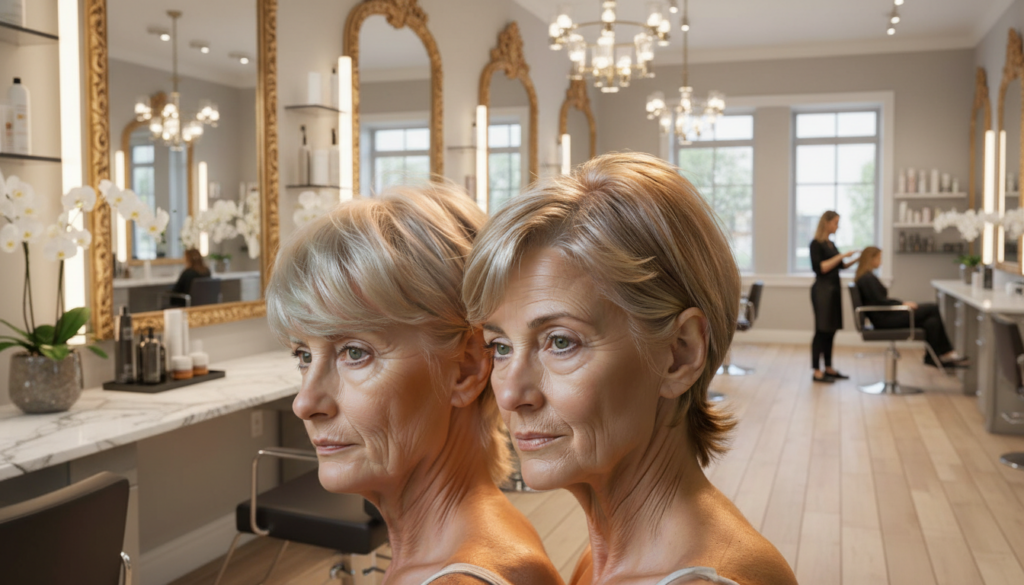
He quietly said, “We’re going to change this,” pointing not to the length but to the shade. That’s where the real aging effect was hiding.
She thought her face was the problem.
He knew that her color was the problem.
 Style after 40: the 5 least complementary bob variations according to this salon professional
The wrong tones were making her tired and bringing out every little line.
He then named the three worst things that can happen to fine hair after age 60.
The ones that make the face look older without anyone knowing.
The worst trap for aging: too dark, too flat, and too hard on fine hair
If you ask any experienced hairstylist who works with women over 60, they’ll all say the same thing when the door opens: deep, monochrome dark brown on very fine hair. It looks stylish and dramatic on a color chart. It often looks harsh on a real face with soft skin and delicate features.
Thicker hair catches the light better than fine hair. A solid, very dark color makes a kind of “helmet” around the face. The shadows under the eyes get darker, the lines around the mouth stand out more, and the jawline looks heavier. The color may be perfect, but the face suddenly looks ten years older.
A stylist in Paris told me about a 67-year-old woman who had dyed her hair the same espresso brown color for twenty years. Nothing had changed on paper. The box, mirror, and bathroom are all the same.
But every year, she felt more “harsh” in pictures. She told him, “My friends say I look tired or angry.” She didn’t want to change her base color or make it softer when he suggested it. But she still trusted him enough to give it a shot. Two hours later, her face had changed. The chocolate was softer and there were soft warm highlights around her face. The lines were still there. The color didn’t clash with her face anymore.
Why does very dark, flat color make fine hair look so old after 60? As you get older, your skin naturally loses brightness and contrast. The balance is off when the hair stays very dark.
The contrast gets too strong, like a thick marker line around a delicate drawing. That effect is even worse on fine hair because the strands don’t spread light. There is no soft halo; just a color block. The white roots, dark lengths, and shadows under the eyes are what the eye sees right away. That’s where the effect of aging really happens.
Other things that make you look older are icy blondes and one-tone beige that wash everything out.
The second shade that hairstylists recommend might surprise you: ultra-ash or icy blonde on very fine hair. At first glance, it looks stylish and “clean.” When you get up close, especially on warm, mature skin, it can make the face look grayish and almost see-through.
When the blonde is too cool and has no warmth or depth, every little red spot, vein, and shadow under the eyes stands out. Fine hair takes ash pigments quickly and can look almost metallic, with no softness. The color doesn’t make the face glow; instead, it makes a pale veil that takes life away from the features.
Then there’s the well-known “full beige” or “uniform sand blonde” that a lot of women want because it makes them feel safe and private. The stylist I talked to said it was “the Instagram filter color that doesn’t work in real life after 60.” It looks stylish and neutral on a screen with good lighting.
That same flat beige can make fine hair look thinner, more transparent, and the face look more tired on a rainy Monday morning, in the office, or in the kitchen. The color doesn’t move, and there isn’t any micro-contrast to make the eyes pop or the jawline look softer. A big, neutral halo that makes everything look fuzzy, especially radiance.
Ultra-ash and flat beige both have the same problem: they don’t have enough nuance. After 60, fine hair needs more than just a color change; it needs dimension.

Cold blondes put gray pigments on top of their white hair, which makes the skin look older instead of fresher. Uniform beiges smooth out everything, even the natural depth at the roots. *The face’s “architecture” of light and shadow is lost.
The brain then sees the picture as “tired” or “old,” even though it doesn’t know why. The color is correct. The face in front of it is just wrong.
What to choose instead: light that frames the face, soft warmth, and gentle contrast
The good news is that you don’t have to change a lot to look better. For almost all of his clients with fine hair over 60, the same stylist uses the same method. First, make the base softer. That means changing a very dark brown to a chocolate color or an icy blonde to a creamy color that is a little warmer. Often, one or two shades lighter is all you need.
Then he makes small differences around the face. Not big streaks or obvious highlights. Just a few lighter pieces in the right places, like around the temples, cheekbones, and the top of the forehead. These lighter spots make the face look higher and draw the eye away from deeper lines.
He also uses a lot of colors that are see-through instead of ones that cover everything. An opaque formula can look heavy, like a mask, on fine hair. A more see-through color lets some natural variation show through, which makes hair look thicker and more textured.
A lot of women think they have to “fight” gray hair with the darkest color they can find. Because they are scared, they go straight to full coverage, full pigment, and no nuance. Let’s be honest: no one really does this every day because it takes a lot of work. Root lines show up quickly, contrast gets very strong, and the aging effect gets even stronger. A gentler method that includes blending and partial coverage often makes you look younger for longer.
“Color isn’t about hiding age after 60. The stylist said, “It’s about working with light on the face.” “Every half-tone matters more than you think when you have fine hair.”
Don’t use very dark, flat browns.
They make facial features harder, shadows darker, and root contrast stronger on fine hair.
Don’t use icy or ultra-ash blondes on warm skin.
- These colors can make the skin look dull or sickly, and they can even make white hair look blue.
Be careful with beige that is all the same color. - A single, flat color can wash out the face and make fine hair look thinner.
Like soft warmth and dimension - Light chocolate, creamy blondes, and soft golden or caramel touches bring the skin back to life.
Don’t ask for a full head of highlights; just ask for face-framing ones. - A few lighter strands around the face make the features stand out and give the skin a soft, flattering glow.
Learning to see yourself in a new way in the mirror
Changing your hair color after 60 is almost like an emotional thing. For a lot of women, that dark brown or icy blonde is a part of who they are that they’ve had for years. The stylist’s chair is a small negotiation between who they were at 40 and who they are now, with a different skin tone, light, and hair texture.
We often choose colors that make our faces look older when we still like them. The real change is realizing that our reflection has changed and that color needs to change too.
Fine hair doesn’t like extremes. Too dark, too cold, and too uniform are the three main problems that most hairstylists point out without naming names. Softness, nuance, and light that is carefully placed are not “anti-aging tricks.” They are just ways to put the focus back on the face, the eyes, and the smile.
Some women leave the salon with hair that is almost the same length, cut, and style. The real difference is in the half-tones and the reflection on the skin that is barely warmer. Friends used to say, “Did you change your hair?” but now they say, “You look rested.”
That’s where the real magic happens.
| Key point | Detail | Value for the reader |
|---|---|---|
| Soften very dark shades | Move from flat dark brown to softer chocolate with discreet highlights | Reduces harsh contrast and hard shadows on the face |
| Limit ultra-ash and icy blondes | Choose creamier, slightly warm tones instead of extreme cool pigments | Prevents a gray, tired complexion and keeps radiance |
| Add dimension, not just color | Use face-framing lights and translucent formulas on fine hair | Makes hair look fuller and features appear lifted |
FAQ:
What color of hair looks best on fine hair after 60?Usually, a soft, warm color that is one to two shades lighter than your natural color, with a few highlights around your face. Instead of black or icy blonde, think of light chestnut, creamy blonde, or soft caramel.
After 60, do I have to stop coloring my hair dark?No, but very dark, flat colors can make the face look older. If you like dark hair, ask for a base that is a little lighter and fine, warmer reflections to break up the “helmet” look.
Are highlights bad for hair that is fine?Fine hair can be harmed by too many strong highlights, but a few well-placed, soft ones can make hair look fuller and more moving. It’s not how much you do, but how you do it and how far apart you do it.
Can I go completely gray and not look older?Yes, if the gray is well blended and the cut is sharp and up-to-date. A gloss or toner can sometimes help get rid of yellow tones and make natural gray look planned and stylish.
How often should I change the color of my fine hair?Most stylists say to get your hair colored and blended every 6 to 8 weeks. If you use translucent, low-contrast colors that grow out more slowly, you can wait a little longer.