From the window, the first real snow always looks beautiful.
But the charm goes away as soon as you open the door and feel your foot slide on a thin, invisible layer of ice on the steps. You grab the railing, your heart races, and you suddenly remember that you forgot to buy salt to melt the ice.
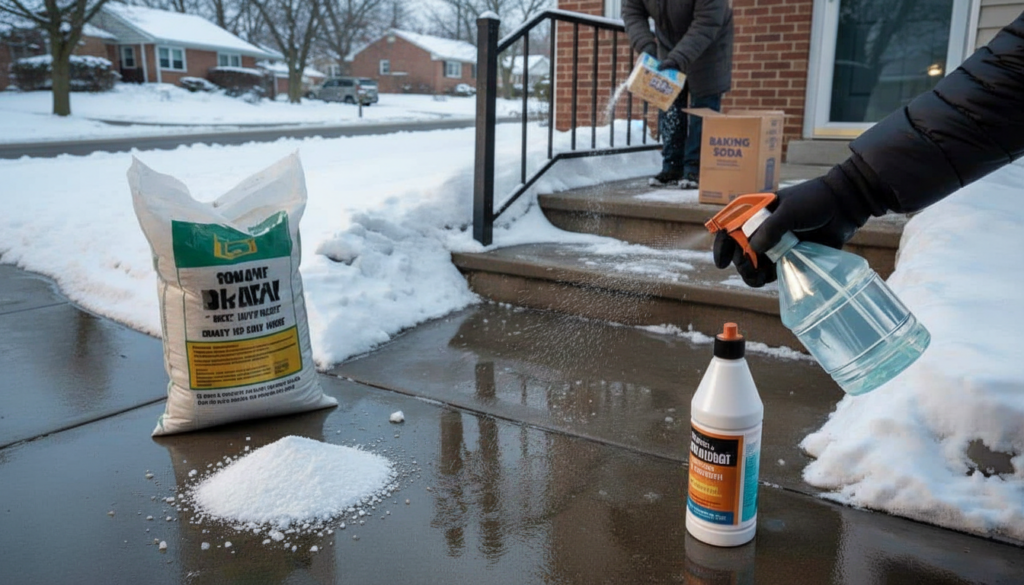
You dig through the stuff under the sink, move the cleaning supplies out of the way, and think about the bag of salt you used up last winter. The sidewalk is freezing, the dog is waiting by the door, and the driveway is a trap.
You see a very normal container right next to the laundry detergent.
And that’s where the little “hack” for winter lives.

Why classic road salt is ruining your winter without you knowing it
People talk about spreading salt like it’s the only polite way to deal with an icy sidewalk.
But anyone who owns a car, a garden, or a pair of leather boots knows the other side: white crust on the floor mats, rims that are rusted, and plants that turn brown in March.
Road salt eats away at concrete, rusts metal, and gets into the ground.
Yes, it works, but the cost stays with you long after the snow has melted.
Every year, cities spread millions of tons of rock salt.
When the sun comes back, that salt doesn’t just disappear. It runs toward rivers, settles into groundwater, and lands on your front step with every splash of slush.
You can see the effects just by walking down a street in the winter.
Stairs that are falling apart, rails that are peeling, and sad, bare strips along the curb where plants die year after year.
We all know that it’s part of winter, like chapped lips and wet socks.
But not every icy spot needs to be covered with the same harsh stuff.
Salt lowers the temperature at which water freezes.
The problem is that it only works well at certain temperatures and stops working well when it gets too cold. It also gets into small cracks in concrete and expands as the water freezes, breaking your steps from the inside.
Also, pets lick their paws, kids kick slush around, and that same salt gets into kitchens, cars, and living rooms.
The truth is that most of us add a lot more salt than we need to “be safe,” and the damage builds up over time.
The surprising household item that melts ice faster than salt
The hero who doesn’t know they’re in your house right now?
Rubbing alcohol that you can buy at the store.
Isopropyl alcohol (70% or 90%) works better than regular salt on many home surfaces to break up thin ice faster when it is sprinkled or sprayed on.
When you add a little water and dish soap to it, it becomes a fast-acting de-icing solution that doesn’t damage concrete as badly.
Instead of throwing salt all over the place, you can put this mix in a spray bottle and spray it on steps, locks, car doors, and short paths.
A small bottle goes a long way for a normal home entrance.
Imagine a normal early morning: you’re already late, and the street plow came by during the night and pushed a shiny ridge of ice toward your driveway. There is a smooth, glassy film on your front steps.
You get the rubbing alcohol that you usually use to clean screens or give first aid.
You mix about two parts rubbing alcohol with one part water in a bowl or an old watering can. Then, you add a small amount of dish soap and stir.
You slowly pour it down each step.
You can almost hear the ice cracking and getting softer in seconds, especially the thin, stubborn layer that salt takes a long time to break down.
While your neighbor pulls out a half-empty salt bag, you’re already scraping slushy ice instead of hard glass.
So, what makes this simple product work so well?
The freezing point of isopropyl alcohol is about -89 °C, which is much lower than that of water. It stops the ice from staying solid when you spread it over it because it mixes with the thin layer of water on the surface.
That means the ice will start to break up and dissolve instead of sticking tightly to your stairs.
You still have to scrape or push it away, but it takes a lot less work.
Also, you’re not adding more chloride to your soil or your dog’s paws. Instead of covering the ground with corrosive crystals, you’re using something you already have in your cupboard in a specific way.*
How to use rubbing alcohol on icy sidewalks without making things worse
The basic method is easy.
For home use, mix about 2 cups of rubbing alcohol, 1 cup of water, and a small squirt of dish soap in a big bowl or bucket. Gently stir.
Put the mixture into a spray bottle for steps, door handles, and tight corners. For bigger patches of ice, use a small watering can.
Spray or drizzle a thin layer over the ice, wait a minute or two, and then use a shovel or stiff broom to break up the layer that has softened.
You don’t have to fill the area with water.
The goal is to make the ice less sticky to the ground, not to make a lake that is slippery.
When people first try this, they often get a few things wrong.
The first thing is to do too much. When we’re scared and stressed, we often think that “more is safer.”
Soaking your steps in alcohol is a waste of product and could make the surface feel greasy.
A light, even layer works best, especially on ice that has formed on top of packed snow.
Another common mistake is to think of this as magic.
It helps a lot, but you still have to shovel, sweep, or scrape. To be honest, no one really does this every day of winter. But even a quick pass after work will keep the ice from turning into armor that you’ll have to fight for weeks.
Claire, a homeowner who lives on a sloped street, says, “I stopped buying big bags of salt two winters ago.” “I have a spray bottle of alcohol mix by the door.” I only use it on the places where we always slip, not on the whole sidewalk. My dog stopped limping in February, and my steps look better.
Put a labeled bottle by the door. A simple spray bottle with the word “De-icer” on it will save you from having to dig through the sink on icy mornings.
Not for deep snow, but for thin ice. First, shovel or push away most of the snow, and then treat the packed, shiny layer.
Try it out on a small area
Mix with sand or grit: A quick spray and a sprinkle of sand give both melting power and grip.
Keep it away from kids and flames. Rubbing alcohol is flammable, so treat it like you would any other cleaning product.
Taking a new look at how we walk in the winter, one step at a time
This trick with rubbing alcohol won’t take the place of big salt trucks or city road crews.
It shouldn’t be used on highways, big parking lots, or when it snows a lot.
But when you look at it from a human point of view, like a front step, a path to the trash cans, or a short stretch of private sidewalk, it changes the equation.
You’re suddenly using what you have, using less of it, and doing less damage over time.
You might still want to keep a small bag of salt on hand for emergencies or for when you’re away for days and it’s really cold and icy.
But your daily reflexes start to change: shovel a little earlier, only treat the slippery parts, and don’t blast every square meter with harsh crystals.
Your concrete lasts longer, your car rusts a little more slowly, and the environment benefits.
And that fear of falling on black ice every day is a little easier to deal with with a simple mix that you can make in two minutes, even if you’re still half-asleep and have a cup of coffee in your hand.
When you open the door on a frozen morning, take a look at your steps in a new way.
Think about whether you really need a lot of salt or if a small, smart gesture would work.
We’ve all been there: that moment when you catch yourself on the railing and feel both silly and relieved.
Those little winter scenes change how safe we feel in our own homes.
Maybe the real winter tip isn’t just how to get ice to melt faster.
Maybe it’s about getting back some control in a season that likes to surprise us.
| Key point | Detail | Value for the reader |
|---|---|---|
| Use rubbing alcohol mix | 2 parts rubbing alcohol, 1 part water, a squirt of dish soap | Quick DIY de-icer with products you already own |
| Apply lightly, then scrape | Spray on thin ice, wait a minute, break up slush with a shovel or broom | Less physical effort and faster clearing in the morning |
| Reduce salt dependency | Reserve road salt for rare, extreme conditions | Protects concrete, plants, pets, and nearby water sources |