The hot water tank is the surprisingly simple reason why millions of homes in the UK and Europe are quietly losing money. A cheap “jacket” of insulation can change that, and the numbers are not small.
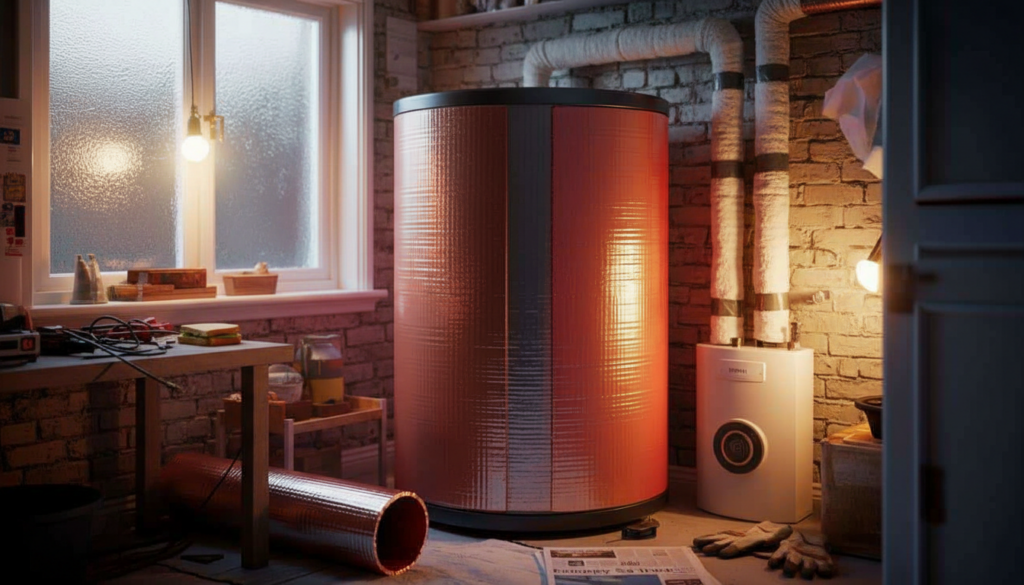
Why your hot water tank could be quietly draining your money
Modern boilers get a lot of attention, but the simple hot water cylinder is often one of the biggest energy hogs in the house. If you have a regular tank in a closet, attic, garage, or basement, it’s probably heating water all day, every day, even if you don’t need it.
That hot water that you keep in storage loses heat to the air around it all the time if it doesn’t have good insulation. The colder the room, the faster the heat goes away. The tank turns on more often to heat up water that has cooled down while it is waiting to be used.

An uninsulated tank and pipes can waste up to 20% of the energy used to heat stored hot water.
This kind of energy loss never gets to your taps. You pay for kilowatt-hours that go into a dusty cupboard or a cold garage and then disappear. When it’s cold outside, the difference in temperature between hot water and the air around it is greatest, and that’s when those losses cost the most.
How a simple “jacket” cuts down on waste
It’s surprisingly low-tech: just wrap the cylinder in an insulating jacket. This is a flexible layer of thermal material that is meant to wrap around the tank and keep heat inside for longer.
The water stays hot without having to be heated up all the time because it loses heat slowly. Your heat pump, boiler, or immersion heater doesn’t run as often. That means you use fewer kilowatt-hours for the same number of hot showers, laundry, and washing up.
A simple cylinder jacket and a few pipe sleeves can cut the amount of energy used by hot water by about 15–20%, which can save you £50–£60 a year.
The effect is even stronger when the tank is in a cold place like a garage, loft, utility room, or hallway that isn’t heated. In those places, insulation is not only a nice thing to have, it’s almost a no-brainer investment.
Where jackets are most useful
- Older hot water tanks with little insulation
- Cylinders put in attics, garages, or basements that aren’t heated
- Homes that heat water with immersion heaters or only electricity
- Homes with big families and a lot of hot water needs
- How much does a hot water tank jacket cost, and how quickly does it pay for itself?
You can buy insulation kits in standard sizes at DIY stores and online. They usually come with the jacket panels and straps or tape to keep everything in place.
A jacket for a normal domestic cylinder usually costs between £20 and £50, depending on how thick it is, what brand it is, and how big it is. Adding pipe insulation sleeves costs only a few extra pounds.
Putting these things together, you have a good chance of saving about £50–£60 a year on your hot water costs. In a lot of homes, the kit pays for itself in just one heating season.
A good cylinder jacket usually pays for itself in less than a year and keeps saving money every year after that.
How to put a jacket on a hot water tank in less than 20 minutes
You don’t need a plumber to put insulation on a cylinder. Most jackets are made so that you can put them on yourself with just a few tools.
A guide with steps
Turn off the power to the immersion heater or boiler circuit that is connected to the tank.
Clean the outside of the cylinder lightly so that straps or glue can hold on well.
Check that the jacket fits by measuring the tank’s height and circumference.
Start at the back of the cylinder, where the pipes are least accessible, and wrap the jacket around it.
Make sure that inspection hatches, thermostats, and valves are still easy to see and reach by moving parts around.
Use the straps or tape that came with it to hold it in place, making sure there are no big gaps.
Some older tanks already have thin insulation that came with them. You can still add a modern jacket on top to make it thicker and keep more heat inside.
The best materials for keeping heat where you paid for it
Different jackets use different kinds of insulation. The goal is always the same: keep warm air in, send heat back to the tank, and stop heat from moving.
Common types of insulation
Foam (usually polyurethane): It’s light, easy to work with, and very good at keeping heat in for its thickness.
Mineral wool, which can be made from glass or rock, is good at keeping heat in and also helps to quiet the small noises that tanks sometimes make when they expand.
Reflective foil layers: These are thin sheets of metal that reflect radiant heat back toward the cylinder. They work best in cold places like garages.
For older tanks that are out in the open, a thick jacket made of foam or wool with a reflective outer layer usually works best.

When you compare products, pay attention to the thickness they say they have and any thermal resistance they say they have (usually given as a “R-value” or in watts per square meter per degree). More resistance means less heat loss.
Don’t forget the pipes. A small change can save you money.
Insulating just the cylinder is a good start, but hot water also cools down as it moves through metal pipes. If you have bare copper pipes running through cold spaces, you could waste a lot of energy before the water even gets to the tap.
Sometimes called pipe lagging, clip-on foam sleeves slip over the pipes to slow down this cooling. They are easy to find, cheap, and quick to put on.
Start with the hot water pipes that are closest to the tank.
Put insulation on any hot pipes that you can see in attics, garages, or underfloor voids.
If you can, add lagging to the first meter or so of the cold feed pipe that goes into the cylinder. This will help keep condensation and heat exchange to a minimum.
Pipe insulation can help you save more money each year, getting you closer to the £60 mark, and it can also speed up the delivery of hot water to taps and showers.
How much money can you really save?
Energy use in homes is very different, but rough estimates can still help with planning.
Depending on its size and how often it is used, an electric hot water cylinder might use between 1,500 and 1,800 kWh per year. That means that insulation saves about 225 to 360 kWh a year, or 15 to 20% of what it costs.
If electricity costs 25–30 pence per kWh, that could save you about £55–£100. Unit prices are lower in gas-heated systems, but the amount of kWh saved is about the same. So the cash benefit is smaller, but it’s still important, especially with prices changing so much right now.
Better insulation can cut down on annual bills and put less stress on boilers, even in systems that use gas to heat.
Important ideas: payback time and standing losses
“Standing losses” and “payback time” are two terms that are often used on energy labels and product descriptions.
Standing losses are the energy a hot water tank uses to stay hot even when no one is using the tap. Insulation cuts down on these losses right away. One of the quickest ways to cut standing losses in a current system is to put on a jacket.
The time it takes for savings on bills to equal the cost of the upgrade is called the payback time. That time is usually short with cheap insulation. After that, every year you use it feels like getting free money back from your old bills.
More benefits than just the bill
Insulating your hot water tank has benefits that go beyond saving money. A water temperature that stays more stable can help the system last longer by putting less stress on heating elements and parts.
Because hot water cools down more slowly, you might notice that morning showers feel more steady or that a bath drawn a little earlier stays warmer for longer. Better insulation can also help stop small knocking and ticking sounds that happen when metal expands and contracts.
There is also a weather aspect. Every kilowatt-hour you don’t waste is one that the grid doesn’t have to give you or your boiler doesn’t have to burn. For homes that only use electricity, those saved units can add up over time to a real drop in carbon emissions.
A cheap jacket and some pipe lagging are small jobs that quietly make you more comfortable, lower your bills, and leave a smaller footprint every winter.