You probably notice it for the first time when you’re standing at the kitchen sink with your hands in warm water and staring blankly out at the cold garden. The borders look flat and grey, the grass is wet with frost, and you’re not thinking about anything at all until a small burst of orange appears. A robin lands on a bare branch with its head tilted and eyes wide open. Its chest glows like a tiny lantern against the dull sky. Then you realise that it’s not just passing by. It grabs a bright red berry, disappears, and then comes back. Again. And once more.
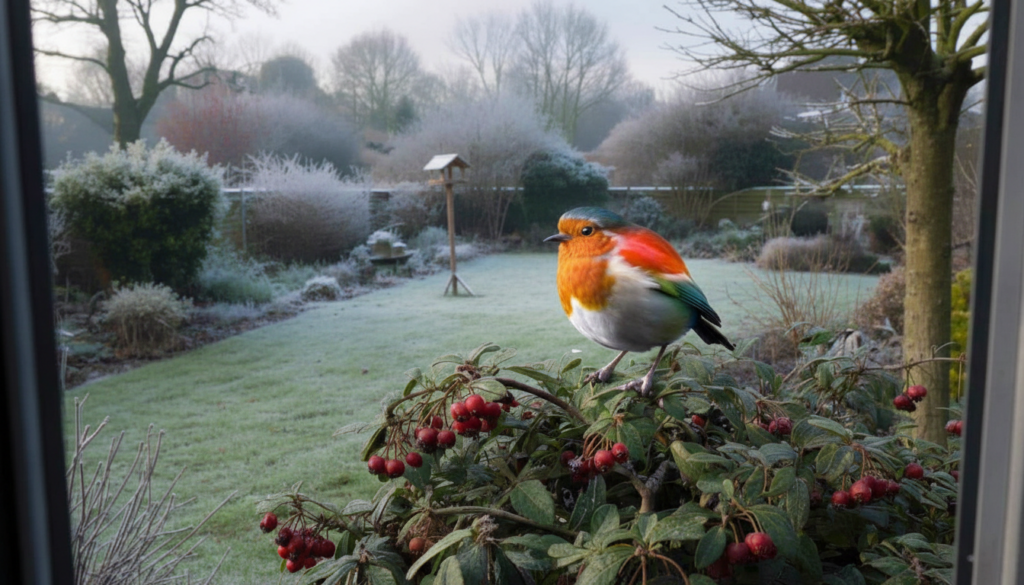
You lean closer to the window and dry your hands on a tea towel. The bird isn’t paying attention to the feeder, the seeds, or the fat balls. It only wants one thing: the berries that are still hanging on that shrub you barely noticed when you planted it years ago.
One quiet winter fruit is in charge of everything.
The calm red magnet that brings robins back
If you ask a few backyard birdwatchers what their robins love to do in the winter, you’ll see a strange pattern. Not mealworms. Not blocks of suet. Not fancy seed mixes with shiny boxes. The humble hawthorn berry is what robins come back to day after day, even when it’s cold outside. Those little red fruits that stay on thorny branches long after the leaves have fallen act like a natural beacon for birds that are hungry.

In the summer, you don’t really notice hawthorn. It blends in with the green and disappears into the hedges. But the berries stay on like little traffic lights when everything else in the garden looks tired. Robins learn that when insects go away, hedges full of haws are easy to pick. That’s why they come back. Once more. And then they think of your patch.
This story comes up again and again when you talk to experienced garden birders. A woman in Shropshire told me that her robin “ignores” her neighbor’s clean feeder “like it’s invisible,” but it spends half the morning darting in and out of her old hawthorn hedge. Another birdwatcher keeps track of what he sees every day and saw that his winter robin numbers nearly doubled the year he let a messy corner hawthorn grow instead of cutting it down.
Local bird groups’ garden surveys show the same thing all over the UK. In the winter, when there are hawthorn trees, there are usually robins too. Not as a random visitor, but as a regular, a small bird that lives in your area and has decided to protect your berry bar. That’s the difference between seeing something for a short time and knowing it well.
This winter fruit is so popular for a simple reason. Hawthorn berries ripen in the autumn, but they often stay on the branches until January, when the soil gets hard and worms go deep. Robins need food that is easy to find because they use a lot of energy just to stay warm. Haws are a quick way to get calories because they are all at beak height.
Hawthorn has grown up with native birds, unlike some decorative garden berries that are more for our eyes than for wildlife. The fruit is soft enough for a robin to eat, but tough enough to last through the first frosts. When robins see that in one cold spell, they usually remember it. They add it to their mental map of winter, and your garden becomes a regular stop.
How to make your hawthorn a popular place for robins
You’re halfway there if you already have hawthorn in your garden. The trick is to let it do what it does best instead of forcing it to behave. Robins like to hide and perch as much as they like to eat berries. A small hawthorn tree or a loose, slightly wild hedge with branches that are stacked on top of each other gives them a place to flit, hide, and watch for danger between bites.
The easiest thing to do is to move your winter birdwatching from the middle of the lawn to the hedge line. Put a simple bird table or low dish near the hawthorn and fill it with crumbs, grated cheese, or a few dried mealworms. The robin might come for the berries at first, but then it will start to use the whole area as its winter home. You are not only feeding a bird; you are also changing its path.
Most of us cut back at the wrong time, even though we mean well. We chop hawthorn hard in late autumn ‘before the bad weather comes in’, and we accidentally cut off half of the berry crop right when robins need it the most. That nice hedge you like? From the point of view of a robin, it’s like going to a café and finding that all the plates have been taken away.
You might also want to plant showier shrubs because they look better on Instagram. Birds will use pyracantha, holly, and cotoneaster, and they all have their place. But if you cut back on the hawthorn or get rid of it completely, you might see that your robin becomes more of a wanderer and less of a fixture. *Even if a garden looks perfect on paper, it can still feel strangely empty of life.
Ian Fletcher, a retired ranger and lifelong birder, says, “If I had to pick one winter plant for robins, it would be hawthorn every time.” “It feeds them, hides them, and gives them a reason to come back tomorrow.” That’s what keeps a bird in your garden: not gadgets, but habit.

Cut back at the right time
You shouldn’t cut back hawthorn in the middle of berry season, when the robins are eating, because it will take away their food.
Leave a “messy” corner
Let one part of the hedge stay a little messy. Robins like branches that are tangled so they can dart in, grab a berry, and disappear.
Put berries with soft food.
Put live or dried mealworms close to the hawthorn. The robin might eat berries to get more energy, then hop over to get some protein-rich food.
Make safe places to land
Keep one or two perches free of snow and ice, and put a bush or fence nearby so that cats and sparrowhawks can get away quickly.
Be nice to the ground
Don’t use strong chemicals below the hedge. A living soil means more bugs all year long, which is your robin’s favourite snack.
To be honest, no one really does this every day. The good news is that hawthorn doesn’t need you to be around all the time. Once planted and cared for, it will quietly do the main job of bringing your winter robin to your yard.
A little red promise in the grey months
When you realise that a small shrub can make a robin treat your garden like a drive-through or a real diner, your view of winter changes. The same dark, dreary months now hold a small red promise. You look outside on a cold morning and see not only frost and dead stems, but also the punctuation marks of hawthorn berries. You start to look for that orange flicker almost without thinking.
The emotional benefit isn’t just about “drawing in wildlife.” The quiet routine you have with this small, brave bird is what makes it special. You go outside with a cup of tea, and your breath makes the air cloudy. There it is again, hopping along the hedge like it’s checking on you. You have a vague, unscientific idea of why the hawthorn is still there day after day, while other gardens are strangely quiet.
You know that feeling when a robin comes close to you and you feel like you’ve been chosen. Planting hawthorn or just letting the old hedge berry up instead of flattening it is a way to say yes to that feeling. It’s an invitation for a wild, watchful neighbour to keep coming over, written in red fruit. Of course, this isn’t a guarantee. A gentle push in your direction is all a robin needs most of the time.
| Key point | Detail | Value for the reader |
|---|---|---|
| Hawthorn berries are prime robin fuel | They ripen in autumn and often last through winter, right when insects are scarce. | Helps you understand why robins return to gardens with berry-heavy hedges. |
| Timing of pruning matters | Cutting hawthorn in late autumn removes much of the berry crop robins depend on. | Shows you when to prune so you don’t accidentally strip away winter food. |
| Pair cover, berries and soft foods | Hawthorn plus nearby perches and extra treats like mealworms create a winter “hub”. | Gives a simple recipe to turn your garden into a reliable robin hotspot. |
FAQ:
Do robins eat berries other than hawthorn?
Yes. Robins will also eat ivy berries, cotoneaster, pyracantha, and some rose hips, but hawthorn is one of the most common native plants that they eat in the winter.
Is it possible to grow hawthorn in a small garden?
Yes. You can keep hawthorn as a small tree or a clipped hedge. It does well with pruning, but don’t do it too much during berry season.
How long does it take for hawthorn to draw in birds?
When a young hawthorn starts to bear fruit reliably, which usually happens after a few years, local birds start to eat it, and robins often follow.
Will hawthorn help other kinds of birds as well?
Yes, for sure. Hawthorn is a food and shelter for thrushes, blackbirds, starlings, and finches, so you might see a wider range of birds in the winter.
Is there a certain kind of hawthorn that robins like best?
Common hawthorn (Crataegus monogyna) is a great choice for most gardens because it is easy to find and is often used as a native hedge plant.