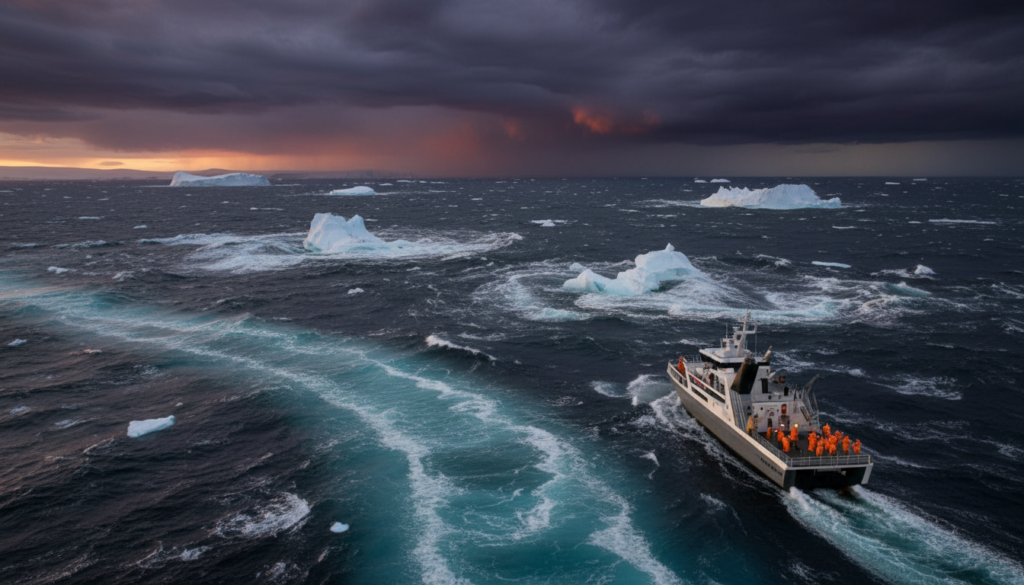
The ship’s metal hull made a low, tired drum sound as it cut through the grey waves of the Southern Ocean. The wind on deck was so sharp that it felt like it could cut your breath in half, and albatrosses flew in lazy arcs over waves that were as big as houses. A few scientists in bright orange parkas stood near a group of tools and stared at a laptop screen that kept showing them the same crazy trend line.
The current was going the wrong way.
At first, no one said it directly. Someone made a joke about a bug, and someone else said it was the satellite link. But the data kept coming, like a nightmare you can’t wake up from. Deep down, the huge “conveyor belt” that usually moves the planet’s air and water seemed to be slowing down, bending, and even, for the first time in recorded history, reversing in some places.

You could almost feel the world holding its breath.
The day the Southern Ocean stopped acting up
The Southern Ocean feels like the last wild guardian of the planet on most days. Cold and unending, its currents flow around Antarctica, pulling heat and carbon down into the deep like a giant hidden lung. This current, known as the overturning current, is what keeps our climate in some kind of balance.
That lung started to wheeze recently.
Oceanographic teams that were following floats and deepwater sensors found something that no one expected to happen so soon: parts of the circulation were not only getting weaker, they were also briefly going the other way. Water masses that should have been sinking and moving north were instead stopping, looping back, or rising. That kind of twitch isn’t just interesting for a system that has been stable for thousands of years. It’s a warning sign.
The Southern Ocean is like the backstage crew of the climate system. While the rest of the world watches heat waves and wildfires, it works in the dark. About 40% of the CO₂ that people put into the air ends up in the oceans. A similar amount of our extra heat is buried deep in the cold, where it is protected from our weather and crops.
Now picture the crew behind the scenes quitting in the middle of the show.
In 2023 and 2024, repeated readings from moored instruments, autonomous Argo floats, and satellites all told the same story: the deep formation of cold, dense water around Antarctica was slowing down quickly. In some places, eddies and counterflows became so strong that they changed the direction of flow in those areas. It wasn’t like a Hollywood moment with a single “switch.” It was more like watching an old machine you trust cough and grind in reverse.
Scientists had thought something like this would happen, but not for another 50 years. The surface waters are getting fresher and lighter as they warm up because of record-breaking heat and melting Antarctic ice. Because the water is lighter, it doesn’t sink as quickly, so the conveyor belt that should drop to the bottom of the ocean stops.
The whole structure of circulation can bend when that sinking weakens.
*The scary part isn’t the brief reversal itself; it’s what it says about limits.* There are a lot of tipping points in climate systems. When you cross a certain line, feedback loops start to make change happen instead of stop it. A Southern Ocean circulation that isn’t working as well as it used to suggests that less heat and carbon are being buried and more are staying in the atmosphere. This could mean that the climate is starting to move away from us faster.
What a falling ocean rhythm means for daily life
From space, the Southern Ocean looks like a grey ring around a white continent that is empty. It seems like it’s a million miles away from your kitchen window. But its circulation is directly linked to the weather, the price of food, and even the air you breathe.
A small change in that deep current can have effects on monsoon patterns in Asia, storm paths in Europe, and drought cycles in Africa and the Americas.
When the overturning slows down or stops in a certain area, less heat is pulled into the abyss, so more heat stays near the surface. That extra heat gets into the air, which makes extremes even worse: longer heat waves, heavier rain, and seasons that change more quickly. It’s like turning the thermostat up a little bit for the whole planet and then finding out that the dial is stuck.
You can already see the prints.
Farmers in southern Brazil have been having a hard time reading seasons that don’t match up with what they remember. In the Mediterranean, marine heatwaves have turned once-cool waters into soup, killing fish and seagrass. In the Indian Ocean, small changes in sea surface temperatures are changing the way cyclones and rains form, moving some areas from flood to famine in just a few months.
The news doesn’t call these events “Southern Ocean current.” But long-term climate models show that when the Antarctic overturning stops, the effects are felt all over the world. The weather gets crazier, and “once in a century” events start to collide like a traffic jam. We’ve all had that moment when the seasons in our heads don’t match what’s going on outside anymore.
So how does a current change in the far south mean that the climate system might break down?
The climate is like a bunch of rhythms that are all connected. For example, ice sheets grow and shrink, forests take in carbon, and oceans move heat around. The Southern Ocean is one of the main drummers in that band. When it loses its beat, the others trip. Greenland is melting faster, coral reefs are bleaching more often, jet streams are wobbling, and permafrost is starting to release more methane. Every change feeds the others, which could push the system into a new, less stable state.
Let’s be honest: no one really does this every day, but it helps to zoom out. Just because the ocean has changed direction for a short time doesn’t mean it will stay that way forever. That means we’re putting a system through its paces that wasn’t made to handle this much heat and freshwater this quickly. And so far, the system is flashing warning lights.
What we can really do when the ocean starts to send us warnings
When we see stories like this on our screens, our first reaction is often a mix of fear and numbness. It feels like the Southern Ocean is turning around, and it’s so big that no one person can touch it. Still, some levers go very far.

Cutting off the heat at its source, fossil fuels, is one of the most direct ways. Every tonne of CO2 that isn’t released is one less unit of heat trying to stop that Antarctic conveyor belt from moving.
On a very practical level, that means making choices that may seem boring on paper but have a big impact on the environment. For example, switching from gas boilers to heat pumps, taking trains instead of planes when possible, choosing smaller homes that are easier to insulate and pushing cities to spend money on public transport instead of more highways. None of this is as exciting as going on a polar expedition. It does change the physics in the Southern Ocean, but not very much.
The other secret lever is pressure. When the social cost of doing nothing goes up, governments and big businesses act more quickly. The moments that really make a difference are often messy and human: a group of parents asking a school board about emissions, workers inside a company organising around its climate promises, or voters putting candidates on the spot about oil drilling in the Arctic, science budgets in Antarctica, or shipping emissions.
If the idea of “solving climate change” seems too vague, try focusing on one layer at a time, like your city, your job, or your bank. Where does it get its money? Is it giving more money to fossil fuel exploration or to renewable energy and adaptation? Little things aren’t magic wands, but they are places where you can put pressure. They make it harder for leaders to act like the end of the world doesn’t have anything to do with their next budget.
The scientific community is also changing the rules as they go. Oceanographers are in a hurry to put more sensors under the Antarctic ice shelves, better satellites over the Southern Ocean, and more computing power into models that can show sudden changes instead of smooth lines.
One researcher told me, half-laughing and half-exhausted, “We thought we had until the second half of the century.” “The ocean is basically saying, ‘You’re on my timeline, not the other way around.'”
To keep track of what’s important without getting lost in noise, it’s helpful to pay attention to a few signals:
Trends in temperature and salinity in the deep Southern Ocean
How fast the ice in Antarctica is melting and the sea level is rising
Using fossil fuels and putting clean energy to use around the world
How often do extreme weather events happen in your area?
Changes in policy, such as climate laws, subsidies, and phase-out dates
These numbers aren’t just numbers. They show us how to read the planet’s hidden engine room’s health chart.
A world that pays attention to its oceans—or not
When you look at the graphs from a distance, all that’s left is a choice about how we want to interact with a living planet. It’s not just a strange scientific fact that the Southern Ocean briefly changed direction; it’s also a story about timing and focus. We pushed the climate system really hard, faster than it has ever been pushed in human history, and now one of its most stable parts is shaking.
There are at least two ways to go from here. On one, the warning comes early, and the next few decades are a messy but determined race to cut emissions, protect important ecosystems, and give the oceans time to adapt. On the other hand, we make the strange seem normal by ignoring things like ice shelves that are falling apart and currents that are flickering. The physics won’t care what story we tell ourselves.
The scientists on the deck of that rolling research ship weren’t thinking in hashtags or slogans as they looked at their screens. They were thinking about limits and how many more years of data they might need before the old baselines don’t make any sense anymore. They were also thinking about their kids and what kind of “normal” climate those kids will grow up thinking is normal.
The Southern Ocean doesn’t want us to be perfect. It wants us to pay attention. To comprehend that a current reversal at the Earth’s extremity is not a remote curiosity but a reflection, initially softly and subsequently more forcefully, of our own decisions. A climate system never falls apart all at once. It comes in a series of moments when we could have pulled back but didn’t or did.
| Key point | Detail | Value for the reader |
|---|---|---|
| Southern Ocean overturning is weakening | Measurements show slower sinking of cold, dense water and local reversals of flow | Helps readers grasp why a distant current matters for global stability |
| Risk of crossing climate tipping points | Weaker circulation means less heat and CO₂ absorbed by the deep ocean, fueling feedback loops | Clarifies how this change could accelerate extreme weather and long-term warming |
| Action is still physically meaningful | Cutting fossil fuels, pushing policy, and funding better monitoring all dampen risk | Offers concrete ways to respond instead of feeling helpless |
FAQ:
Is the Southern Ocean current really going the other way?
Not everywhere. Scientists are seeing temporary and regional reversals and strong slowdowns in some parts of the overturning circulation. This means that the system is under a lot of stress.
Does this mean that the climate will suddenly fall apart overnight?
No. Climate systems usually change over years to decades, but these changes can still happen quickly and cause weather that is more extreme and less predictable.
How is this different from the Gulf Stream getting slower?
The Atlantic overturning includes the Gulf Stream, and the Southern Ocean circulation goes around Antarctica. Both are “engines” of the world’s climate, and they both seem to be getting weaker, which makes the risks even higher.
Will this have a direct effect on the sea level where I live?