You pick up the blue spray bottle without thinking. A few quick sprays and the satisfying sound of a paper towel on glass will make your TV look… clean. The lights go down, and then you see it. Weird patches of clouds. When the screen goes black, a rainbow halo appears. You know something is wrong, but you can’t put your finger on it.
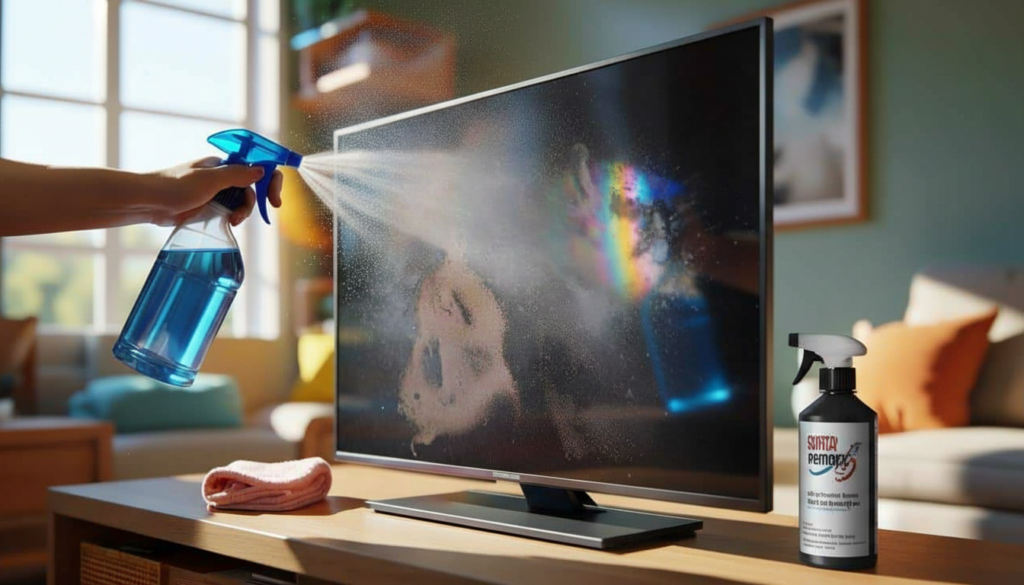
The next day, when the sun comes up, the horror begins. It looks like you wiped your expensive flat-screen with oily water. Those dull marks won’t go away no matter how much you polish. That “just clean it like a window” instinct?
Why glass cleaner and flat-screen TVs don’t mix well
A lot of us watched our parents clean old boxy TVs and windows with the same bottle of glass cleaner when we were kids. Blue liquid, strong smell, quick wipe, and you’re done. When a smudge shows up on your new flat-screen, your brain automatically goes to that shortcut. Spray, wipe, and forget.

But modern screens are nothing like those old glass tanks. They have very thin coatings on them that control reflections, make blacks darker, and keep pixels safe. Glass cleaner doesn’t just “clean” those layers. It eats them. Slowly. Quietly. For good.
If you ask a TV repairman, they’ll roll their eyes. Every week, they see the same damage. A family says they “just wiped it once” with window cleaner, and now there is a hazy spot in the middle of the screen that looks like permanent fingerprint grease. If you tilt it in the light, you’ll see rough, dull spots where the surface used to be perfectly smooth.
A tech in Chicago told a story about a brand-new OLED TV that was less than three weeks old. The owner had kids and pets and was worried about fingerprints and nose smudges, so they used household glass cleaner with ammonia. The anti-glare coating along the bottom edge had literally come off by the time the streaks were dry. In bright light, that strip looked like tape that had been frosted.
This is what really is going on. Most flat-screen TVs, whether they are LED, OLED, QLED, or something else, have a special coating on the front panel that keeps glare and reflections from happening. That coating is very thin and reacts to chemicals. Many common glass cleaners contain ammonia, alcohol, and strong solvents that react with that film. They break down its structure, dissolve micro-layers, and leave patches of bare skin.
You don’t always see the disaster right away. The first “deep clean” can sometimes make the coating weaker. The next time you spray, it will finish the job. You get that annoying feeling that your TV never looks really sharp again. Spots turn into smears, blacks turn gray, and blacks turn gray. The worst thing is? There is no magic cloth that will bring back the coating once it is gone.
How to clean a flat-screen TV without breaking it
It’s almost insulting how easy it is to clean a flat-screen TV safely. Shut off the TV. Give the screen a few minutes to cool down. Then, with a dry, clean microfiber cloth like the one you would use on glasses, wipe in straight lines without putting too much pressure on it or making circles. Most of the time, that’s enough to get rid of dust and small marks.
If the spots are really hard to get rid of, lightly dampen one corner of the microfiber cloth with plain water. Not dripping, but a little wet. Gently wipe the area, and then right away use a dry part of the cloth. No sprays directly on the screen. No chemicals for the house. No paper for the kitchen.
Most people make mistakes here. They are in a hurry, the remote is stuck, and the screen is obviously dirty. So they grab the first thing they see: a roll of paper towels, a random cleaning spray, or even a disinfectant wipe. It makes sense right now. You just want the fingerprints gone, but the kids are yelling and the dinner is burning.
The problem is that paper towels can be a little rough and leave tiny scratches. Generic wipes usually have alcohol and detergents in them that can damage coatings. You don’t notice the damage right away, but after a year of “just a quick wipe,” the screen looks worn out, dull, and uneven. Let’s be honest: no one really cleans their TV according to the manual every day.
A home-theater installer who has been called in to replace a lot of “cleaned to death” panels says, “Think of your TV screen as a camera lens, not a window.” “You wouldn’t spray ammonia on a thousand-dollar camera’s lens cleaner.” You should treat your TV with the same respect.
Before cleaning, always turn off the TV and let it cool down. A dark, cold screen makes smudges easier to see and cuts down on streaks.
To avoid hidden residue, use a microfiber cloth that is only for one purpose and that you don’t share with kitchen counters or windows.
Never use generic glass sprays; only use water or a cleaner made for TVs that the manufacturer recommends.
Don’t press down hard on the screen. The panel is safe with light pressure, straight movements, and patience.
If you’re not sure, look at the manual or the manufacturer’s website. The cleaning section is usually short but very important.
The hidden cost of “just cleaning it once”
It’s heartbreaking to realize that you broke something expensive while trying to take care of it. Screens let us watch movies, play games, make video calls, and even work. When the picture gets cloudy or weirdly reflective, it makes you feel different in your own living room. You pull the blinds down more often. You don’t watch during the day. You see that the colors don’t stand out as much as they did when you first opened the box.
All because of a few sprays from the wrong bottle on a Sunday.
| Key point | Detail | Value for the reader |
|---|---|---|
| Protect the anti-glare coating | Ammonia and alcohol in glass cleaners dissolve this fragile layer permanently | Longer life and better picture quality for expensive TVs |
| Use gentle cleaning methods | Microfiber cloth, soft pressure, and plain water or TV-safe products only | Clean screen without streaks, scratches, or chemical damage |
| Avoid common “quick fix” mistakes | No paper towels, no kitchen sprays, no direct spraying on the panel | Prevents costly repairs or full TV replacement down the line |