It often starts in the produce section. One shopper fills a bag with rough brown potatoes, while the person beside them stacks bright orange sweet potatoes into theirs and laughs, “Same thing, just healthier, right?” No one objects. Both bins carry the word “potato.” The cashier keys in the same produce code without a second glance.
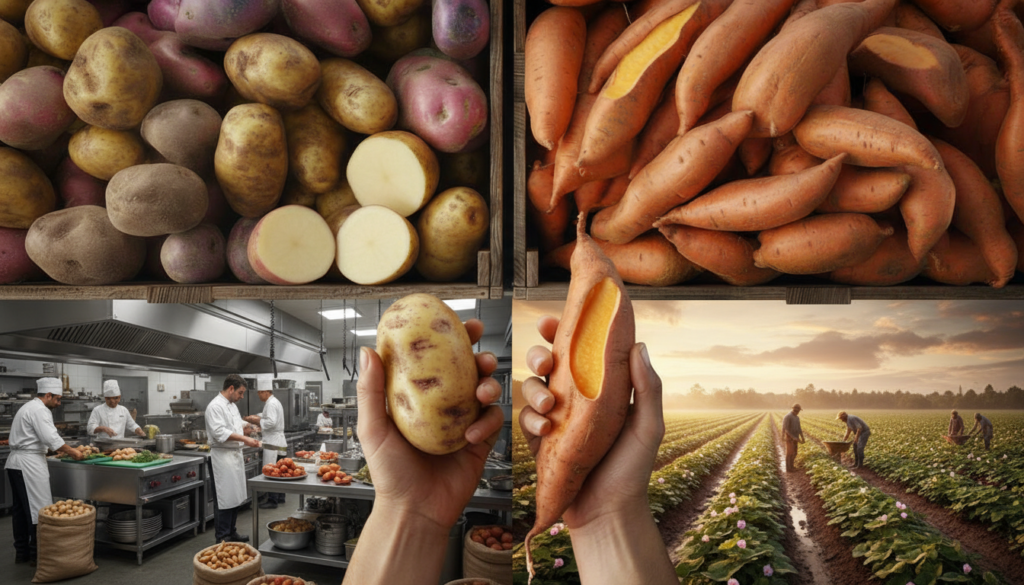
Out in the parking lot, grocery bags rustling, hardly anyone realizes that one of those “potatoes” is botanically closer to a flowering morning glory than to its earthy-looking neighbor.
That small detail, easy to ignore, has quietly become a point of debate between professional chefs and farmers who grow these crops for a living.

Two Roots Sharing a Name, Not a Family Tree
At first glance, the mix-up feels understandable. Both grow underground. Both are rich in starch. Both end up mashed, roasted, or fried on dinner plates everywhere. In English, they even share the same basic name. You won’t find “Solanum tuberosum” or “Ipomoea batatas” on a café menu. You’ll just see potatoes.
But beneath the surface, the story changes completely. Regular potatoes belong to the nightshade family, alongside tomatoes and eggplants. Sweet potatoes come from a separate botanical family known for its delicate climbing flowers.
Walk across a mixed farm and the difference becomes obvious. In one field, regular potatoes grow as compact leafy plants with pale blossoms, their tubers protected by carefully ridged soil. Farmers discuss blight risks, seed stock, and varieties like Yukon Gold or Maris Piper.
Across the dirt path, sweet potatoes sprawl outward in creeping vines. Their heart-shaped leaves look almost ornamental. When harvested, their long, tapered roots reveal vibrant orange flesh glowing in the sun. Different growth habits. Different root structures. Entirely different origins — sharing one simple word.
Scientifically, they are not close relatives at all. Regular potatoes are native to the Andes and part of the Solanaceae family. Sweet potatoes belong to the Convolvulaceae family and evolved in warmer tropical regions. They do not cross-pollinate, they respond differently to pests, and they prefer different soil and storage conditions. Grouping them together is a bit like calling whales and fish identical just because they both live in water.
Why the Mix-Up Matters in Kitchens and Fields
In home kitchens, the confusion often appears in recipes. Someone reads “potatoes” and substitutes sweet potatoes, assuming the result will be the same — maybe even better. Instead, the mash turns soft and watery, or the fries caramelize too quickly and burn. The balance of starch and sugar shifts. Cooking times change. Texture behaves differently.
Experienced cooks quickly learn that these roots are not interchangeable.
Dietitians hear similar questions all the time: “Can I just swap regular potatoes for sweet ones to make a meal healthier?” The answer depends on context. Sweet potatoes offer high levels of beta-carotene and slightly more fiber. Regular potatoes, especially when cooled, contain resistant starch and can be deeply satisfying without added fats.
We’ve all had that moment — proudly serving sweet potato fries, only to watch them soak up oil just as eagerly and vanish even faster.
For farmers, the distinction carries financial weight. Storage requirements differ sharply. Regular potatoes store well in cool, dark environments for long periods. Sweet potatoes suffer damage in cold storage and need warmer conditions. They also tolerate climate stresses differently and require separate planning for irrigation, harvest timing, and market supply.
At the checkout counter, none of this seems important. Yet that small misunderstanding travels backward through supply chains, influencing funding, crop planning, and agricultural policy. For growers, the difference between “similar” and “completely unrelated” can shape an entire season’s outcome.

Choosing, Cooking, and Talking About Them Clearly
One helpful habit is simple: mentally separate the names. Think “potato” for classic white, red, or floury varieties. Think “sweet potato” as its own category, not just a variation. When reading recipes, pay attention to which one is actually required.
Dishes that rely on fluffiness and neutral flavor — gnocchi, creamy mash, duchess potatoes — work best with regular potatoes. Recipes built on caramelization, sweetness, and color lean naturally toward sweet potatoes.
Treat them like cousins at the same table, not twins switching seats.
Another common trap is assuming the orange one is automatically the better choice. A plain baked sweet potato can be nourishing. But cover it in syrup, marshmallows, or excess sugar, and the nutritional advantage fades. The same principle applies to regular potatoes: boiled with herbs and olive oil is very different from deep-fried chips.
Each root vegetable has strengths. Lean into what it does well rather than forcing one to imitate the other. When you move away from labeling one as “good” and the other as “bad,” the conversation becomes more practical and balanced.
The Bigger Lesson Beneath the Soil
Behind this botanical detail — that sweet potatoes and regular potatoes are unrelated — lies a broader lesson about how we view food. Many of us grew up dividing ingredients into moral categories: good carb, bad carb, superfood, guilty pleasure. The potato debate fits neatly into that narrative, with one painted as innocent and the other as indulgent.
But once you understand their distinct origins, climates, and histories, the story becomes richer. You start to see them not as rivals but as different characters with different roles.
That awareness changes everyday choices. You notice which type appears on a menu. You understand why farmers discuss blight or heat stress with such concern. You may even feel less guilt enjoying a salted baked potato alongside a balanced meal.
There’s space here for experimentation and personal preference. Some families reserve sweet potatoes for slow Sunday roasts and keep regular potatoes for quick weeknight dinners. Others do the opposite. What matters is informed choice rather than habit.
Language shapes perception. For decades, calling two unrelated plants by the same name blurred understanding. Now that you know the distinction, the supermarket aisle might look slightly different.
And the next time someone jokes that they’re “basically the same,” you’ll know that beneath the soil, beneath the skin, there’s an entirely different story unfolding — one between a nightshade plant and a flowering vine.
| Key point | Detail | Value for the reader |
|---|---|---|
| Botanical families differ | Potatoes are nightshades, sweet potatoes are morning glory relatives | Helps you understand why they grow, store, and cook differently |
| Nutritional profiles vary | Sweet potatoes bring more beta-carotene, regular potatoes more resistant starch when cooled | Lets you choose the right root for your health goals, not just trends |
| Cooking behavior changes | Different starch and sugar levels affect texture, browning, and timing | Reduces kitchen flops and gives you better control over recipes |