The broccoli was just right. It was bright green and still a little crunchy, the kind that makes a squeaking sound when you bite into it. There were two plates on the table. One had bright green broccoli that smelt like nuts, and the other had a dull, soft, olive-gray version that had been overcooked. Guess which one everyone stayed away from.
I saw my friend laugh as she pushed the sad florets to the side of her plate. She said, “I have to eat this, not because I want to.” Then she tried the greener batch and raised an eyebrow. “Wait… this is broccoli?”
The talk that night went from “ugh, vegetables” to “okay, how did you cook this?” It wasn’t just the taste that changed. It was how we treated the vegetable from the beginning.
The secret starts long before the fork hits the food.
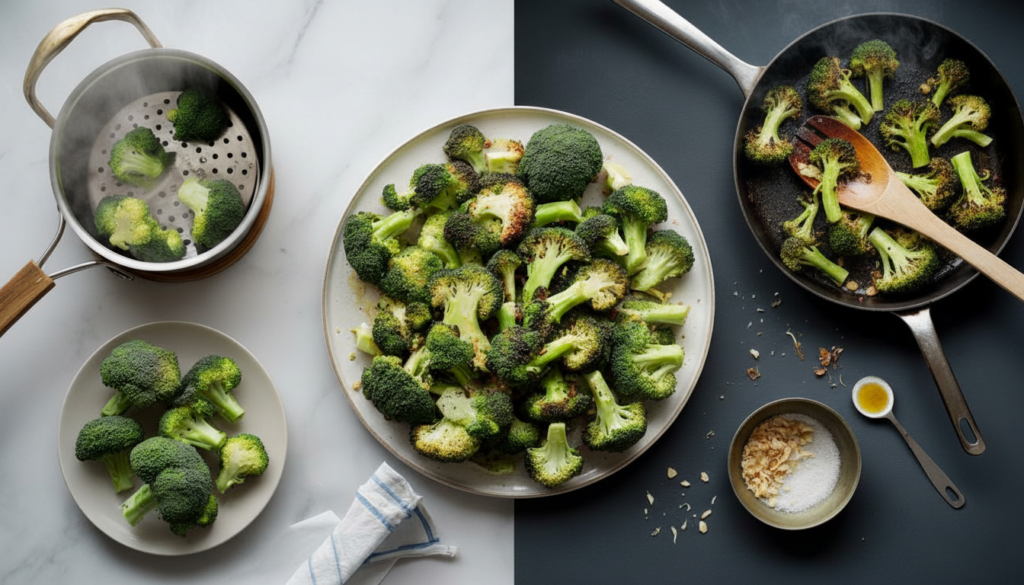
Why steaming broccoli the old-fashioned way isn’t the best way
For a long time, steaming has been seen as a healthy way to cook. No fat, no crust, no char, just a little heat and a feeling of goodness. The issue is that broccoli doesn’t always like it. Long steaming makes the florets limp, the colour fades, and the nutrients slowly leak out with the steam.
Steaming seems like the safest way to do it on paper. In real life, most of us walk away, forget the timer, and come back to a soft, slightly sulphurous pile that nobody really wants to eat. So we eat it with a little guilt, telling ourselves it’s “good for us” and wishing it tasted as good as roasted potatoes.
A small dinner with friends a few months ago turned into an unplanned science experiment. One person cooked the broccoli by steaming it “the healthy way.” Someone else quickly stir-fried it over high heat with garlic and a little water at the end. A third person put it in boiling water for a short time, then put it in a pan with olive oil and lemon zest.
Three plates of the same vegetable, but very different reactions. The steamed version stayed almost full. The stir-fried bowl was the first to go empty. People picked the florets with their fingers and then went back for the little crunchy bits that were stuck in the pan.
“Is this healthy?” was not asked. “Can I have the recipe?” they said.

Nutrition research has made one thing very clear: the magic of broccoli comes from its compounds, especially sulforaphane, which are sensitive to time, temperature, and water. Some of the most important enzymes are broken down by long cooking. Touching a lot of water directly can wash away important vitamins.
Broccoli likes to be cooked quickly and with some aggression: high heat, short time, and little water. Think about quick pan-roasting, stir-frying, or sautéing.
The goal is not to cook it slowly, but to cook it well.
That’s when the colour stays bright, the taste stays good, and those well-known nutrients stay where they should be: in your fork, not in the sink.
The best way to cook broccoli is to do it quickly, at a high temperature, and with just the right amount of time.
Quick pan-cooking is the way that health nuts and flavour chasers agree on. Cut the stems of the broccoli into thin slices and the florets into small pieces so that nothing goes to waste. Put a little olive oil or neutral oil in a large pan and heat it over medium-high heat. Then add the broccoli and a pinch of salt.
Let it sear for 2 to 3 minutes without moving it around too much so it gets some colour. Add a splash of water, cover it, and let it steam in its own little cloud for another 2–3 minutes when the edges start to brown and the green gets darker.
When you can push a knife into it with some resistance and the colour is still bright, you’re done. Add lemon, garlic, chilli, toasted nuts, or nothing at all to finish.

Broccoli is funny because a few seconds can change everything. If you leave it in for one minute too long, it goes from juicy crunch to mushy school cafeteria food. That’s usually when steaming goes wrong: we put the florets in the basket, walk away, and get distracted by our phones.
To be honest, no one really does this every day.
You stay in the action when you cook in a pan. You can taste, poke, and turn off the heat at just the right time. A common mistake is to put too much broccoli in the pan, which makes it boil in its own moisture instead of searing. It’s better to cook in two quick batches than to lose nutrients and texture in one soggy round.
One nutritionist I talked to said, “Think of broccoli like a good conversation.” “Short, intense, and you leave while it’s still interesting.” Long, drawn-out, and overcooked? “People lose interest… and so do the vitamins.”
Broccoli with garlic and lemon quickly
Follow the instructions for cooking broccoli in a pan, then add two minced garlic cloves, the zest of half a lemon, and a squeeze of juice at the end. Take off the heat and add black pepper and a little olive oil.
Bowl of broccoli with spicy tahini
Sear the broccoli until it’s just soft. Mix tahini, soy sauce, lemon, a bit of honey, and chili flakes with enough water to thin it. Pour over warm broccoli, top with sesame seeds and crushed roasted peanuts. Serve with rice.
Sheet-pan broccoli “fries”
Toss florets with oil, salt, smoked paprika, and a spoon of grated Parmesan. Roast at high heat (220°C / 430°F) for 12–15 minutes. Nutrient loss stays limited because the water contact is low and cooking is quick. A lot of the time, kids eat these with their hands.
Changing how you think about broccoli at home: from work to fun
It’s hard to go back to the sad beige side dish once you’ve had broccoli cooked quickly and hot. You begin to see it less as a medicine you have to take and more as a real food with its own mood and balance of sweet and bitter. The stems turn into something you want to keep, not throw away. The florets stop being a sign of dieting and turn into tiny green sponges for sauce.
We’ve all been there: staring at a head of broccoli in the fridge and feeling bad because you know it’s going to die there. If you change how you cook it, it can change the story without anyone knowing.
Broccoli suddenly appears in your weeknight pasta with garlic and chilli. It lands on your tray of roasted vegetables on Sunday. It goes with your omelette, your grain bowl, and your lunch of leftovers. Not as a punishment, but because it tastes good enough to be on the plate.
| Key point | Detail | Value for the reader |
|---|---|---|
| Fast, high-heat cooking is best | Stir-frying, sautéing, or quick roasting keeps color, crunch, and more vitamins | More nutrients and better taste in the same amount of time |
| Limit water and cooking time | Short contact with minimal water reduces vitamin loss and preserves sulforaphane | Health benefits of broccoli are better preserved, especially for daily eaters |
| Flavor boosts change everything | Lemon, garlic, spices, nuts, and sauces turn broccoli into a dish people want | Higher chance your family actually eats their vegetables without protest |