At 2 a.m. and 2 p.m., the city is the same, but when you’re lying in bed with your phone screen glowing and your breathing slowing down, it doesn’t feel that way. Emails don’t make any noise. The group chats are frozen. The loud neighbor upstairs has even decided to stop making noise on the floorboards. The streetlights outside hum like a soft ceiling over your thoughts. Your mind, which has been racing all day, suddenly slows down and stretches out.
You scroll, look at the ceiling, and listen to old conversations. And oddly, you don’t feel more stressed; you feel… safer.
It’s almost like the world has left you alone.
The world is secretly relieved when it sleeps.
When you realize “everyone else is asleep,” there is a small change that happens. Your brain, which is still wired from the day, finally gets proof that the race is on hold. No more quick answers are expected. No more work pings hiding. No one is watching, posting, or performing.
That quiet outside becomes a quiet inside.
You don’t feel like you’re behind, late, or being compared for once. The constant, invisible pressure to keep up with everyone—coworkers, friends, and strangers online—fades into the background. You can almost hear your nervous system let out a sigh of relief, like a laptop fan that calms down when you close all the tabs.
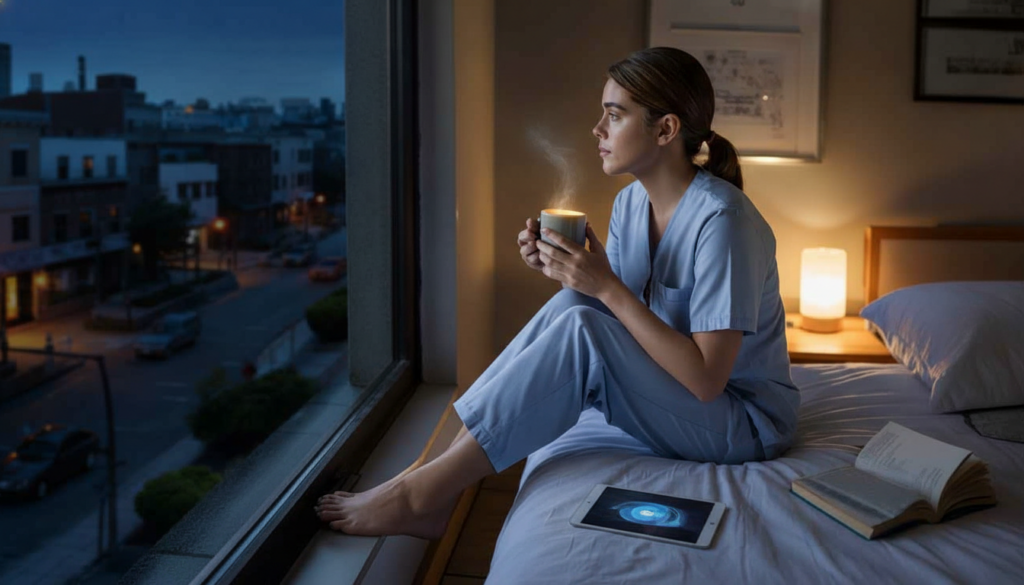
Imagine a nurse who is young coming home from a late shift. She drops her bag, takes off her shoes, and looks at her phone. There are a lot of messages from earlier, but none now. Her social media feeds are old. No green dots that say “online.” She showers, sits on the edge of her bed, and all of a sudden she feels calm.
During the day, she has to deal with a lot of things at once: patients, notifications, and expectations. At night, when the world is dark, she can finally hear what she needs without being bothered. At 1 a.m., she makes tea, eats cereal straight from the box, and opens a book she has already started three times.
Outside her apartment, nothing really changed. But not having to do anything feels like freedom.
Psychologists say this is a drop in “social load” and “anticipatory stress.” Your brain is always on the lookout for possible requests, judgments, or comparisons. That radar gets a lot fewer signals back at night when everyone is asleep.
Your threat system can now relax. Your body sees the nervous tension of “What am I missing?” or “Who needs me?” going away as safety.
*Less noise from other people means more space inside.*
This is why your mind may be clearer at 1 a.m. than at 1 p.m. The same problems are still there, but they seem smaller, less sharp, and easier to deal with when there aren’t so many people around.
Why calm at night is so hard to resist
There is also control. At night, you get a rare feeling that this time is all yours. No bosses. No due dates. No dropping off at school. You can binge-watch a show, write in a journal, stare at the wall, or clean out a drawer that has been bothering you since 2022.
This little bit of freedom is especially hard to deal with when you have a lot of things to do. That calm at midnight isn’t just calm. It’s a powerful silence.
Researchers have even come up with the term “revenge bedtime procrastination,” which means staying up late to make up for time you think you lost during the day. You know you’ll be tired tomorrow, but you stay in the calm because it feels like the only time that is really yours.
Imagine a parent who finally gets the kids to sleep. The dishes can wait. You can wait to do the laundry. They tell themselves they’ll only scroll for ten minutes, but then they look at the clock and see it’s already 00:47. The house is dark, the neighborhood is quiet, and for the first time all day, no one needs anything.
They either play a video at a low volume, answer that one friend’s question correctly, or just sit in half-light and do nothing “productive.” Of course there’s guilt—the alarm, the meeting, the school run tomorrow. But once again, the relief of not having to be on call for anyone wins.

To be honest, no one does this every day because they are “bad at time management.” They do it because they think the night is the only time when demand stops.
That calm is a mix of less outside stimulation and a feeling of more control. The brain gets fewer sensory hits: less noise, less movement, less talking, and less pressure to respond. At the same time, the voice inside your head gets louder and clearer.
You’re not just running away; you’re getting back on track.
When people say “I’m a night owl,” they are often talking about more than just their biological clock. They are also talking about their mental preference for this low-pressure, low-visibility zone. No attention. No race. You and your thoughts are finally walking at your own pace instead of running to catch up with someone else.
How to use that night calm without ruining your sleep
You don’t have to give up that deep, late-night calm if you love it. You can make it into something. Put a soft limit on the “awake for me” time to start. This hour is mine, for example, “From 10:30 p.m. to 11:30 p.m.”
Turn down the lights, cut down on blue light, and pick one or two simple rituals that tell your brain, “We’re going from doing to being.” Tea. A list of slow songs. A book that you can hold in your hands. Laying on the floor like a cat that doesn’t want to move.
The goal isn’t to be in perfect health. The goal is to keep the emotional benefits of that calm while saving a little more energy for tomorrow than you did yesterday.
Many people make the mistake of turning that quiet hour into another performance zone, like a self-improvement marathon, intense journaling, overthinking life, or never-ending “catching up” on everything. That usually lets the stress back in right away.
Be nice to yourself here. You don’t have to make the most of every second of rest like a robot. Try asking, “What would really make me feel better right now, not impress me?”
That could mean stopping after one show instead of five. Or shutting your eyes for five minutes before you pick up your phone. Small, realistic changes are more important than big, impossible promises.
One sleep therapist I talked to said, “Night isn’t magic, but the way we treat it can either heal us or quietly wear us out.”
- Keep one small habit
Put on some music, wash your face slowly, or write two lines in a notebook. Your brain gets the message from repetition: “We’re safe, we’re winding down.” - Pick a “no-intensity” rule
No heavy work emails, no big talks about relationships, and no big changes to your life after a certain time. Keep the peace from turning into another war zone. - Use sound like a blanket
Podcasts, audiobooks, or ambient sounds that are soft can keep the noisy parts of your mind busy while the rest of you relaxes into the silence. - Put your worries down on paper.
Make a quick list of the things you need to do tomorrow. Your brain relaxes when it knows that the problems are not in your head. - Check an earlier calm
Try to make the same mood one hour earlier than usual once a week. Same routines, same quiet, but a little more sleep in the bank. - The quiet hour is like a mirror for your life.
That odd calmness you feel at night says a lot about how your days go. If you can only relax when everyone else is asleep, it might be because your schedule, your limits, or your expectations during the day are too tight.
You don’t have to stay inside at night. It could be a sign.
Pay attention to what you do when you feel safest at night. Do you read? Are you just breathing and staring? Do you finally think about what you want instead of what everyone else needs? You probably want those things at 11 a.m. but only let yourself have them at 11 p.m. You might not be able to change everything right away. You can still sneak some of that calm from the night into the day, though. For example, you could take a ten-minute walk without your phone, eat with the door closed, or spend an hour a week “offline” from everyone’s expectations.
The world will keep on going. People will continue to sleep and wake. Your nervous system will keep looking for times when it can finally stop being “on.”
Maybe the real question isn’t “Why do I feel calmer at night?” but “Where else, in broad daylight, could I give myself that same quiet permission to just be?”
| Key point | Detail | Value for the reader |
|---|---|---|
| Night reduces social load | Fewer messages, demands, and comparisons at night lower stress signals in the brain | Helps you understand why your body naturally relaxes when others are asleep |
| Calm is tied to control | Late hours often feel like the only time that truly belongs to you | Gives language to the “revenge bedtime” cycle and why it’s so hard to break |
| Rituals can protect that calm | Simple, repeated actions turn night into a soothing space instead of a stress extension | Offers practical ways to keep the benefit of night peace without destroying sleep |
Questions and Answers:
Why do my thoughts seem clearer at night? Your brain isn’t juggling as many social and sensory inputs because there isn’t as much outside stimulation. It’s easier to hear your inner voice when there are fewer distractions.
Am I a night owl if I feel calmer at night? Not all the time. You might just be reacting to less stress and more control. Even if you like the quiet of midnight, going to bed earlier could still help your body.
Is “revenge bedtime procrastination” really that common? Yes, especially for people with busy jobs, caregivers, students, and anyone else who thinks their days are too full. It’s normal to feel this way when you think your time isn’t your own.
How can I stay calm without staying up too late? Set a time limit that isn’t too strict, add one or two calming activities, and stay away from tasks that are too hard. Instead of trying to quit your habit overnight, try to change the same vibe a little bit earlier.
Is it bad that I like the night better than the day? Not right away. Take it as information. If you only feel safe or free at night, it might be time to change your daytime boundaries, workload, or screen time so that you can feel calm at other times of the day as well.