The sidewalk café got very quiet just before noon. People stopped talking, spoons stopped halfway to their mouths, and everyone looked up at the sky through cardboard glasses with crinkled edges. The sun, which had been so bright a few minutes before, was now a thin, white crescent. It was like someone had opened a huge freezer door over the city, and the temperature dropped. A dog barked at nothing and then stopped, not knowing why. Day forgot how to be day for two long, fake minutes.
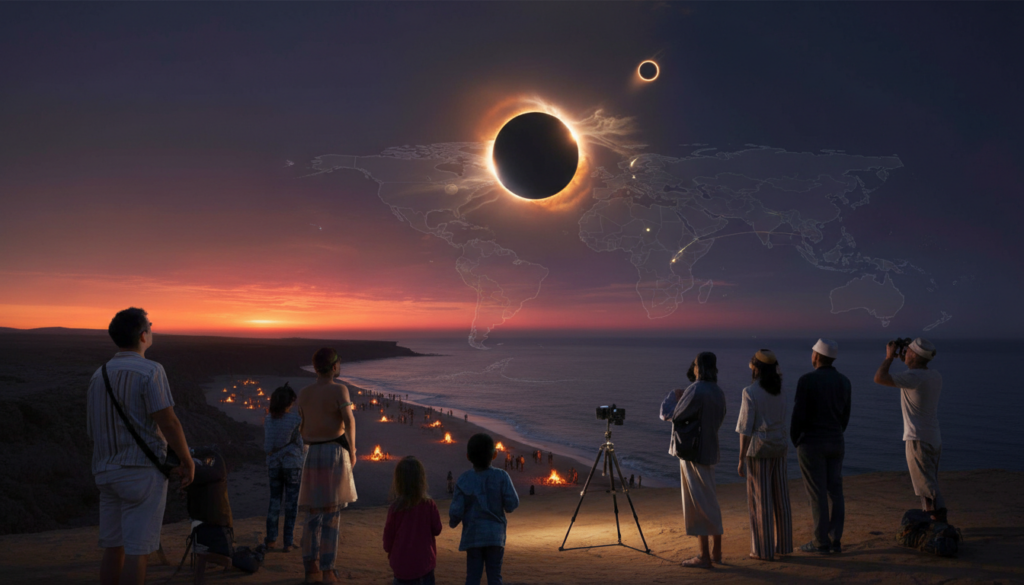
When six minutes of darkness will fall, it will be the eclipse of the century.
Astronomers are quietly calling it “the eclipse of the century” all over the world. Not because of how dramatic it is—every total solar eclipse is dramatic—but because of how long it lasts. In the middle of the day, there was total darkness for six long minutes, which covered thousands of kilometers. You don’t see that kind of show very often. It has been decades since a total solar eclipse lasted this long. What’s next? It could be your grandchildren who are looking it up.
On August 2, 2027, the “six-minute eclipse” will happen. The Moon will be perfectly in line with the Earth and the Sun, casting a long shadow over North Africa, southern Europe, and the Middle East. In some places, totality will last more than 6 minutes, which is a record for our lifetimes. Cities like Luxor in Egypt will suddenly go dark in the middle of a summer afternoon, as if someone had flipped a cosmic switch.

Numbers don’t usually give you goosebumps, but these ones do. Astronomers think that in Luxor, the totality will last for about 6 minutes and 23 seconds. About four minutes south of Spain, near Gibraltar. Parts of Saudi Arabia and Yemen across the Red Sea will also see more than six minutes. That’s long enough for the crowd to shout and then be quiet. Long enough for Mercury and Venus to show up. Long enough for you to feel very small and strangely connected to everyone else who is standing in that moving shadow with you. The path of totality will be about 250 kilometers wide and will go from the Atlantic Ocean through Morocco, Algeria, Tunisia, Libya, Egypt, Saudi Arabia, and Yemen before disappearing over the Arabian Sea.
Mapped and decoded: the best places to watch
This one needs a different approach if you’ve ever missed an eclipse because you “thought you’d just step outside at the last minute.” You plan this trip months in advance. The first thing you need to know is that you want to be on the center line of the eclipse path, where the Moon’s shadow is the darkest and the totality lasts the longest. Astronomers have already mapped it with crazy accuracy, even down to tiny desert villages.
The big prize is Egypt. The Sun will disappear for more than six minutes over ancient temples and the Nile near Luxor and Aswan. Picture the Valley of the Kings in complete darkness, with the columns of Karnak reaching up into a fake night sky and the shapes of hot-air balloons frozen in the air. Morocco is also in the way, especially the southern parts near Marrakech and the foothills of the Atlas Mountains. The eclipse will happen lower in the sky there, and the corona will look like a ghostly crown because of the African summer haze.
One small detail: being in a well-known city won’t matter as much as having clear skies. In early August, North Africa is usually dry, which is what you want. The desert plateaus in Libya, inland Tunisia, and the Egyptian Sahara are some of the best places in the world to see things without clouds. But there are some downsides, like the heat, the logistics, and the long, dusty roads. Spain will only see a partial eclipse, but the strange midday darkness will still be felt in coastal towns and villages on hills. There are a lot of tourists on the riverfronts, but there are also lonely stretches of sand and stone along the path.
How to get ready: from “where did you sleep?” stories to eclipse glasses
If you don’t want to ruin the “eclipse of the century” for yourself, think of it as a festival that happens once every ten years instead of just a regular afternoon. First, let’s talk about the date and time. The total eclipse will happen on August 2, 2027, and it will hit North Africa in the afternoon, between 12:00 and 15:00 local time, depending on where you are. Look at your local eclipse map, then zoom in on the exact city or even the exact hill you want to be on. Set a date and time for that trip in your calendar, then three months before it, add a reminder that says “book trip or regret it.”
The next step is to get the gear. You need the right eclipse glasses with ISO 12312-2 certification for every second before and after totality. Sunglasses that are normal don’t work. A lot of people think they can just “peek for a second” and be okay. That’s a dangerous myth. If you want to take pictures, you should also bring a hat, water, sunscreen, and maybe a light tripod. Let’s be honest: no one really does this every day. So, before you start taking pictures, test the settings on your camera or phone in bright sunlight and write down a simple setup that you can follow without thinking too much when the sky starts to change.
What is the most common mistake?
Instead of looking up, you were messing with screens, lenses, or social media during totality. We’ve all had that moment when we realized we watched our child’s performance on our phones instead of with our own eyes. An eclipse is even less forgiving. You only get one chance. Take a deep breath when the last bright “bead” of the Sun goes away and the world goes dark. For at least 30 seconds, put down the tech. Take in the black sun, the bright white corona, the sunset that goes all the way around the horizon, and the sudden chill. Your brain puts this kind of memory in the “life anchor” folder.
French astrophotographer Léa Martin says, “During the 1999 eclipse in Europe, I spent most of totality adjusting my camera.” “I took beautiful pictures. I also missed the pure awe. I promised myself that in 2027 I would take two quick shots and then nothing but my eyes.
Before you go, pick a spot on the center line, look up the weather in the past, and book your hotel early.
One week before, check your transportation, print or download an eclipse map that you can use offline, and buy extra eclipse glasses.

On the day of the eclipse, get to your viewing spot at least two hours early, set up once, and then relax.
During partial phases, only use certified eclipse glasses or filters, and look at the crescent shapes under trees.
During totality, take off your glasses, look up, see the stars and planets, and feel the temperature drop.
What six minutes of darkness really does to people
Anyone who has seen a total solar eclipse will tell you that the pictures don’t do it justice. When the Sun goes down in the middle of the day, something primitive wakes up. Birds settle down for the night, streetlights turn on, and bugs start to sing. People laugh, yell, or stop talking all of a sudden. Some people cry for no reason at all. That’s the weird power of an event in the sky that everyone can see. People who don’t know each other on the same rooftop or stretch of desert become a kind of instant community, all saying the same shocked “Did you see that?”
This time, the emotional level is even higher. Six minutes is not a quick shock; it’s a long-lasting state. Long enough for the first screams to stop, long enough for your pupils to adjust, and long enough for you to realize that you’re standing on a moving planet in a perfect clockwork alignment that almost never happens. People often ask, “Where were you during the 2027 eclipse?” later in life stories. It’s like a reference point, a shared timestamp across continents.
Maybe that’s why it’s so important to plan and map out this event so carefully. Not just to help people get the perfect shot, but also to help them be there. Families will go. Couples will choose this as a fun, nerdy vacation. Those six minutes could make kids who are seven or eight in 2027 the scientists and photographers of the 2050s. The map shows the path of totality as a thin line. In reality, it’s a moving wave of stories waiting to be told, from Morocco’s rocky coasts to Egypt’s ancient stones and Yemen’s highlands, all briefly stitched together under a blackened Sun.
| Key point | Detail | Value for the reader |
|---|---|---|
| Exact date and duration | Total solar eclipse on August 2, 2027, with over 6 minutes of totality in parts of North Africa and the Middle East | Allows readers to plan travel, time off, and long-term scheduling |
| Best viewing locations | Center-line zones in Egypt (Luxor, Aswan), desert regions in Libya and Tunisia, southern Morocco, limited totality in Spain’s vicinity | Helps choose the optimal destination balancing weather, accessibility, and experience |
| Preparation essentials | Certified eclipse glasses, early bookings, simple photo setup, arriving hours ahead on site | Reduces stress, increases safety, and maximizes the chance of enjoying the event fully |
Questions and Answers:
How long will the 2027 solar eclipse last at its longest? In Egypt, near Luxor, totality will last about 6 minutes and 23 seconds at its peak. This makes it one of the longest total eclipses of the 21st century.
What are the best places in the world to see it? The longest and most impressive views will be along the center line in Egypt (Luxor, Aswan), desert areas of Libya and Tunisia, and parts of Saudi Arabia and Yemen that are in the path of totality.
Will I see anything from Europe?Yes, a deep partial eclipse will happen in a lot of southern Europe, including Spain and parts of Italy. The Sun will look like a thin crescent, but it won’t be completely dark.
Do I really need glasses for the eclipse? Yes. You should always wear certified eclipse viewers (ISO 12312-2) during partial phases to protect your eyes. You can only look without protection during the brief totality.
When should I start making plans for my trip? If you want to go to popular places like Luxor or coastal Morocco, you should start looking for flights and places to stay 12 to 18 months ahead of time. Demand is expected to rise closer to 2027.