An email that hasn’t been read. You need to open this file. A blank page that you promise yourself you’ll “just start” after a cup of coffee, a scroll, or one more video. The sun has moved across the sky, your jaw is tight, and you still have to do that same thing. A lot. Almost unfriendly.
Your brain starts to talk to you in a familiar way. “You’re lazy. You are broken. “Other people just seem to do things.” You bring the guilt with you to the couch and try to relax, but it keeps humming in the background like a fridge you can’t unplug.
Here’s the twist that most of us never learned in school. That thing you call “putting things off”? A lot of the time, it’s not laziness at all.

The calm storm behind every “I’ll do it later”
From the outside, it looks boring to watch someone put things off. A person, a screen, and a deadline that isn’t on stage. But inside, it’s a mess of feelings. Fear, shame, perfectionism, and a strange kind of self-defense get in the way of a simple task.
Most of the time, people who put things off don’t want to do anything. It’s about not wanting to feel anything. That hurt of not being good enough. That fear that you’ll prove your worst fear right: that you can’t handle it. So you scroll, clean up, eat, “research,” and float. Don’t go into that emotional minefield.
It looks like a delay on the outside. It’s protection underneath.
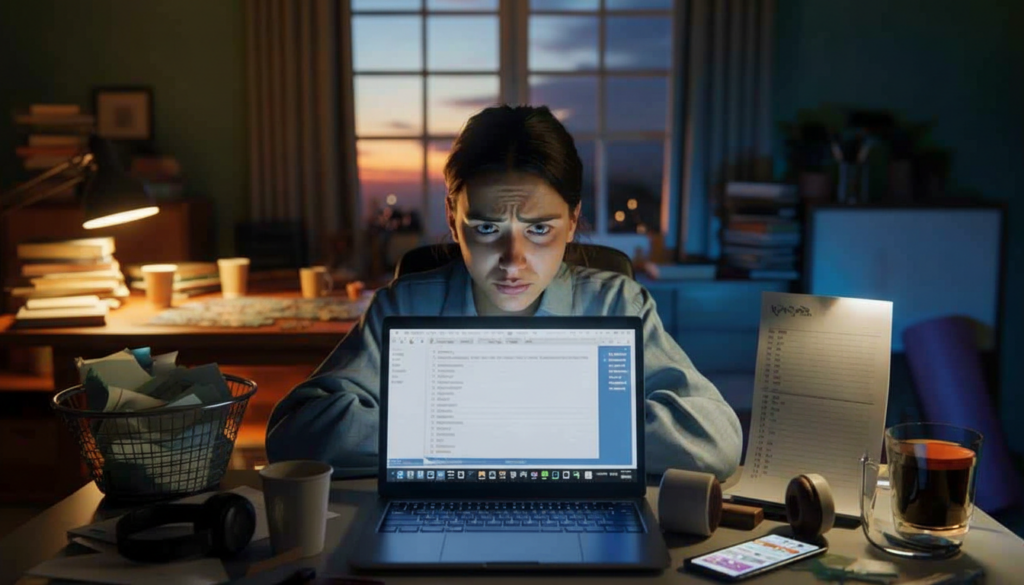
At 10:47 p.m., Laura, 32, is staring at a job application that she hasn’t finished yet on her laptop. All day, she’s been “working on it.” She has actually rewritten the first sentence twelve times, checked LinkedIn five times, and done two loads of laundry that she forgot to fold.
Every time she hovers over “Submit,” she feels a wave of fear: “What if they say no?” “What if I get it and fail?” “What if I never get out of here if I don’t try?” Her chest gets tight, and her fingers pull back. She tells herself she’s tired and that she will “finish fresh tomorrow.” The tab stays open for three weeks.
Someone might say from the outside that she just doesn’t care. She is using email drafts and laundry detergent to deal with questions about her identity. That’s not being lazy. That’s too much emotion hidden behind “later.”
Psychologists say that putting things off is a way to control your emotions. Not a problem with time management. Your brain sees a task and immediately runs a threat check: “Will this hurt?” Embarrass me? “Expose me?” If the answer is yes, even slightly, it slams the emotional brakes.
The brain isn’t thinking about deadlines or what will happen in that split second. It’s chasing relief. “I’ll check my messages first” doesn’t sound like someone is scared. Yet it gives you a quick hit of comfort. The problem is that comfort has interest rates. The more you delay, the heavier the guilt, and the more painful the task feels.
So you end up in a loop where the thing you’re avoiding grows teeth. Not because the task changed, but because the feelings around it did.
From self-attack to emotional first aid
One small way out begins in a surprising place: how you talk to yourself the moment you notice you’re procrastinating. Most of us go straight for the whip. “You’re lazy. You always do this.” That might sound like motivation, but it’s more like pouring petrol on a fire you’re trying to calm.
Instead, try treating procrastination as a signal, not a verdict. The moment you catch yourself drifting, pause and ask: “What am I actually scared of with this task?” Then write the answer down in one or two sentences. Naming the emotion pulls it out of the fog and into the light, where it loses some of its power.
Now the task isn’t just “answer that email”. It’s “answer that email that triggers my fear of conflict”. Different game.

People often think the solution is to suddenly become a productivity robot, waking up at 5 a.m., doing perfect deep work sessions, color-coding their calendars. Let’s be honest: nobody really does this every single day.
Real change usually starts much smaller, and much more clumsily. For example, setting a “ridiculously easy” version of the task: open the document and write one sentence. Draft a reply and don’t send it yet. Read the brief once, then close it. These tiny actions don’t fix your life in one go. What they do is prove, quietly, that you can touch the task without falling apart.
Every time you touch the task, you teach your nervous system: “We can survive this feeling.” Over time, the emotional alarm gets a little quieter.
“Procrastination is not a character flaw, it’s an emotional coping strategy that’s run out of runway.”
That line stuck with me after a therapist said it in passing. It shifts the question from “What’s wrong with me?” to “What pain am I trying not to feel right now?” That’s a gentler, but also more honest, question.
Here are a few practical ways to work with that pain instead of fighting yourself:
- Ask, “What feeling am I avoiding?” and write down the first word that comes up.
- Break the task into the smallest possible visible step and only commit to that.
- Use a timer for 10–15 minutes and stop when it rings, even if you’re “in the zone”.
- Plan “aftercare”: a walk, a call, a snack you enjoy, so your brain associates action with relief, not punishment.
- Talk to someone about the story you’re telling yourself about this task (you’ll be surprised how often it sounds harsher out loud).
Living with “later” in a world that worships “now”
Once you start seeing procrastination as emotional armor rather than laziness, daily life looks different. The pile of unopened letters on a friend’s desk stops being a joke and becomes a quiet question: what’s in there that hurts? The teen refusing to start homework might not be “unmotivated”, just scared of proving a teacher right about them being “stupid”.
The culture around us doesn’t help. Productivity porn tells us that the good life is a series of completed to-do lists and perfect morning routines. That leaves almost no room for real human feelings: grief, self-doubt, boredom, anger, fear. *No wonder our nervous systems grab any strategy available to avoid a task that might poke those bruises.*
So the next time you catch yourself lost in the small, guilty rituals of “I’ll do it later”, you could try a different line of questioning. Not “Why can’t I just get my act together?” but “What part of me is trying to stay safe right now?” You might still delay sometimes. You might still miss a deadline. You’re human.
But each time you notice the emotional mechanism behind the delay, you get a tiny bit more choice. A little more space between the feeling and the scroll. A little more room to act, not because you bullied yourself into it, but because you understood what you were protecting.
That shift, quiet as it is, can change how you work, study, parent, love. And if more of us started treating procrastination as a conversation with our emotions rather than proof of our flaws, we might talk to ourselves very differently on those long, restless nights with the cursor blinking on an empty page.
| Procrastination is emotional, not moral | Delay is often driven by fear, shame, or perfectionism rather than laziness | Reduces self-blame and opens the door to kinder, more effective strategies |
| Small actions calm the nervous system | Tiny, low-pressure steps prove you can “touch” the task and survive the feelings | Makes starting feel possible instead of overwhelming |
| Self-talk shapes your response | Shifting from “I’m lazy” to “What am I avoiding feeling?” changes the whole dynamic | Gives you practical leverage on procrastination instead of staying stuck in guilt |
FAQ:
Is procrastination always emotional, or sometimes just bad planning?Both can be true. Poor organization plays a role, but when you repeatedly avoid the same type of task, there’s almost always an emotional charge underneath.
How do I tell the difference between laziness and emotional avoidance?Ask yourself: “If this task felt totally safe and low-stakes, would I still avoid it this much?” If the answer is no, you’re likely dealing with emotion, not lack of will.
Can productivity tools alone fix procrastination?They can help, but without addressing the feelings behind the delay, tools often become sophisticated ways to rearrange avoidance.
What if my procrastination is linked to anxiety or ADHD?That’s common. Emotional avoidance often overlaps with neurodiversity and anxiety, and getting professional support can be a game-changer in those cases.
Is it possible to completely stop procrastinating?You can reduce harmful procrastination a lot, but never delaying anything ever is unrealistic. The real goal is learning to understand your “later” and respond with awareness, not self-hate.