Sunday afternoon. Your phone lights up with a message that says, “Coming for coffee?” You are halfway through wiping down the kitchen counter, the vacuum is out again, and the laundry basket is full. You look at the crumbs on the floor, the bathroom you “kind of” cleaned yesterday, and you already know what to do. You’re not going anywhere.
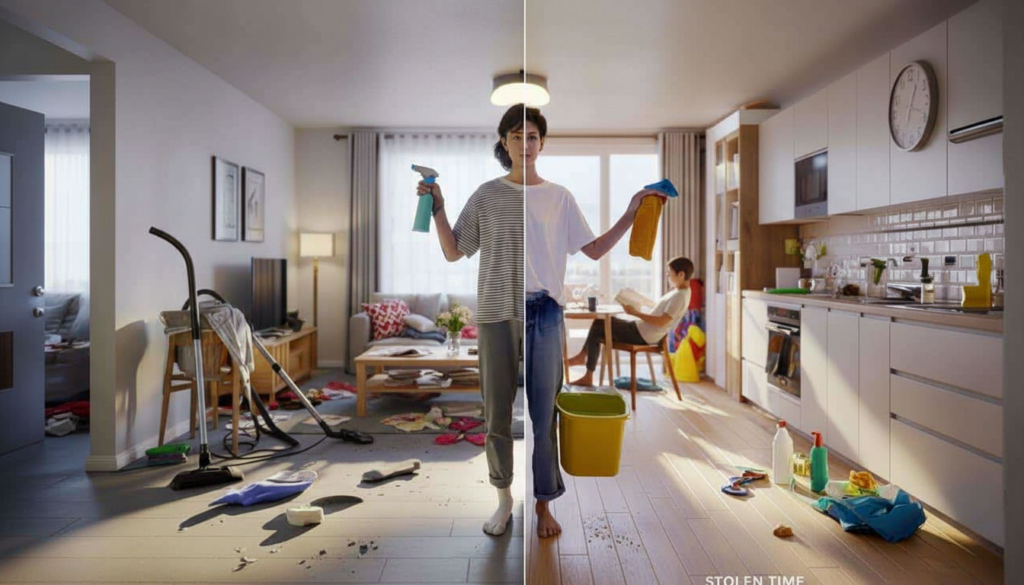
You spent the whole weekend “cleaning,” but the apartment looks strangely the same. Every week, the sponge drama happens again, with the same gestures, the same half-finished tasks, and messes that come back faster than you can clean them up.
It’s odd that you’re not lazy. You’re just cleaning in a way that takes up a lot of time without you knowing it.

Where your time for cleaning really goes
Be careful during your next “big clean.” You might be doing the housework equivalent of scrolling: moving a lot but not making much progress. You clean a shelf, remember the laundry, open the machine, start a cycle, and then you see the mirror in the bathroom. Two minutes later, you’re looking for the glass spray you left in the living room.
This constant back and forth makes me feel busy and even happy at times. Your brain likes the feeling of “doing something.” But after two hours, the place doesn’t look any cleaner. It just looks a little less messy.
For example, Emma, who was 34 and said she cleaned “all the time,” always felt like she was behind. She timed herself one Saturday. It took 17 minutes to walk from room to room with one item at a time. She spent thirteen minutes looking for cleaning supplies and cloths that she had left “somewhere over there.” Twenty-one minutes spent redoing things she had only half-finished faster than her coffee cooled.
By the end of the day, she had spent almost 90 minutes not cleaning, but switching between tasks, looking for things, and fixing small mistakes. That’s more than three full days a year wasted on inefficiency when you multiply that by 52 weeks. Three stolen days that could have been spent napping, reading, or living life.
Your home has a “cleaning system,” even if you never meant to make one. Every object, product, or gesture either makes the route shorter or longer. Random storage makes you take detours. Tasks that are the same make loops. When you don’t know what your priorities are, you go in ten different directions at once.
To be honest, no one really does this every day.
We tell ourselves, “It will only take five minutes,” but those five-minute chunks add up to hours that we can’t see. Cleaning poorly isn’t just about how hard you work; it’s also about how things are built. The way you move, where you start, and what you use. That’s where the time is going.
Cleaning smarter: small changes that give you back your weekends
The most important change is very simple: clean by zones, not by impulse. Choose one room (the kitchen, the bathroom, or the bedroom) and set a timer for 20 to 30 minutes. Do only that. No wandering off with a stray mug, and no “I’ll just quickly do this while I’m here.” The mug goes on a tray by the door, not all the way to the sink.
Make a small caddy for each floor or group of rooms. One all-purpose spray, one microfiber cloth, one sponge, one pair of gloves, and one microfiber cloth. You have everything when you enter a zone. When you leave, the zone is clearly over. The brain loves this kind of ending. So does time.

The second key is to stop doing work that doesn’t need to be done again. You don’t have to clean the whole house every weekend. Change. This week, the kitchen is the main focus. Next week, the bathrooms. The rest gets a quick reset: beds are made, surfaces are cleared, and floors are checked. That’s all.
We’ve all been there: cleaning the baseboards while the sink is still full of dirty dishes. It seems good, but it’s wrong. First, do the things that have the most effect, like cleaning floors, surfaces, and smells. If you still have energy, you go into more detail. If not, at least the house feels really cleaner, not just “technically cleaner.”
Cleaning really well doesn’t mean working harder.
Make “reset points”Pick two short times during the day, like morning and evening, to reset for five minutes. You could clear off counters, put away obvious clutter, or start or fold a load of laundry. These little anchors stopped the avalanche on the weekend.
Make a “holding zone” by putting a basket or box in each main room for things that don’t have a home. You only put things in the basket while you are cleaning. In the end, you do one focused tour to put them back, not twenty little trips.
Make your products the sameOne spray that works on a lot of surfaces, one product for the floor, and one for the bathroom. Less choice, less time to think, and fewer bottles to move around. Your future self will be grateful.
Put the boring things in a batchDust all the surfaces in a room in one go, from top to bottom. One pass of the vacuum should clean the whole house. Your body gets into a rhythm, your brain can wander, and you get done faster.
Accept “good enough clean.” This is where a lot of time is wasted. Doing one thing perfectly takes away the freshness of the whole house. Instead of trying to get everything done 100% of the time, try to get 80% of it done all the time.
Taking back your time from the vacuum and the mop
When you pay attention, you can see these little time leaks all over the place. The five minutes you spend arguing with yourself about where to begin. Seven minutes of scrolling because you’re already tired before you start. The ten minutes you spent redoing the bathroom because you forgot the mirror. This has nothing to do with your worth or discipline. It was never really chosen to be a system.
It’s not about becoming someone else when you redesign it; it’s about accepting how you really live. Kids will leave crumbs, emails will come in, and energy will drop. Instead of fighting chaos every Saturday, a realistic cleaning system lets it happen and then gently guides it.
You might find that with zones, caddies, and simple rotations, whole parts of your weekend suddenly become free. Not because the house is clean, but because the work finally fits with your life. Between “Pinterest clean” and “livable clean” is a space that holds your time, your hobbies, your naps, and your coffee with friends.
The truth is that a good routine is less exciting than a long cleaning session. It’s short, regular, and almost boring. But that steady, quiet reliability is what slowly gives you your hours back, week after week.
Notice the next time you find yourself walking down the hall with a sponge and a sock. That’s a small fork in the road. You can keep moving from place to place until Sunday night, when you’ll feel guilty for “cleaning all day and doing nothing.” You could also stop, choose a zone, get the right tools, and finish one thing all the way.
Those little decisions don’t seem brave. No one will clap when you make it easier to store your sprays or when you decide to wait a month to put up the skirting boards. But this is where life changes in a quiet way. One less hour of cleaning means one more hour of living. The house won’t remember. You will.
| point | Detail | Value for the reader |
|---|---|---|
| Zone-based cleaning | Focus on one area at a time with dedicated tools and a time limit | Reduces wandering and transition time, making each session visibly effective |
| Task rotation | Alternate deep-clean focus by week and keep the rest on a quick-reset level | Prevents burnout and stops you from wasting time over-cleaning low-impact areas |
| Micro-routines | Short daily resets, holding baskets, and batched tasks | Spreads the load across the week and cuts the need for endless weekend marathons |
Frequently Asked Questions:
How many hours a week should I really spend cleaning?
If you use zones and daily micro-resets, three to five focused hours a week is usually enough for a small to medium-sized home. The feeling of “all weekend cleaning” usually comes from short, ineffective bursts of work instead of real hours worked.
Is it better to clean every day or just once a week?
A combination works best. Short daily resets for surfaces, dishes, and clutter, plus one or two longer zone sessions each week. That mix keeps deep work in check and stops messes from getting out of hand.
If I’m always behind, what’s the first thing I should do?
To begin, do a simple evening reset: clear off the main surfaces, run or empty the dishwasher, and pick up the mess on the floor in the living room. This one habit cuts down on the work you have to do on the weekends right away.
How do I stop cleaning the same spots over and over?
In each zone, clean from the top down (shelves, counters, and then floors), and then move on to the next room. Put your tools in a caddy so you don’t have to leave a room in the middle of a task to look for something.
What if the people I live with don’t meet my standards?
Set a “baseline clean” that you both agree on: floors that are clean, a kitchen that works, and a bathroom that is decent. Keep your personal extras optional, knowing that they are for your comfort and not for the survival of the household. Just changing your mind can save you hours of anger and work.