The first Airbus test pilot saw it on a screen before he saw it in the air.
Two small symbols and two real jets are moving toward each other on purpose.
No radio calls saying “traffic, traffic.” No sweaty hands holding the yoke. There was only a calm voice in the cockpit and a quiet, almost eerie faith in the code that was running in the background.
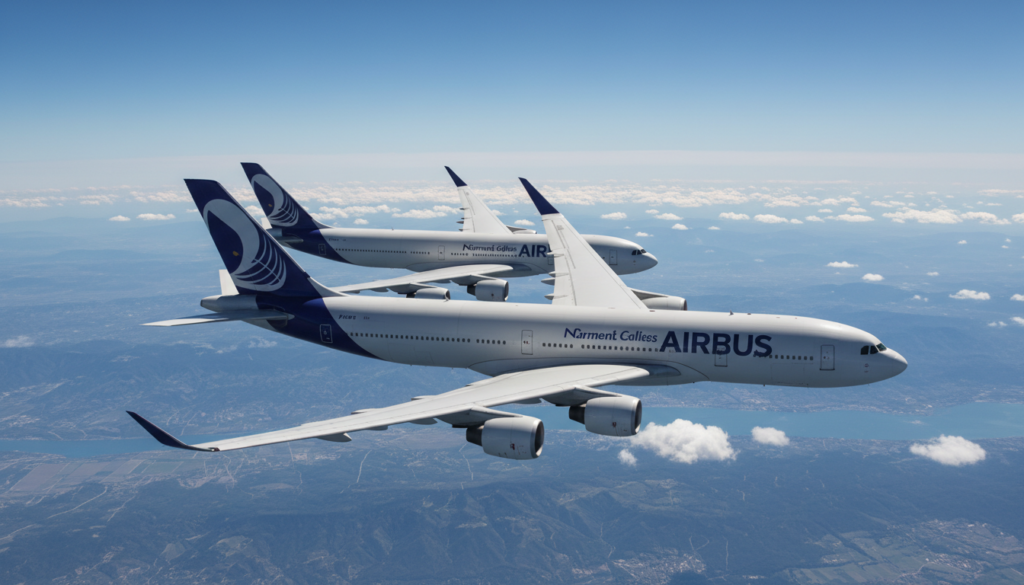
Two Airbus planes flew closer together in the calm sky outside, guided not by human reflexes but by a shared digital brain. The goal was to get close, react, and then leave as if an invisible hand had planned it all.
Everyone in that cockpit knew how stories about mid-air collisions end.
This time, they were trying to come up with a new ending.

Two planes, one sky, and machines talking to each other without sound
Airbus did something that regulators have been worried about for decades: it let two planes move toward each other on purpose on a clear test day, far from busy hallways.
Not carelessly or blindly, but in a very controlled digital bubble.
Each plane had a new layer of automation, a step up from today’s collision-avoidance systems. Instead of just yelling “pull up” at the last second, this system quietly talks to, negotiates with, and coordinates with the other planes long before danger appears.
The scene didn’t seem dramatic.
No last-minute dives and no near-misses like in Hollywood.
It was like they knew what they were doing as they glided with surgical precision.
For years, pilots have had to deal with the famous TCAS alerts, which are loud commands that say things like “CLIMB, CLIMB” or “DESCEND, DESCEND.”
They are supposed to save lives when people or controllers mess up.
But they react quickly, almost violently, and they don’t always pick the easiest or most fuel-efficient way out.
Airbus’s test goes even further.
The two planes “agreed” on how to avoid each other long before there was a real conflict by using better automation, secure data links, and better algorithms.
Imagine going from yelling in an emergency stairwell to calmly making plans to leave a meeting room.
The company has taught both planes to share the same goal in real time, not just how to avoid each other.
The key to this breakthrough is a simple but very hard idea: predictive cooperation.
The new system doesn’t wait for altimeters and radar to scream danger. Instead, it shows where both planes will be in the next few seconds and minutes.
If their paths start to cross, each plane gets a suggested move that fits together like two pieces of a puzzle.
For years, engineers and regulators have been talking about this kind of “airborne choreography.”
It seemed impossible to prove it safely with real jets and real crews on board.
Not just in a simulator or on a whiteboard, but in the real sky.
The test flights for Airbus finally crossed that line between theory and real life.
From quick reactions to calm, agreed-upon choices in the sky
The way this test works is almost disappointingly calm.
Before the flights, engineers set up a safe corridor where the two planes would meet. The planes would be on paths that crossed each other, but they would be separated vertically and horizontally.
Each plane had better avionics that allowed for secure, direct communication between planes using protocols that build on today’s ADS-B and ACAS technologies.
Onboard computers made constant guesses about where the jets would be in the future as they flew their paths.
When those predictions started to match up, the systems sent out coordinated instructions: one plane changed its climb, and the other changed its descent.
Small changes that a passenger might not even notice, but that are enough to change the ending of a classic near-miss.
If you’ve ever seen pilots in a simulator, you know how quickly a calm session can turn into a flurry of alarms.
We’ve all been there, when your mind seems like it’s just one step behind the chaos.
In real life, mid-air fights have that effect, but you can’t stop them.
The opposite happened during the Airbus tests.
Pilots said they felt a strange calmness: alerts came early, the manoeuvres felt natural, and the two planes never got close enough to set off heart-stopping alarms.
The company hasn’t shared all of its numbers yet, but internal data shows that there are cleaner vertical separations, fewer sudden pitch changes, and smoother energy management.
In short, moves that are not only safer but also smarter.
This change is important because aviation safety has reached a strange limit.
People and the systems we have now have already made flying very safe. Accidents are rare, and crashes are even rarer.
This means that the next gain won’t come from scaring pilots more often, but from making it less likely that they will be scared in the first place.
Airbus is looking into a world where planes don’t act like separate metal birds but instead work together as part of a shared network.
Air traffic controllers still keep an eye on the big picture on the ground, but the dance of separation happens right where the danger is: on board, between machines.
To be honest, no one really wants more alarms in the cockpit. They just want fewer reasons for alarms to go off in the first place.
This test pushes aviation in that direction.
What this means for pilots, passengers, and the future of flying without hands
The method looks like raw code on paper.
It looks like a small change in how pilots do their jobs in real life.
Instead of reacting at the last minute to TCAS commands, they see conflicts as soft suggestions that fit naturally into the flight path.
The gesture is almost invisible: a small change to the flight management system or a slightly different climb or descent profile.
The new path is followed by the plane, and the other jet does the same on its side, with systems that had just talked to each other a few seconds before.
The magic isn’t in one brave act; it’s in the quiet prevention that no one sees.
People on the plane keep reading, drinking coffee, and scrolling through their feeds, not knowing that their plane just took part in the first-ever negotiation in the sky.
This kind of automation can make people scared right away: “Are we taking the controls away from pilots?”
Airbus engineers are very careful to say the opposite.
The pilot is always in the loop, knows what’s going on, and can say no if something seems wrong.
The system is not in charge; it is a partner.
People make mistakes when they think technology will work perfectly right away.
When it comes to flying machines at 35,000 feet, people often go back and forth between trusting them completely and being completely suspicious.
The right way is in the middle: letting computers do what they’re good at (quickly predicting things and sharing data) while people still have the power to make decisions and take responsibility.
That balance is delicate, and each new test flight is a small step toward getting it back on track.
After landing on one of the first test flights, a senior Airbus test pilot said quietly, “The best part is that nothing felt dramatic.” It all just felt… in sync.
His words show the hidden goal: not to impress, but to make a new kind of safety normal.
Early, planned moves
Give both planes room to move freely, which will lower the chance of sudden, violent changes at the last minute.
Less stress in the cockpit
Fewer surprise alarms mean crews are calmer, and calmer crews make better decisions when things get tough.
Path to more air traffic that is cleaner and denser
More planes can share the same sky without causing a traffic jam thanks to smarter separation.
A sky that doesn’t just fly together but also thinks together
From the cabin window, what happened during those Airbus tests might not seem like a big deal.
Two planes fly by, and no one gasps. Life goes on.
But there is a bigger question behind that quiet scene: what kind of sky do we want in ten or twenty years?
There will be more traffic, more drones, more self-driving cars, and more pressure to cut emissions in the aviation world.
Old ways of keeping everything safe, like wide buffers, strict routes, and constant human oversight, start to seem slow and heavy when you think about the future.
Cooperative, machine-to-machine avoidance isn’t a magic button, but it gives us a glimpse of a world where every object doesn’t just take up space; it also helps protect it.
For passengers, the value might be as simple as smoother flights, shorter detours, and safety that fades into the background.
For pilots, it’s about tools that don’t take away their skill but help them in those rare but important moments when human reaction isn’t enough.
For regulators, it’s a test lab in the real world that shows that algorithms can act, negotiate, and follow the rules that have kept planes apart for decades.
The most surprising thing about this story is that nothing blew up, no one freaked out, and there was no viral video.
Two planes, two crews, one piece of sky, and a shared future that starts with a simple, almost boring fact: they met, reacted together, and then went their separate ways without ever crossing that deadly line.
Sometimes the biggest changes happen like that: quietly, on a clear day, when nothing bad happens at all.