Café in a small town on Saturday morning. The kind of place where the menu hasn’t changed since the 1990s and the sugar packets are kept in a chipped ceramic bowl. Three people in their late 60s are slowly drinking coffee, doing crossword puzzles, and talking about who is painting their fence at the back of the room by the window.
At the next table, two people in their twenties sit still over oat milk lattes, their shoulders hunched and their faces lit up a pale blue by their phones. Notifications go off. Roll the reels. People don’t really look at each other.
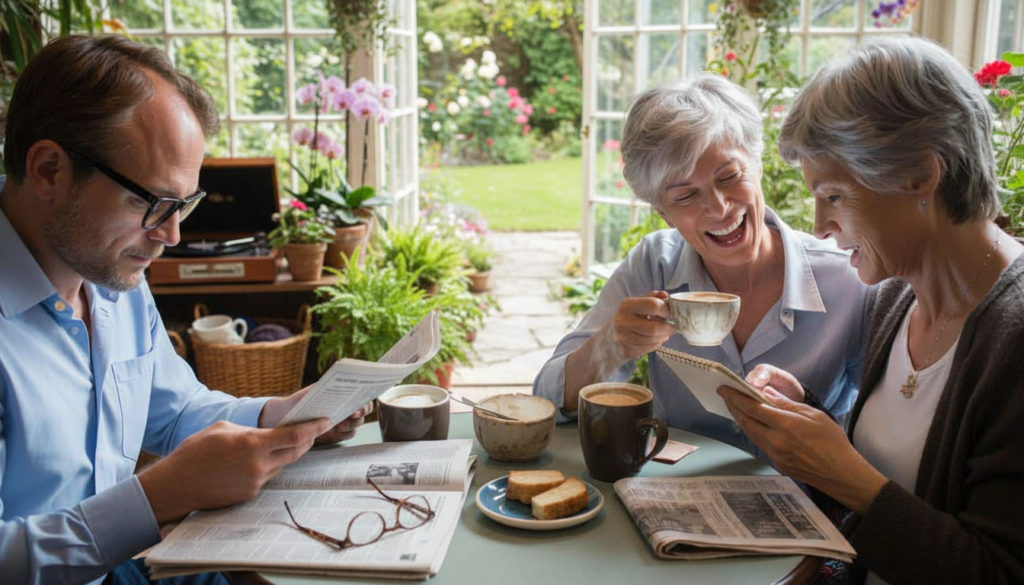
You can almost tell whose heart rate is lower.
We talk a lot about “the future” and “new ideas.” But older people who refuse to give up their old habits are still quietly defiant.
They don’t miss it. They’ve got something going on.
1. Breakfasts without screens that take a long time
When you ask people in their 60s what their mornings are like, you don’t often hear, “I doomscroll for 45 minutes in bed.”
You can hear things like the radio playing softly in the kitchen, toast, the newspaper, and maybe a short walk to get fresh bread. Morning is a time for rituals, not a race.
There are coffee steam clouds instead of notification bubbles.
The phone is on the counter, but it’s not the main character.
That quiet half-hour with a cup in hand is like a daily reset. They feel like they are anchored at the start of the day, not already behind.
Jean, 72, a retired bus driver I talked to, starts every day the same way. A thick mug of tea, the local paper folded in half, and a pencil for the crossword. No loud TV or looping TikTok in the background.
He said that his grandson kept looking at his phone while he was at the table. Jean just tapped the newspaper and said, “The news is here, not there.” At first, the kid rolled his eyes. On the third day, his phone was face down, and he was arguing about a headline instead.
The whole mood in the room changed because of that small change. More talking and less buzzing. More raised eyebrows and laughter, and less twitching thumbs. Breakfast became a real event, not just a time to fill up.
Psychologists keep saying that our brains aren’t made to handle constant alerts and divided attention.
Older people who defend their screen-free mornings seem to have known this for a long time, before push notifications took over the alarm clock.
Reading, stirring, buttering, and looking out the window at the start of the day sets a rhythm that your nervous system can follow. You aren’t negotiating your worth with likes before you’ve even brushed your teeth. One of this generation’s secret superpowers is that they see the first few minutes of the day as theirs, not as public property that apps can rent.
That kind of ownership seems a lot like happiness.
2. For important things, call instead of text
If you tell a 70-year-old that you broke up with someone over text, they will often wince like you just scraped a plate with a fork.
They think that big news should be in a voice, not a bubble. They still call people to tell them about a birth, offer condolences, or share a promotion.
They can tell when someone is breathing heavily on the other end of the queue.
They can hear a smile, not just see a heart emoji. And that deep connection, which happens over and over again for years, creates a shield against loneliness that no group chat can fully replace.
I saw this happen during the pandemic. Rosa, a woman in her late 60s, took out a real notebook with a list of names and phone numbers in it. Every day, she would sit in her armchair by the window and call two or three people. Not a message. Call.
She called an old coworker she hadn’t talked to in ten years one day. No one online knew that the woman had just lost her brother. “I don’t know why I picked up,” she said. “I just felt like I needed to hear from someone who knew me from another life.”
That call became a weekly habit. Two older women sharing recipes, sadness, and jokes about their sore knees. No filters. There is no mute button. Just being there.
Younger people often say they are “always connected,” but they also report feeling more alone than ever. There is a difference between the number of interactions and the number of real contacts.
Older people who keep answering the phone don’t want to turn relationships into blue and grey bubbles. They put up with the awkward pauses, the broken voices, and the sentences that aren’t heard right. That little bit of social awkwardness pays off in the long run. When we get real human signals like tone, rhythm, and warmth, our brains calm down.
Texting is a good way to get things done. A voice is in charge. One gives information. The other makes you feel like you matter to someone.
3. Paper, pens, and the happiness of having something real
Watch the hands of a person in their 70s as they write a list of things to buy. There is a kind of calm focus there. The pen moves a little slower and the letters are a little bigger, but the action is planned.
They keep their address books in drawers, their recipes on index cards, and their photo albums on the couch, where you have to sit and turn the pages. Those things don’t buzz. They are patient.
They still trust paper, even though there are auto-save and cloud backups. They don’t hate technology; they just trust what they can feel with their hands.
My aunt, who is 68, has a small notebook next to her bed. She writes down three good things that happened that day every night. Not in a cool app. Not for Instagram. Just a tight blue script going down the page.
One night, she got mad at a neighbour and felt awful. She looked at the last week’s pages in her notebook, which were full of little things like “warm bread,” “nice chat with pharmacist,” and “sun on balcony.” She said, half-laughing, “It’s hard to feel like life is a disaster when the evidence says I was excited about strawberries yesterday.”
That cheap notebook has done a better job of keeping her grounded than a hundred guided journaling apps.
When reality has some weight, our bodies relax. A book, a picture, or a letter that you can read again after twenty years.
Life online is light, slippery, and always scrollable. It makes you want to keep going. Paper makes a line. This page, this story, this memory.
People in older generations who hold on to their pens and albums are also holding on to a sense of continuity. Memory is no longer a feed you can lose in a second with the wrong swipe; it’s a place you can go. *In a time when people are obsessed with unlimited storage, they quietly protect the things that are really worth storing: the little things in life that you can hold in your hands.
4. Always walking, even when the car is right there
If you spend a day with a healthy 70-year-old, you’ll see something simple: they walk. To the post office. To the bakery. Around the block just to “get some air.”
You don’t need a step counter. No smartwatch to cheer them on. Walking isn’t just a way to get around; it’s also a way to think and socialise.
They don’t have routines; they have routes. The way to the dog that always barks, the bench that gets sun at 4 p.m., and the corner store that has their favourite yoghurt. These little loops connect their days.

There is a man in his mid-70s who does the same 20-minute loop every day in the afternoon. It doesn’t matter if it’s raining, hot, or windy. He waves at the florist, nods to the bus driver, and stops to pet any dog that will let him.
He shrugged when I asked him why he doesn’t just drive to the store once a week like everyone else. “Then I wouldn’t see anyone.” That line stuck with me.
He walks every day, but it’s not for exercise; it’s for socialising. Those short nods and “how are yous” make a web of small connections. Sociologists call them “weak ties,” and they hold him in place without making a sound.
Younger people often rely on gym sessions or fitness apps to get them moving. It’s all or nothing. Three hard workouts one week, then none the next. To be honest, no one really does this every day.
People who grew up walking to school, work, and the store as kids still do it, but they don’t call it “self-care.” They move their bodies in a moderate way on a regular basis. Their brains get a dose of sunlight and things that happen in the real world.
That one easy choice makes running errands a way to improve mental health and slows down the shrinking of their social circle. The car goes faster. The walk is more full.
5. Making food from scratch and eating at a real table
If you ask your parents or grandparents what they had for dinner, you probably won’t hear a brand name.
They’ll say things like “pasta with tomatoes from the garden” or “soup from the chicken we had yesterday.” Food is an activity, not a delivery.
They cut, mix, taste, and change things. The smell of garlic, onions, or something cooking slowly on the stove fills their kitchens. Eating is more than just getting nutrients. It’s a time event. A lot of people still sit at a table with a plate on a real placemat, even when they live alone. The TV might even be off for once.
A neighbour who was in her early 70s and was widowed told me she wouldn’t eat on the couch because “then the day has no shape.”
So she sets the table every night with a plate, silverware, a glass and a cloth serviette. Some nights, all I have is scrambled eggs and salad. But the gesture says, “This moment is important.” I saw her invite a younger coworker over once. The coworker came in glued to a group chat and left asking for the soup recipe and saying, “I forgot what it’s like to have a real dinner.”
Yes, cooking the old-fashioned way may take more work. It also makes small acts of care, like peeling vegetables, simmering sauces, and waiting for bread to brown. Your brain gets the message from those little things: “You’re worth this time.”
Studies on nutrition keep showing that cooking your own meals is good for your health and makes you feel better. Not a surprise. Your body stops going up and down with blood sugar when you watch how much salt, sugar, and food you eat.
There is also the social side, in addition to biology. A table is one of the last places where you can easily put your phone down without a fight. You give the salt, not the link. You look up. You tell someone to tell the story again.
People who are older and still enjoy family-style meals are actually keeping one of the few places left where people can focus on each other instead of screens. People feel like they are being seen instead of just “tagged” when they are focused.
6. Keeping hobbies that don’t help you get things done
One of the most underrated old-school habits is doing things that are “useless” in terms of money.
Birdwatching, knitting, model trains, gardening, stamp collecting and choir practice. Hobbies that don’t grow, make money, or “build a personal brand.”
People in their 60s and 70s who hold on to these interests seem to be oddly happy. They forget what time it is. They talk about sounds, colours, textures, and seasons. They get excited about small changes, like a straighter seam, a rarer bird, or a more confident note.
I met a retired accountant who had a whole room full of miniatures, like tiny furniture, plants, and lamps that worked. No Etsy shop, no social media account, nothing.
He smiled when I asked why he spent hours arranging and painting. “I like making little worlds where nothing bad happens,” he said. That answer is both simple and deep. His hobby isn’t content. It’s a place to stay.
He showed me a chair that he had painted three times until the colour “felt right.” Not a boss. No due date. Just what he thinks is enough.
In our culture, almost everything is a hustle. People ask you if you’ll take commissions if you draw. Someone suggests a side business if you bake.
Older people who don’t give in to this pressure and keep their hobbies just for fun are protecting an important mental space. A place where the process is more important than the outcome.
They are quietly following a rule that many younger people are just now rediscovering: not everything you love has to pay its way.
Hobby as a safe place: a regular activity that isn’t work, numbers, or judgement.
Ten minutes of daily practice is better than a big project you never start.
Community doors: Hobbies can help you make friends and join clubs and groups in real life.
The old-fashioned ways that quietly protect happiness in the future
These six habits look almost boring when you put them all together. Slow breakfasts, real phone calls, writing with paper and pens, walking, cooking at home, and “useless” hobbies. Nothing fancy. You can’t show off on LinkedIn.
But these are the kinds of things that therapists, neuroscientists, and longevity experts keep coming back to: regular contact with other people, gentle movement, touchable reality, predictable rituals, and play without pressure.
Older people aren’t holding on to them just because they don’t want to let go. A lot of people have seen trends come and go, and they’ve seen what stayed strong during tough times.
We’ve all had that moment when you look up from your phone and see that an hour has gone by and you still don’t feel better.
Being around people in their 60s and 70s who live by these analogue rhythms can feel like being in a different time zone where life moves in a different way. Yes, slower. But in some way, it’s also thicker.
Maybe the real question is why they won’t stop doing these things.
Maybe that’s why so many of us gave them up so quickly in the first place.
And which one you’d be okay with quietly taking back into your own life this week.
| Key point | Detail | Value for the reader |
|---|---|---|
| Screen-free rituals | Slow breakfasts, calls instead of texts, meals at a table | Ideas to reduce anxiety and rebuild real connection |
| Tangible anchors | Paper notes, photo albums, handwritten lists | Simple tools to feel more grounded and less “scattered” |
| Everyday movement & hobbies | Walking as transport, joyful “useless” pastimes | Accessible ways to boost mood and health without apps |
FAQ:
Question 1: Are these habits possible for someone who works a lot of hours?
Answer 1: Yes, if you only borrow them a little bit at a time. One breakfast without screens a week, one phone call instead of a text, and a 10-minute walk after lunch. The goal isn’t to live like a retiree; it’s to get back some old-school moments that help you relax.
Question 2: Is it true that older people use their phones less, or is that just a myth?
Answer 2A lot of people do use smartphones a lot, but they usually keep some areas “sacred,” like meals, social visits, and bedtime reading. Not having any technology is not the difference; it’s having clearer lines between online and offline life.
Question 3: What is one habit that makes you the happiest?
Answer 3: Research shows that regular walks are the best choice over and over again. They make you feel better, help you sleep better, and give you chances to meet new people. Begin with a short, enjoyable route that you can do again and again.
Question 4: I don’t like calling people. Where do I begin?
Answer 4Start with low-stakes calls, like a quick check-in with a family member or a “thought of you when I saw this” chat with a friend. Say right away, “I know we usually text, but I wanted to hear your voice.” A lot of people are secretly happy.
Question 5: Is it possible for technology and these old habits to work together?
Answer 5: Yes, for sure. Tech can help with these things, like sending reminders for walks, saving recipes online, and backing up photos. The most important thing is to let analogue moments take the lead, with digital tools in the background.