The boat engine cut off like someone hitting mute on the world.
The only sounds were the small waves hitting the hull and the bubbles coming from the tanks on the deck. It was just before dawn off the coast of North Sulawesi, and the sky was still dark from the night before. Three French divers shuffled into their gear with the sleepy choreography of people who’ve done this a thousand times.
Below them was 150 meters of black water. And a rumor.
Underwater cameraman Gaël tapped his lens dome, as if to wake up the glass. He mumbled, “If it’s down there, we’ll find out today.”

No one wanted to say the name out loud yet.
Some situations seem almost like magic.
The night the “living fossil” finally showed up
Like many technical dives, the descent began with numbers, protocols, and routine.
The depth gauges lit up in a cold blue color. The dive computers beeped softly. The world shrank down to a dark vertical tunnel with three cones of LED light pointing straight into the unknown.
The colors faded away at 60 meters. Reds went away first, then oranges, and finally yellows. It was like going down through an old black-and-white TV set. The water temperature got a little colder at 100 meters. There were no fish or coral gardens, just the rock wall and the quiet fall of plankton like snow under the water.
Then the seabed came into view, a dark plateau of sand and rock. This is where legends usually stay legends.
That night, they didn’t.
A shadowy figure moved into the light from the darkness.
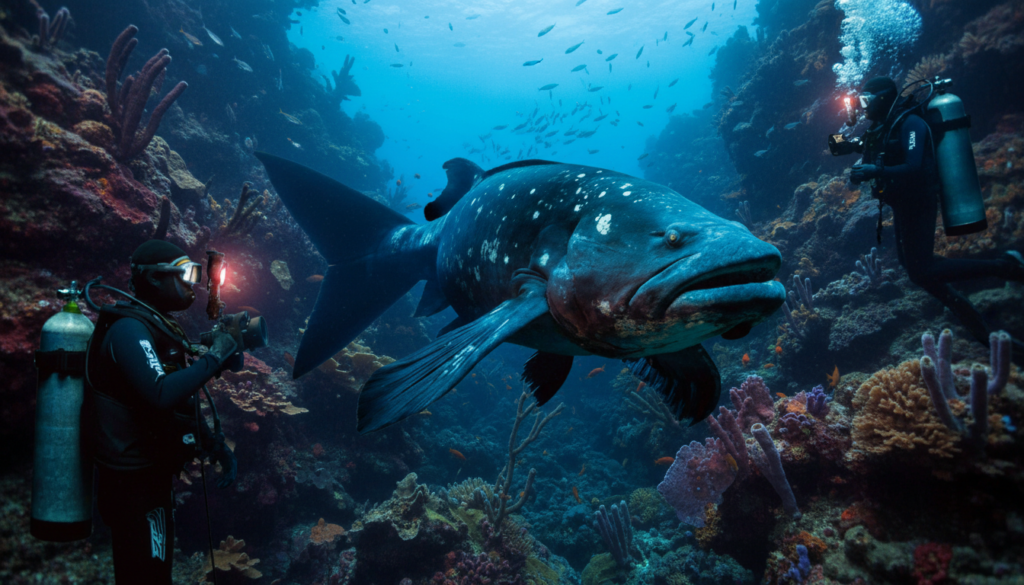
Large. Not a shark. Not a grouper. The shape is wrong. The three beams came together, and all of a sudden, the creature was there, filling the camera frame like a ghost. It had thick, lobe-finned limbs instead of the usual thin fins.
The French team had been diving in this area for days, following rumors from local fishermen. They were working with Indonesian guides who knew these canyons inside and out. Old men in the village talked about a fish with “hands,” a blue ghost that sometimes showed up dead in deep nets.
It wasn’t a story anymore. It was right in front of them, calmly beating its old tail. A real coelacanth, with its eyes shining in the light, stuck somewhere between a dinosaur and a fish.
For a long time, the coelacanth was almost like a myth. Textbooks said it had been extinct for 66 million years, so scientists were shocked when the first modern specimen was found off the coast of South Africa in 1938. Later, a different group of people was found in the Sulawesi Sea, which is in Indonesia.
But no one had ever taken clear, high-quality pictures of an Indonesian coelacanth in the wild. We learned a lot from dead animals that were pulled from places they were never meant to leave.
The French divers were using closed-circuit rebreathers, mixed gas, and low-light cameras that were made to work well in the dark. This wasn’t just another trip to dive. It was a small, dangerous trip that was set up to study the biology of a species that likes to live in cold, deep, quiet caves. *If they wanted to see deep time still swimming, they had to meet it on its own terms.*
How do you get to know a creature that doesn’t like the light?
Stay calm, quiet, and low were the simple but very hard rules to follow. Coelacanths are shy and only come out at night. During the day, they hide in caves and hover in the current. Big, loud bubbles or bright flashes? That’s a quick way to see nothing at all.
The French team changed every little thing. They dove at night or in the morning, hugged the rock walls, and let the current move them instead of kicking hard. The cameraman used guide lights with red filters and softer beams that wouldn’t blind the animal.
This wasn’t about running after someone. It was about being patient.
About becoming just another slow, drifting thing in a place where time moves in a different way.
We’ve all been there when waiting feels like crazy.
Day after day, the team went back to the same steep canyons, using sonar scans and stories from Indonesian captains who had seen strange blips on their fish finders. Some dives ended with nothing but a few small sharks and the dull pain of decompression stops.
A big grouper turned in the light, and its mottled sides looked like the coelacanth’s pattern for a short time. Hearts went up and then down. Another dive: one of the rebreathers signaled a problem at depth, which forced an early ascent. The team came up angry, their faces lined with that tired mix of fear and obsession.
To be honest, no one really does this every day unless they’re trying to catch something that’s caught their imagination. This wasn’t a dive for tourists. It was more like a stakeout.
The coelacanth didn’t freak out when it finally showed up. That could be the most strange part of the story.

The video shows the fish hovering almost still, with its thick, cobalt-blue body dotted with light spots. The lobe-fins move like slow, deliberate oars, making it look like the creature is walking in water. It opens and closes its mouth very slowly, and every breath is like a shrug at the chaos of the world above.
Later, scientists who watched the video pointed out things like how the tail fin bends, how the paired fins rotate, and how the fish stands in the current. This isn’t just a strange fish to evolutionary biologists. It’s a point of reference, a living chapter from a book we thought had burned.
For the divers, who were looking at it through masks that were fogged at the edges, one thought kept coming to mind: this thing has been here for millions of years without being seen. What else are we missing in the dark?
When the amazing things in the deep sea meet the fragile world we live in
This underwater epic has one useful lesson: being curious doesn’t mean you can be careless. The team had to find a way to document a rare species without putting it in danger by stressing it too much. That meant only short interactions, no chasing, no touching, and no heroic selfies.
They strictly limited how long they could stay at the bottom, followed conservative ascent profiles, and kept an eye on how close they were to drifting. The plan was to back off if the coelacanth showed any signs of being upset, even if it meant missing “the shot.”
One diver later said that he kept saying to himself, “Don’t turn a miracle into a problem.”
If you’re interested in this story and want to go on your own deep-sea adventures, there’s an uncomfortable truth: going deeper without training and help is not romantic; it’s dangerous. It takes years, not weeks, to get ready for technical diving at 100 to 150 meters. You need to turn down your body, mind, and ego, not up.
A common mistake is to think that having fun in the water means going really deep. No, it doesn’t. Gases act differently, narcosis hits harder, and small mistakes add up. Indonesian crews, safety divers, surface support, backup gas, and detailed weather checks all helped the French team.
They also valued what people in the area knew. Fishermen who had never read a scientific paper still knew roughly when and where the “hand-fish” might appear. It would have been easy for someone to ignore that advice out of pride.
One of the French divers told a local reporter afterward, “Down there, you feel very small.” “Not because of how deep it is, but because you know that this animal lived through things we only know about from fossils. The asteroid, the ice ages, and the deaths. And the one thing it can’t handle is us being careless in its world.
- Honor the depth
Technical diving is not just a weekend upgrade from recreational diving. It has its own rules, gear, and ways to fail, so it’s a whole other discipline. - Listen to stories from your area
Fishermen, guides, and coastal communities often have decades of observational knowledge that no database can give. - Film with care
Soft lights, short time limits, and no chasing behavior all help lower stress levels in deep, slow-moving animals like the coelacanth. - Consider what you can’t see
Not all of the strongest shots are the ones that are closest or brightest. The story is sometimes the distance that is polite. - Leave a small mark
Every choice you make at sea, from anchors to trash to noise, echoes in places you’ll never go.
A blue ghost from the past and the question it leaves us with
In just a few clicks, the pictures of that Indonesian coelacanth will be seen all over the world. People will watch them on the subway, while they’re waiting for an email, or while they’re half asleep in bed. There will be dance challenges and cat videos on the screen with a prehistoric fish that glows softly in the dark.
That makes me feel a little dizzy. From the first coelacanths dragging their lobe-fins along the ocean floor to a French cameraman floating in the night sky in Sulawesi, to you reading these words on a glass rectangle, there is a line. The timeline gets shorter. Past and present shake hands.
But it’s not just awe that stays. It’s a question.
What about the unknown species that don’t have a name, a lobby, or a camera crew? If this well-known species could still surprise us with first-ever pictures in 2026, what about the unknown ones? The coelacanth is strange in a way that makes it seem like a character in a play. Most creatures that live deep in the sea are not. They are small, fragile, and anonymous, floating through a world that we mostly see as a trash dump or a place to get things.
But they are all part of the same slow, stubborn flow of life that this “living fossil” represents so well.
This dive story might have a quiet power that makes it work. Not only does it add an amazing video to the internet, but it also makes us think about how big things are. Even in 4K, it reminds us that our maps still have a lot of empty spaces.
The French divers went down looking for a myth and came back with proof that some myths are just facts that need the right person to see them. The coelacanth went back to its cave, where it was dark, blue, and old.
Now that we know the past is still swimming in waters we barely understand, what do we do with that information?
| Key point | Detail | Value for the reader |
|---|---|---|
| Living fossil revealed | First clear footage of an Indonesian coelacanth filmed in its natural deep-water habitat by a French-Indonesian team | Offers a rare window into an animal thought extinct for millions of years |
| Delicate exploration | Night dives, rebreathers, soft lighting, and strict protocols to avoid stressing the animal | Shows how curiosity and ethical wildlife observation can coexist |
| Hidden oceans | Despite GPS, sonar, and HD cameras, much of the deep sea remains unmapped and unseen | Invites reflection on how little we truly know about the planet we live on |
Questions and Answers:
Question 1: What is a coelacanth, and why is it called a “living fossil”?
It is a big lobe-finned fish that lives in the deep sea. People thought it had been extinct since the time of the dinosaurs. The term “living fossil” comes from the fact that it looks a lot like fossils that are over 300 million years old and have changed very little.
Question 2: Where did the French divers film this coelacanth?
They worked with Indonesian crews in deep canyons off the coast of North Sulawesi, in Indonesian waters where a different coelacanth lineage, separate from the African species, has been found.
Question 3: How deep do coelacanths live?
They usually live at depths of 100 to 300 meters, where they spend the day in caves and come out at night to hover and eat in slightly shallower areas along steep underwater walls.
Question 4: Is it possible for recreational divers to see a coelacanth?
No. The depths, conditions, and equipment used are way too dangerous for fun. For things like this to happen, you need to be an expert diver, use advanced gas mixes, and have serious safety support.
Question 5: Is it dangerous to film them?
Yes, if done carelessly.