This sudden change has shocked farmers, city planners, and climate scientists all at once. After seven years of terrible drought, the skies finally opened up. This gave a thirsty nation hope, but it also raised difficult questions about what kind of climate Morocco is heading into.
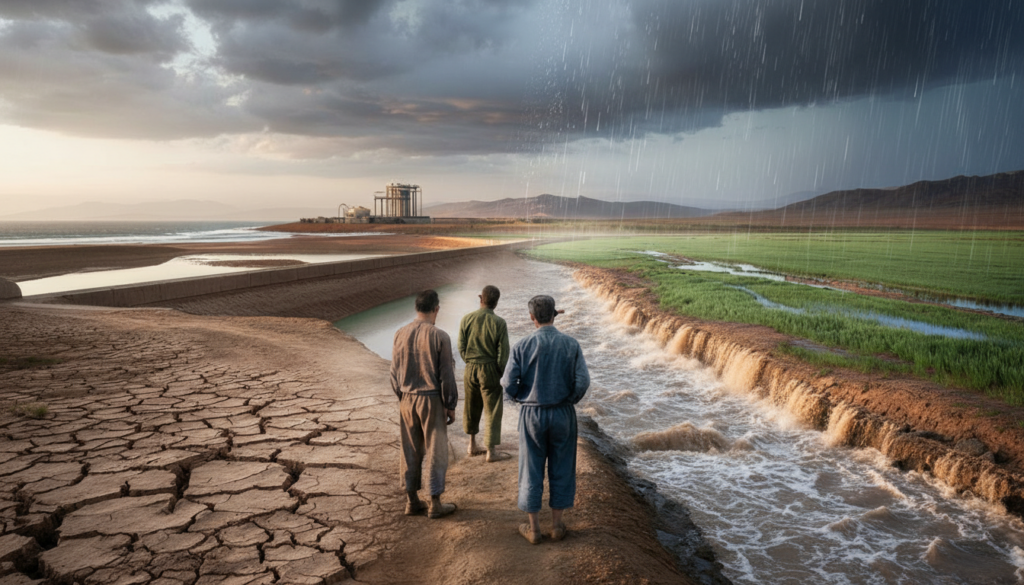
From a long drought to a sudden flood
Morocco has been under constant water stress for most of the past ten years. Fields in the Atlas foothills split open, reservoirs dropped to dangerous levels, and wells in rural areas ran dry.
Then, in 2025, winter came. The amount of rain that fell across the country rose by about 95% compared to the year before. That is not a small change. It is a structural shock to a country that was starting to get used to not having enough of anything.

Morocco has had almost twice as much rain in one season this year as it did last year, after seven years of drought.
The change in appearance is very noticeable. Dams that used to be signs of trouble are now said to be at about 46% of their normal capacity. Streams that had become dry channels are now flowing again. This winter felt like a collective exhale for a lot of Moroccans, especially those who live in the country.
A weak relief for farming
The agricultural sector, which makes up about 14% of Morocco’s GDP and supports millions of jobs, is the biggest winner right away.
The drought hit cereal farmers the hardest. Year after year, their harvests got smaller and seasonal workers left. This year’s rains change that, at least for a while.
At least for this season, the rise in rainfall has stopped the drop in cereal yields and slowed job losses in rural areas.
Farmers are planting with more confidence now that there is more water in dams and the soil is wet again at the surface. Some irrigation plans that had been cut back a lot have started up again. People are already expecting a better supply of domestic grains this year than in previous years.
But this relief is not very stable. The long-term water crisis that has been affecting Morocco since the 1990s is still going on. One wet winter doesn’t change three decades of structural hydrological stress.
Why does a warmer climate cause more rain?
Climate scientists say that global warming doesn’t cause regions to dry out or get wetter in a simple, straight line. It messes up the whole cycle of water.
The atmosphere can hold more water vapor as it gets warmer. When the weather is right for storms, that extra moisture is released in shorter, more violent bursts.
Warmer air over the Mediterranean and North Africa means that there are fewer rain events, but they are usually much stronger.
This means that Morocco will no longer have steady winter rains; instead, it will have heavy downpours. Rain that used to last for weeks can now happen in just a few days. One reason for the 95% jump is that it wasn’t a slow return to “normal.” Instead, it was a spike caused by a more chaotic climate.
When the land won’t drink, it’s called hydrophobic soil.
It’s not just how much rain falls that matters; it’s also what the land does with it. Moroccan soils have changed after seven years of extreme heat and drought.
Many topsoils are now hydrophobic, which means they don’t soak up water but instead push it away. Farmers say it’s like trying to water concrete.
Most of the new rain runs off hard ground and into rivers and then out to sea, instead of filling aquifers.
There are three big effects of this:
- Less water going back into the ground, which puts stress on aquifers even after a wet year.
- When strong storms hit hard land, the risk of flooding goes up.
- The next heatwave will make surface water go away faster.
Experts are worried that the impressive filling of dams may not last long. Under a hotter sky, open-air reservoirs now hold a lot of water. This makes them easy to lose water quickly during summer heat waves.
A state that is betting on desalination
Because of this uncertainty, Morocco has decided it can’t depend on the weather. The government is putting a lot of effort into desalinating seawater, with the goal of changing its whole water strategy by 2030.
The goal is to increase the amount of desalinated water in drinking water supplies from about 25% to 60% in the next five years.

Morocco wants the Atlantic Ocean to be the main source of water for cities, so it can use dams mostly for irrigation.
Morocco has done this before. It has been removing salt from seawater since the 1970s, first for certain coastal towns and industrial sites. The scale is different now: it has gone from being a helpful tool to being a key part of national water security.
What the water mix might look like in 2030
| Source | Role by 2030 (planned) |
|---|---|
| Desalinated seawater | Main source for urban drinking water |
| Dams and reservoirs | Priority use for irrigation and rural supply |
| Groundwater | Backup and local use, under pressure from over-pumping |
Authorities want to “sanctuarise” dam water for farms by sending desalinated water to big cities. This will protect both food production and city taps.
The high cost of making seawater into drinking water
Desalination costs money. It needs a lot of infrastructure, advanced technology, and energy.
New desalination plants will need a lot of power and will dump millions of cubic meters of brine into the ocean every year.
If not handled carefully, that brine, which is a concentrated salty waste, can harm marine ecosystems. Higher salinity near discharge points could harm seagrass, fish nurseries, and local fisheries that many coastal communities depend on.
Also, who pays is a question. In countries where access to water is very important, large-scale desalination projects often depend on public-private partnerships, long-term contracts, and complicated financing. This can make political tensions worse.
Political tensions over power and water
Politics and the water question are very closely linked. Prime Minister Aziz Akhannouch, who is also a billionaire businessman, is getting more and more criticism for what people see as conflicts of interest between public policy and private profit.
His opponents say that his government cares more about big companies and agribusinesses that export than it does about small farmers and families with low incomes. In that light, some people see a multibillion-dirham desalination push as both necessary and very suspicious.
Critics say that the risk is a water system where security looks better on paper, but fairness and openness don’t keep up.
How contracts are given out, how tariffs are set, and whether rural areas get as much benefit as cities on the coast that are growing quickly, like Casablanca, Agadir, or Tangier will all affect how much people trust the government.
Important climate and water terms that need to be explained
Two ideas are at the center of Morocco’s situation, and they are likely to come up more often as climate change speeds up.
The water cycle is speeding up: A warmer planet makes evaporation happen faster and the air can hold more moisture. That makes rain events stronger and more unpredictable, and it also makes droughts between those events more severe. Morocco’s 95% increase in rainfall after years of dryness is a perfect example.
Hydrological stress is when there is a long-term imbalance between the amount of water needed and the amount that is naturally available. This problem gets worse when rivers and aquifers are overused. If agriculture, cities, and industry keep using more than the system can reliably provide, the structural stress will still be there, even if it rains a lot.
How might Morocco’s next ten years go?
There are a number of possible scenarios that could happen, and they don’t rule each other out.
- Climate change is making things worse: More extreme swings between drought and heavy rain make it harder to manage water and force governments to rely even more on man-made solutions like desalination and transfers.
- Groundwater levels keep dropping: If pumping isn’t controlled, aquifers may keep dropping, even in wet years, leaving rural areas without water when surface water runs low.
- Tensions between cities and rural areas grow: As cities get desalinated water, farmers who can’t get to that water may feel left behind, which could make social and regional gaps bigger.
There are also chances. If solar and wind energy are used more and more to power desalination plants, which Morocco is already investing a lot of money in, the environmental footprint can get smaller. Treated wastewater, which is still not used enough, could help with irrigation and ease the strain on freshwater supplies.
A mixed strategy works best for families and farmers. This includes collecting rainwater, using drip systems for irrigation, growing crops that can grow in dry conditions, and better insulating city water networks to stop leaks. Each step seems small on its own, but when you put them all together, they can make every liter go further.
The 95% increase in rain has given Morocco some time, but not a permanent break. The real test will be if this time is used to build a water system that can handle the next shock, whether it comes as a hot drought, another heavy rain, or both in a short amount of time.