People first noticed the noise. Not the usual quiet of winter, but a low, steady roar coming from the mountains like a freight train going by. By late afternoon, the flags on Main Street were snapping sideways, the traffic lights were swaying on their cables, and the sky had turned a heavy, yellow-gray color that made even kids stop talking. There were carts blocking every aisle at the grocery store. People grabbed salt bags, water jugs, and batteries with the half-embarrassed urgency of people who aren’t sure if they’re overreacting or not.
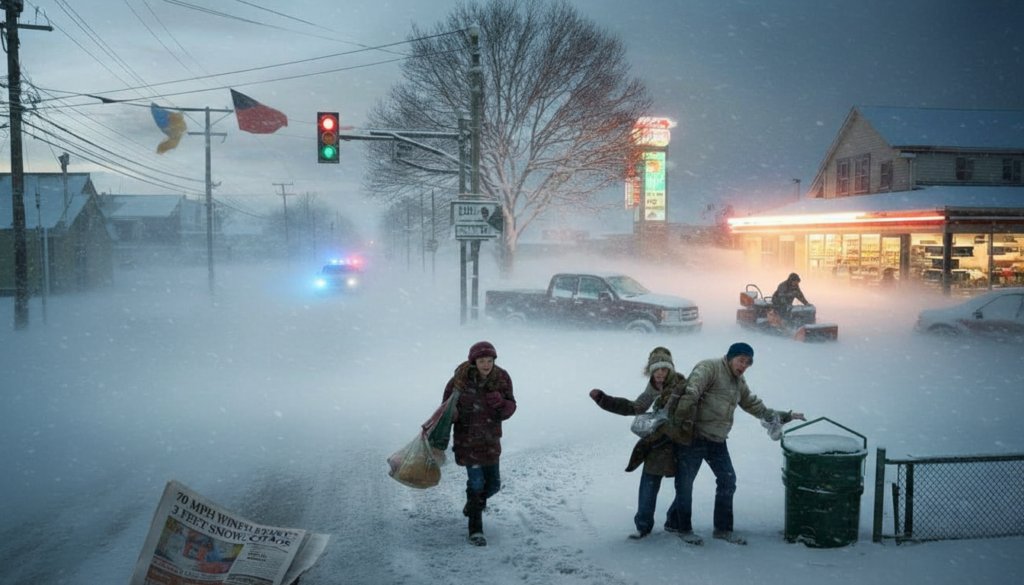
You could already hear the split-screen conversation on the sidewalk. One neighbor grumbled about “the big one” as she brought in patio furniture. Another person laughed and said, “This is just weather with better PR.” New alerts came in on phones: “Winter storm warning.” Wind gusts of 70 mph. *Up to 3 feet of snow in 24 hours.
Between the push alerts and the eye rolls, there was a quiet tension in town.
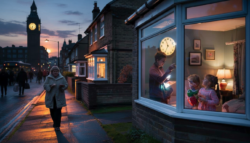
Is this a sign of chaos to come, or is it just another overhyped headline?
For this one, meteorologists are using language that isn’t very common. A quickly deepening low-pressure system is racing across the area, bringing in Arctic air and moisture in the perfect ugly mix that turns a “snow event” into something more like a shutdown. The numbers on paper are awful. Winds up to 70 mph. Visibility was whiteout for hours at a time. Drifts that could eat parked cars by morning.
For people who plan for emergencies, the snow total isn’t the only thing that stands out. It’s the wind and the time. Heavy bands are expected to hit overnight, when plows are stretched thin and most people are sleeping. If the models are right, there might not be a morning commute. People were just stuck in traffic, ramps were closed, and a lot of people were staring at their driveways in disbelief.
There are big red and purple maps in the operations center, phones that never stop ringing, and employees who thought they would be home with their families tonight are quietly unrolling sleeping bags under their desks.
The town’s only gas station on a hilltop became an unintentional storm barometer during the last big storm. At 9 p.m., the parking lot was a mess—pickup trucks were parked at the pumps, people were filling gas cans for generators, and it seemed like half the town remembered at the same time that their windshield wipers were broken.
Dana, the owner, watched the whole thing from behind the counter. People grabbed coffee and donuts like they were getting on a long flight. They stayed open all night, with lights shining through the sideways snow, making them a silent beacon on a dark highway. The power grid held up that long, but just barely. Afterward, the crews said that if a few more lines had gone down, parts of the county would have been without power for several days.
Dana has already made room for cots in one corner of the store this week. She has read this script before, but this time she says the wind scares her more than the snow.
The National Weather Service’s forecast talks sounded a lot like friends warning each other: travel could become “impossible,” visibility could drop to “near zero,” and power outages could be “widespread” with “long” restoration times. That’s very frank talk, especially when you think about how 70 mph gusts are hitting trees and infrastructure that are already under a lot of stress.
It’s true that storm skeptics aren’t wrong when they say that forecasts can be wrong. We’ve all been there when schools close because of a light dusting and a sunny afternoon. That sticks in people’s minds. They don’t remember the times when a two-degree temperature change or a small change in the track turned a disaster into an inconvenience.
This time, the gap between “overblown hype” and “historic storm” is annoyingly small. A 30-mile wobble in the storm’s path could mean the difference between three feet of snow and a nasty slush-fest. That thin margin is what keeps the people in charge up at night.
How to stay sane while riding out a 70 mph blizzard
Not all homes with a lot of gear are the most peaceful. They are the ones who don’t panic when it’s time to get ready for a storm. One firefighter in the area has a rule: they have to go through the house once every 20 minutes. That’s all. First, charge up all of your devices, like your phone, power bank, and laptop. Then, take out flashlights and a battery-powered radio and put them somewhere you can get to them in the dark, not in a drawer with old takeout menus.
Next, take care of the boring things that your future self will be grateful for. If you have an electric well pump, fill up a bathtub. Put the wrench next to the gas valve, not “somewhere in the basement.” Get the car out from under that one tree you’ve always meant to trim. None of this is cool. It’s just getting options for when the house goes quiet all of a sudden and you hear that unmistakable click of everything turning off.
This is when the human part comes into play. People either deny it or go into overdrive. Some people just shrug and say they’ll “deal with it when it happens,” but then they find themselves wrapping frozen meat in towels during a power outage and wishing they had planned ahead. Some people go the other way, though, making long lists, going to the store seven times, and scrolling through doom until 2 a.m.
Most of us are somewhere in the middle, trying not to feel stupid if the storm doesn’t happen after we’ve bought a lot of stuff. Let’s be honest: no one really does this every day. If you forgot to buy extra candles last month, you’re not failing at being an adult. Begin with small things. Think about 48 hours: food you don’t have to cook, medicine you can’t skip, and at least one room that can stay warm and lit even if everything else goes down.
Comparing your prep to a perfect checklist online is an emotional trap. Storms don’t give you grades. They just show where the weak spots are.
Local leaders are trying to find a balance between being urgent and being tired. They remember what happened after the last “bust,” when people made fun of empty schools and salted streets on social media. They are also looking at the wind forecasts and thinking about the old man on oxygen at the end of the cul-de-sac or the single mother whose car tires are already at the warning line.
One emergency manager said over the phone, “We’d rather be called overreacting than have to explain to a family why we didn’t warn them strongly enough.” His voice was flat from working too many 14-hour days in a row.
There is a quiet request behind those public briefings, and it has nothing to do with fear. It sounds more like: “Take care of your small group so we can deal with the real emergencies.” That could mean checking on the neighbor who always waves but doesn’t say much, or texting your group chat to say you have extra blankets if someone loses heat.
- If the power goes out, have a backup plan for staying warm.
- In every main room, there should be at least one light source.
- To save heat, make one room your “base camp.”
- Know who to call first if things go wrong.
- Know who might be depending on you without saying anything.
The real fights start when the snow stops.
In a few days, the story people tell about this storm will become more solid. If the models are right and three feet of snow hit the area with 70 mph winds, the headlines will write themselves: highways will be blocked, neighborhoods will be buried, and heroic rescues will happen in whiteout streets. The skeptics will stop talking for a while, and a new group of people will complain that the warnings came too late, weren’t loud enough, weren’t in the right language, or weren’t sent through the right channels.
The story changes if the storm goes north or dies out at the last minute. Pictures of driveways that are wet and half-melted and kids throwing slushballs will fill up timelines with captions like “This is the ‘historic’ storm? People will say that the government is trying to scare them, the media is just trying to get clicks, and meteorologists are just crying wolf. Next time there are warnings, a few more people will roll their eyes and not pay attention.
The real story will live quietly in the space between. In the neighbor who finally gave out their phone number “just in case.” In the grocery store cashier who stayed late so a worried customer could get formula. In the family that used a power outage to have a card game by candlelight. *Storms don’t just show us how our infrastructure works; they also show us how we act when the weather gets real and the windows start to shake.
| Key point | Detail | Value for the reader |
|---|---|---|
| Early warnings matter | 70 mph gusts and 3 feet of snow can overwhelm services quickly | Helps you decide to act before roads and power go down |
| Simple prep beats panic | Charging devices, backup light, 48 hours of basics | Reduces stress and keeps you functional if the storm hits hard |
| Community is a resource | Checking on neighbors, sharing supplies, trading contact info | Turns isolated households into a small safety net |
Questions and Answers:
Question 1: Is this storm really different from a “normal” winter storm?Forecasters say that the combination of heavy snow and 70 mph winds is what makes it dangerous. This is because it can turn a manageable snowfall into full whiteouts and widespread outages.
Question 2: Should I cancel my trip or just leave earlier?If you’re traveling during the busiest time, the safest thing to do is to wait; once visibility drops, “leaving early” won’t help much if plows and emergency crews can’t get to you.
Question 3: What do I need to have at home?Instead of thinking about the end of the world, think about short-term survival: water, food that doesn’t need to be cooked, medicines you need, flashlights with batteries, and a way to stay warm in one room.
Question 4: How can I tell if the weather report is being exaggerated?Look at a lot of different places, especially the detailed information from your local National Weather Service office. Pay attention to words like “life-threatening” and “impossible travel.” They don’t use those words very often.
Question 5: What should I do if I can’t afford to stock up?Focus on what you already have: fill containers with tap water, cook and store simple foods ahead of time, and talk to neighbors or local groups that might be able to share blankets, batteries, or a warm place to stay if the power goes out. You open the hotel bathroom door and it hits you right away.
That smell of a clean, neutral room, almost like it was just built. No strong scents. No fake pine. Just… new.
You look around. There is no spray bottle in sight. There is no blinking plug-in diffuser in the corner. There was nothing next to the towels.
You light candles and buy expensive air fresheners at home, but your bathroom still smells like something happened there five minutes ago.
What are hotels doing that we aren’t?
There’s a small system that works in the background.
You can’t unsee it once you see it.

What really goes on in a hotel bathroom
If you watch a housekeeper clean a hotel bathroom for five minutes, you’ll see why it smells so different from yours.
They don’t just walk in with a vanilla spray and hope for the best. They go after the smell where it comes from.
Open windows or vents first, even if it’s just for a little while. That quick change of air does more than any aerosol can.
After that, everything that can hold smell goes. Towels, bathmats, tissues, tiny soap slivers, and the shampoo bottle that you thought they might leave behind but didn’t.
The air feels lighter because the things that soak up smell don’t have time to stay.
When I asked a cleaner at a mid-range chain hotel what spray they used, they laughed.
“Spray?” She said, “If we need spray, something went wrong,” and then she stripped the room like a pit-stop mechanic.
She lifted the lid of the toilet, flushed it twice, wiped down all the surfaces, and then poured a small cup of hot water with disinfectant right into the bowl and down the sink.
There were no clouds of floral mist, just steam rising slowly. The room already smelled better, and not because of the scent.
Hotels don’t cover up smells; they reset them. That’s the secret rule.
Odor can be found in three places: fabrics, humidity, and hidden residue.
All three are handled by hotels.
Fabrics? They keep turning them. Bathmats, towels, and shower curtains don’t stay wet for long.
Is it humid? Strong fans, quick drying times, and doors left open while the room is cleaned.
Most of us skip the hidden residue part at home. Soap scum, hair stuck in drains, and that ring you can’t see under the toilet rim.
Even when you think everything “looks” clean, those tiny layers hold smells in. *Everything changes when you stop thinking of smells as a perfume problem and start thinking of them as a cleaning problem.*
Things you can do at home that hotels do
Want the look of a hotel bathroom without making your house a cleaning war zone? First, do what hotels do, not what they don’t do.
Before you do anything else, open the window or turn on the fan.
Next, take out everything that is wet or soft, like towels, bathmats, robes, and that shirt that is hanging on the door.
Then, for 30 seconds, run very hot water in the sink and bath. After that, dry them off.
The heat gets rid of smells that are stuck in the pipes, and the wipe keeps residue from building up.
You should only think about adding a smell after all that.
You probably won’t need as much as you think.
We’ve all been there when guests text, “We’re 10 minutes away!” and you run to the bathroom with the strongest spray you have.You run to the bathroom with the strongest spray you have.
For five minutes, the room smells like a fake garden. After that, it smells like whatever was there before.
The way to the hotel is slower, but better. They don’t leave wet towels lying around. They don’t let the lid on the toilet stay open to “air dry.”
They don’t leave the half-used bar of soap from yesterday slowly breaking down in the dish.
To be honest, no one really does this every day.
But if you borrow one or two of these habits a few times a week, your bathroom will go from “covered up” to really clean.
A head housekeeper in Lisbon told me, leaning on her cart, “People think we use some magic hotel perfume.”
“The real secret? No wet surfaces, clean drains, or leftover fabrics. The best smell is one that doesn’t smell at all.
Now translate that into a simple routine you can actually live with:
Instead of leaving puddles, dry the sink and shower right away after you use them.
You should hang towels so they are fully open, or you should change them more often than you think you should.
Once a week, pour a kettle of hot water down the drain in the shower.
Use a small brush just for the toilet rim, and use it quickly, not perfectly.
Last, add a light scent, like a drop of essential oil near the fan or a neutral bathroom cleaner.
The calm mind of a bathroom that smells good
When you walk into a hotel bathroom, you feel safe right away.
A clean, neutral smell tells your brain, “This place is safe.”
Our bathrooms at home tell the whole story of our day: mornings when we have to hurry, showers at night, bath time for the kids, and laundry drying on the radiator.
Odors build up like memories, and after a while, we stop noticing them.
People who come don’t.
Using some hotel tricks doesn’t mean you have to act like you live in a showroom.
It’s about making a small space where your senses don’t have to work as hard.
You could start by opening the window for three minutes after every shower or by switching to a lighter spray instead of that heavy, sweet one.
You might just decide to rotate your towels more often, like hotels do with theirs.
The interesting thing is that once your bathroom smells clean and not like perfume, you want to keep it that way.
And that small change in the room changes how you move around, how often you wipe things down, and how quickly you deal with that wet bathmat.
Fresh air stops being a surprise and starts to feel like your new normal.
Main point: Detail: Value for the reader
Start with the source, not the spray. Hotels take out wet fabrics, clean drains, and dry surfaces before adding any scent. This gets rid of bad smells instead of just covering them up.
Controlling moisture is key. Fans, windows, and quick drying keep smells from “sticking” to the room. This makes the bathroom smell better for longer with less work.
Small, repeatable habits beat deep cleans. Short, frequent actions like wiping and airing mimic hotel routines. This makes a hotel-level freshness possible in everyday life.
Questions and Answers:
Do hotels use air fresheners that are made for businesses?
Some high-end hotels use subtle diffusers in hallways or lobbies, but bathrooms usually don’t smell good because of strong perfumes. Instead, they rely on good cleaning, ventilation, and mild cleaning products.
Why doesn’t my bathroom smell clean even after I clean it?
Odors often linger in small amounts in drains, damp towels, shower curtains, and other places. The room can still smell “off” even if the surfaces look clean if those things aren’t taken care of.
Should you keep the bathroom door open or closed?
After taking a shower, open the door or window to let the steam out. You can close it again once everything is dry without letting moisture in.
How often should I change the towels to keep the hotel feel?
Hotels often change them every day. Every three to four uses at home is a good goal, or sooner if the towel stays wet or the bathroom doesn’t have good air flow.
What is one hotel tip I can use right away?
Pour very hot water down the sink and shower drain, wipe them dry, and then hang towels up all the way. It’s easy, quick, and you’ll notice a difference right away.