The first thing that hits you is the silence, not the cold. Niagara Falls is always roaring. You can feel the low thunder in your ribs long before you see the water. But at minus 55 degrees, the sound is hard to hear because of the ice walls and snow that are blowing around. Tourists move slowly along the railings, their faces covered with scarves and their phones held out with shaking hands, trying to get pictures of what their brains are still having trouble processing.
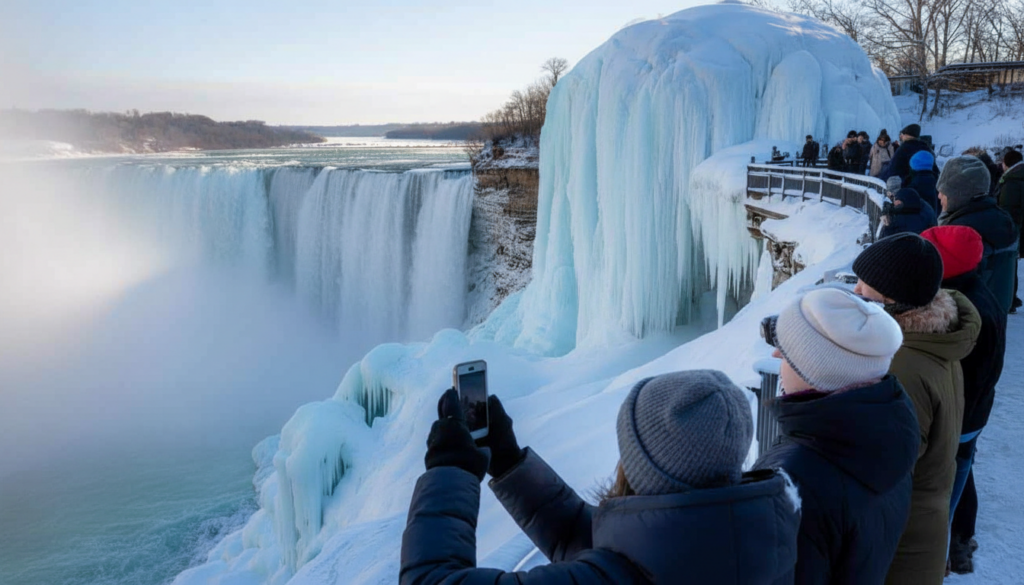
One of the strongest waterfalls on Earth looks almost like it’s stopped before you. There should be water, but instead there are huge blue-white columns, mist that has frozen in mid-air into sparkling crystals, and the American Falls look like they are stuck in a glassy shell. The water is still moving forward inside, hidden and unrelenting. You can almost touch it.
It feels like you’re in a documentary frame that forgot to unfreeze. But it’s right there.

When the water at Niagara Falls almost stops
On these cold winter days, the usual chaos at Niagara slows down. Buses still come, but people get off carefully, squinting through the steam from their own breath. The usual rush of people taking selfies and talking dies down as people look up and drop their jaws. Even the most cynical traveller usually stops talking for a few seconds.
The falls don’t freeze completely, like we see in films. The river is still rushing behind it in the dark, but a thick layer of ice is forming on top of it. All you can see from the railings is a white wall that sparkles and huge icicles that hang from the cliffs like crystal daggers. It looks both weak and strong at the same time.
Local guides say that this kind of deep freeze doesn’t happen very often, but when it does, it changes the whole atmosphere of the place. The wind hurts more. The mist turns into needles that get stuck in camera lenses and eyelashes. For a few days, Niagara changes from a bucket-list destination to something more primitive, rough, and almost prehistoric.
Families huddle together for warmth on the Canadian side, close to Table Rock, as they get closer to the railings. Kids pull on their parents’ sleeves, half excited and half scared of the big white drop. A teen tries to make a TikTok, but his phone dies in the middle of a sentence, so he laughs and puts it back in his pocket. The cold is so bad that batteries die, fingers go numb in minutes, and faces turn red like they’ve been slapped.
Ice bridges form like secret paths between rock faces beyond the crowd. They’re not official, and you can’t walk on them; they’re just nature making its own structures overnight. Old postcards from the 1800s show people walking on solid ice at Niagara. That doesn’t happen anymore, and it probably never will again, but the memory of it still lingers. You can tell when you see thick sheets of snow and ice piled up on the river.
The numbers that go with all of this are mind-boggling. When the flow is at its highest, about 3,160 tonnes of water flow over the falls every second. It takes very special conditions for that amount to look frozen. You need bitter cold, wind, and days of temperatures below zero to make the mist harden into ice and build up like winter armour. The landscape looks almost like the moon from a distance, but you know that a strong current is still pushing through just out of sight.
Scientists say that the water keeps moving under the frozen shell because the river is too strong to stop. The surface gets cold first. Mist rises, freezes right away, and then falls back down onto the rocks and cliffs that have been shaped. With each gust, another layer is added, and what starts out as a clear coating slowly turns into a solid crust. It looks like an icy mask over something that is very much alive.
People stare longer than they thought because of that difference. We often see snow on roofs, ice on windscreens, and maybe even a frozen pond. Standing in front of a waterfall that is only half-frozen and could power millions of homes is a whole new level. It’s a visual paradox: stillness and motion in the same frame. *You can almost hear the water rushing behind the quiet.
For people who live there, it serves as a reminder of how extreme the area can be. For tourists, it’s a once-in-a-lifetime picture that doesn’t need filters or clever captions. It’s just that I was there when Niagara Falls almost stopped.
How to see a frozen Niagara Falls without getting cold yourself
If you want to see this icy show up close, you need to know when to go. In the middle of winter, when Arctic air moves south and stays there, deep freezes usually happen. You look at the weather reports, not just for one cold day, but for a whole week. That’s when the ice has time to build up, cover everything in a layer of ice, and make the cliffs and railings look like something from a fantasy movie.
Dress like you’re going to be on a frozen planet. Two pairs of socks, real winter boots, thermal base layers, a face mask, and gloves that let you use your phone. People don’t realise how strong the wind is that blows off the gorge and sends icy mist straight into your bones. You might last ten minutes without the right gear, but with it, you can stay long enough to really look instead of just rushing back to the car to warm up.

One useful tip is to go into the visitor centers often, not just to warm up but also to let your eyes get used to the light. It can be jarring to go from a dark room to bright white ice. Your patience will also improve, and so will your photos.
It’s romantic to think about standing alone in front of a frozen Niagara, but in real life, it’s a lot more chaotic. Tour buses, kids crying because they’re cold, the sound of generators, and people laughing when the wind blows their hats off. You might be disappointed if you were hoping for quiet time to meditate. Instead, you get a shared experience, with dozens of strangers whispering “wow” to each other.
One of the biggest mistakes visitors make is not realising how quickly things can change. The fog can get thicker in a matter of minutes, making it harder to see, and paths can become slippery even if they were clear an hour ago. People lean too far over the rails to get a better shot. They go into closed-off areas to get that “unique angle.” Let’s face it: when the perfect picture is right in front of them, no one really thinks about safety signs.
If you go, do it for the memory, not the viral video. You’ll remember the pain in your cheeks, the quiet in the air, and how small you felt in front of something so big and old. A blurry picture that doesn’t do it justice is still good enough. The real story is in your body.
People who have seen this freeze-up dozens of times still come back with a sense of awe. A former guide from Niagara Falls, Ontario, says it best:
“People act like it’s the first time in history every time the falls almost freeze. I’ve been living here for 40 years. I still come down to the railings, and I still get chills.
You hear that and get why people put on a lot of clothes for a five-minute look. This isn’t just about the show; it’s about touching something that doesn’t care who’s watching.
A few reminders can make the visit less stressful and much more enjoyable for guests:
Get there early in the day when the light is softer and the crowds are smaller.
Keep your phone and batteries close to your body so they don’t die from the cold.
Take short breaks outside and then warm up inside.
First, look with your eyes, then take a picture.
Even if “everyone else” seems to ignore them, you should still pay attention to warning signs and barriers.
Every little thing you do protects not only your toes and fingers, but also the quiet, shared awe of the place.
The strange calm that comes from watching power slow down
You feel something you don’t always feel in everyday life when you stand at the edge of a nearly frozen Niagara Falls: scale. The cold takes away all the noise. Your phone hurts to hold, small talk dies in the air, and you’re left with this harsh, humbling fact of nature in front of you. If the temperature drops a little more, a waterfall that is known all over the world might stop for a moment.
That feeling of stillness is part of what makes it so interesting. We know that the water hasn’t stopped, it’s just been hidden. The turbines at the power plant keep going. The river keeps going past the ice shelves. Life goes on under the armour. It’s a quiet way of saying that a lot of things are moving even when we can’t see them.
We’ve all been there, when it feels like everything in our lives is stuck, but something is still moving forward. Seeing Niagara Falls in the winter gives you that feeling of being in a landscape. You can see the crust, the stillness, and the shapes that look like they will last forever. And you can also hear the roar, which is quiet but still very much alive. Sharing that sight, whether with strangers at the railing or later through a photo on someone’s screen, opens a small door to talk about how fragile things are, how powerful they are, and how quickly a familiar place can become strange. You leave with cold fingers, sore cheeks, and a story that you can’t quite put into words without saying, “You had to be there.”
| Key point | Detail | Value for the reader |
|---|---|---|
| Extreme cold reshapes Niagara Falls | At around minus 55 degrees, thick ice crusts over the falls while water still rushes beneath | Helps the reader visualize what “frozen” Niagara really looks like |
| Safety and comfort are non-negotiable | Layered clothing, warm breaks, and respect for barriers keep the visit enjoyable | Gives practical tools to experience the spectacle without turning it into an ordeal |
| Rare moments create lasting memories | Deep freezes don’t happen every winter and never fully stop the falls | Encourages readers to value the uniqueness of such events and share their stories |