Now, new observations with the James Webb Space Telescope are lifting that veil. They show how a hungry black hole in the middle of a nearby galaxy eats things around it and changes what scientists thought was going on there.
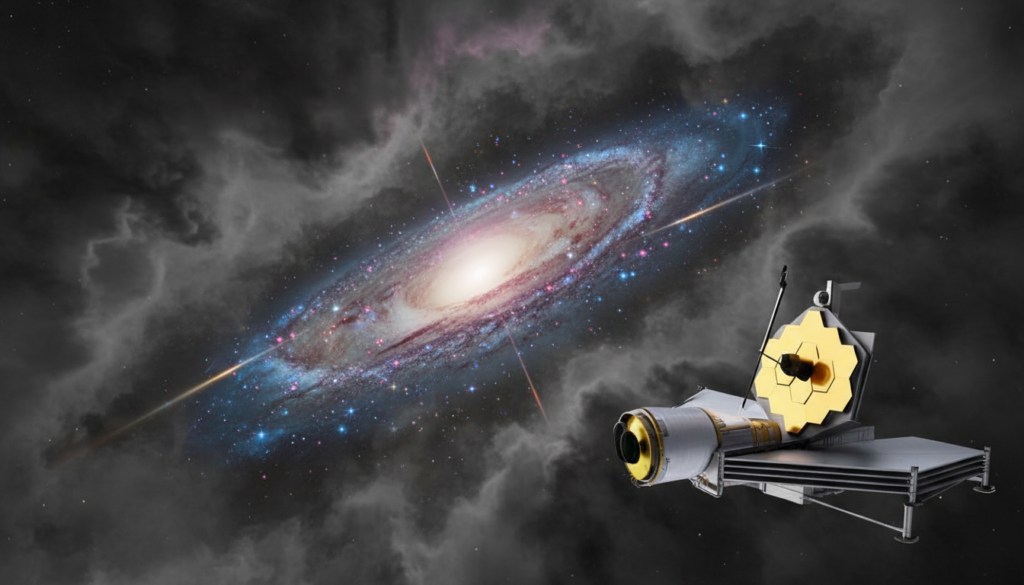
A galaxy that is very active but hard to see
The Circinus galaxy, which is about 13 million light-years from Earth, is the main galaxy in this work. It is also known as the Compass galaxy. That puts it in our larger neighborhood in terms of the universe.
Circinus has been hard to study from the ground, even though it is close by and bright. It is near the plane of the Milky Way, where gas, dust, and foreground stars block the view for telescopes on Earth.

Amateur astronomers can sometimes see it with simple tools, but professional teams have had a hard time figuring out what’s really going on around its bright, compact core.
There is a supermassive black hole at the very center of Circinus. It has a mass that is millions of times that of the Sun. That black hole gives energy to an active galactic nucleus, which is one of the most powerful things in the nearby Universe.
Circinus looks like a messy knot of light from Earth. It’s bright, dusty, and chaotic, and its central engine is mostly hidden from view.
James Webb’s clear view
The James Webb Space Telescope (JWST) was made to do things like this. It orbits 1.5 million kilometers from Earth. It uses instruments that are sensitive to infrared light, which can get through dusty clouds that block visible light.
JWST has taken some of the clearest pictures of Circinus yet thanks to this advantage. The new study, which came out in Nature Communications, uses Webb to figure out where the infrared radiation coming from the galaxy’s core really comes from.
Previous observations with the Hubble Space Telescope had already shown a strong infrared glow close to the center. A lot of astronomers thought that a lot of that emission could be matter that was heated to very high temperatures and then pushed out by the black hole.
The picture isn’t complete, though.
An unexpected feeding frenzy, not a big blowout.
JWST has used its sensitivity and interferometric techniques to separate structures in Circinus that were previously blurred together. It used to look like one glowing spot, but now it is made up of separate parts.
Webb’s measurements show that about 87% of the infrared radiation comes from a thick, dusty cloud that surrounds the black hole. This cloud feeds the black hole instead of being thrown away.
This cloud of dust and gas makes a donut-shaped torus that goes around the black hole. Material slowly spirals inward, forming what astronomers call an accretion disk. This is a hot, swirling disk of matter that slowly drains into the black hole, like water circling a plughole.
It looks like only about 1% of the infrared light is connected to material actually being thrown out of the center. That goes against what people thought before: that strong outflows were the main source of emission near the black hole.
The last 12% of the radiation seems to come from areas of the galaxy that are farther away and were not seen in earlier datasets.
What the new numbers mean
87% of the infrared light comes from the dusty torus that surrounds and feeds the black hole.
1%: because of gas being pushed out by activity near the black hole
12%: from structures in the galaxy that are farther away and are only now becoming clear
The center of Circinus now has a much cleaner energy budget thanks to this breakdown. Instead of mostly being a cosmic flamethrower that throws out hot gas, the black hole seems to spend most of its time quietly eating the material that surrounds it.

How Webb kept from being “blinded”
One of the problems with studying active galactic nuclei is that the middle part is very bright. Hot dust, gas, and stars nearby can make detectors too bright and blur fine details.
JWST used a special interferometric mode on an instrument called NIRISS (Near-Infrared Imager and Slitless Spectrograph) to make this observation. In short, this setup lets the telescope block or cancel out some parts of the light so that the detectors don’t get too much light.
NIRISS worked like a finely tuned filter, letting scientists see the bright central glare and the fainter surrounding structures with more clarity than ever before.
Interferometry is common in radio astronomy, but using a similar method with a space telescope at infrared wavelengths is a big step forward in technology. James Webb has never studied a source outside the Milky Way in this way before.
The success with Circinus suggests that the same method could be used on other nearby galaxies with active black holes, which would be a new way to observe galaxies outside of our own.
Why astronomers are interested in dusty donuts
A ring of dust around a black hole might not seem like a big deal at first. For scientists who want to know how galaxies grow and change over billions of years, it’s anything but.
The ring of dust and gas around the black hole controls how much matter gets to it and how much radiation gets out into the galaxy. That radiation can change the temperature and movement of nearby gas, which affects where and when new stars can form.
This type of torus has been a part of models of active galaxies for a long time, but it has been hard to get direct, detailed observations. Circinus is now an important test case that helps theorists improve their simulations of how galaxies change over time.
The most important words behind the news
Some of the technical language used to talk about these things may sound strange, but it points to very real processes:
A light-year is the distance that light travels in one year, which is about 9.46 trillion kilometers. Circinus is 13 million of these away.
Infrared light has longer wavelengths than visible red light. It’s great for looking through dust that blocks normal starlight.
An accretion disk is a flat, rotating disk of gas and dust that slowly spirals into a huge object, like a black hole.
The torus is the thick, donut-shaped ring of material that surrounds the accretion disk. It is full of dust that glows in infrared light.
What this means for future research on black holes
These results suggest a future in which Webb methodically charts the dusty formations surrounding black holes in numerous galaxies. Researchers can find patterns across different types of galaxies by looking at how much they feed, how much they flare, and how their dust is arranged.
There are also useful side effects. Knowing how dust acts in areas with very high radiation can help improve models used in many areas of astrophysics, such as the early Universe, when young galaxies were full of gas and dust.
Circinus is a real-life example of how tools like JWST turn blurry cosmic smudges into clear, physical stories for people who are interested in space science from home. A galaxy that used to look like a bright blur now looks like a busy system, with a central black hole quietly changing its surroundings from behind a dusty curtain.