The leaders of the kingdom are rethinking one of their most ambitious goals. They are turning a project that was once pitched as a city with no roads and a 100-mile-long road into something more realistic, based on cash flow and deadlines.
From a sci-fi fantasy to a new budget plan
Reports say that Saudi Arabia is going to cut back on Neom, the huge “city of the future” project on the Red Sea, by a lot. This is because high-ranking officials were worried about rising costs and delays.
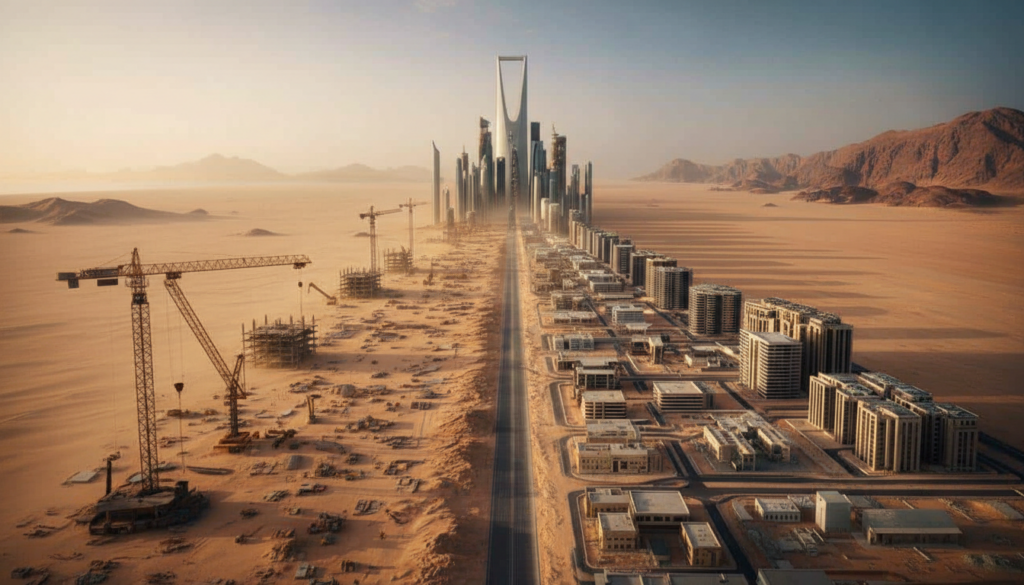
At the center of Neom was The Line, a proposed 200-kilometer (about 100-mile) strip of mirrored skyscrapers that would rise 500 meters (1,640 feet) above the desert. It was marketed as a new way to live in cities. The project was a key part of crown prince Mohammed bin Salman’s Vision 2030 plan to move the economy away from oil.

That vision needs a big rewrite now. Late last year, construction on The Line was quietly put on hold while Riyadh looked for a cheaper, slower, and possibly more realistic way to move forward. People who know about the talks say that the crown prince now supports a “much smaller” version of the project.
Officials say that about $50 billion has already been spent on Neom, while the original cost of The Line alone was $500 billion.
At a well-known investment forum in Riyadh in November, a Saudi official said that the spending spree had gone too far, too quickly: “We rushed at 100 miles an hour.” We are now in the red. We need to change our priorities.
What The Line was meant to be
People said that The Line was a complete break from how cities are usually planned. In marketing videos, a narrow, shimmering canyon of mirrored towers rose out of the sand and ran straight from the coast to the desert interior.
There are no roads or private cars, and people get around the city on high-speed public transport.
There is room for about 9 million people in a narrow corridor.
All of the power comes from renewable sources, like wind and solar.
About 95 percent of the land around it is set aside for nature.
Saudi officials said the project was a model for a future civilisation that would be dense, green, powered by clean energy, and have AI. Images of floating helipads, layered public parks and vertical farming pods spread quickly on social media, making The Line as much a social media phenomenon as a development plan.
The Line was marketed as a high-tech, zero-emissions urban revolution, but the cost and speed needed to reach the 2030 goal have become politically and financially toxic.
Engineers, city planners, and environmentalists from all over the world tore the idea apart, asking about the construction schedule, the environmental effects, and whether people would really want to live in a glass wall in the desert.
Worries about oil prices and costs
The issue in real life is the money. Saudi Arabia has paid for a lot of big projects in the past few years, like new industrial zones and coastal resorts. They have also made big sports and entertainment deals to change the country’s image.
Those costs have run into problems because oil revenues are uneven and global growth is slowing. The kingdom has started to run budget deficits again because it still depends on crude oil exports. That has made discussions within the company more heated about what can actually be built by 2030 and what needs to be put on hold or cut back.
People who know about Neom say that the project’s internal budgets have gone over and over again because contractors have had trouble with the huge size of The Line’s foundations, infrastructure, and support systems. Higher interest rates and rising construction costs around the world have made things even harder.
Officials admit that the state can’t keep giving blank checks for every new idea that comes up, even if they look great on paper.
From megacity to data center?
As the original urban vision fades, it seems that people in the project are starting to pay attention to other things. Reports say that Neom is now being rebranded as a regional center for data centers and AI research. This is part of the crown prince’s efforts to make Saudi Arabia a leader in AI.
That change fits in perfectly with the government’s larger efforts to attract cloud computing providers and tech companies from around the world. Neom is a good place for big server farms and AI training centers because it has a lot of empty land, cheap energy, and the promise of government support.
A source close to the project told UK media that it is still unclear if The Line will be cut down or put on hold completely. There may be more important smaller, more typical urban clusters within Neom than one long 200-kilometer structure.
The only part that really opened
Neom may be in the news a lot, but in real life, it’s still not very big. Only one piece is up and running so far: Sindalah, a high-end resort for yachting and tourism in the Red Sea.

In October 2024, Sindalah finally had its “grand opening.” This was three years later than planned and cost about three times as much as planned. Will Smith and Alicia Keys reportedly performed at the launch party, which shows how much the kingdom loves big-name entertainment
| Neom element | Original idea | Current status |
|---|---|---|
| The Line | 200km car-free megacity for 9m residents | Construction paused, likely to be downsized |
| Sindalah resort | Luxury island, yachting and tourism hub | Opened in 2024 after delays and cost overruns |
| Data and AI hub | Support role within a broader smart city | Emerging as a primary focus for Neom |
The fanfare didn’t go over well in Riyadh. Crown Prince Mohammed was upset about the extra costs and delays, so he fired Neom’s long-time CEO, Nadhmi al-Nasr.
Neom partOriginal thoughtStatus right now
The Line: a 200-kilometer-long megacity with no cars for 9 million peopleThe construction stopped, and it will probably be smaller.
Sindalah hotelA luxury island, a place for yachting, and a place for touristsIt opened in 2024 after delays and costs that went over budget.
Data and AI centerA support role in a bigger smart cityBecoming a major focus for Neom
Conflict between ambition and what is possible
Neom is a symbol of a bigger conflict in Saudi Arabia’s economic change. Vision 2030 needs big, eye-catching plans that will draw in both young talent and foreign investors from both the region and around the world. At the same time, the state needs to make sure it doesn’t use up its reserves faster than it can build new industries.
Neom and Saudi Arabia’s urban experimentation will not end if The Line is cut back. But it does mean that projects will be smaller and more focused on making money.
Investors in London, New York, and Dubai will see the move as a sign that the kingdom is willing to cut back on or delay its biggest projects if they put the country’s overall financial stability at risk. That can boost long-term confidence, even if it hurts the idea that Saudi Arabia has endless money.
What “scaling back” could look like in real life
Urban planners who have looked at Neom’s early construction say that a smaller version Line could mean a lot of different things:
Instead of building the full 200km stretch of The Line, they are only going to develop a few key parts of it.
Cutting the number of people who are supposed to be targeted down from 9 million to a smaller, easier-to-handle number.
Taking decades to build instead of rushing to show off in 2030.
Cutting infrastructure costs by allowing more traditional modes of transport to work with high-speed transit.
Each option takes away from the original marketing pitch, but it also makes things easier for the state and contractors.
Important ideas behind projects like Neom
Neom was sold as a mix of a smart city, a way to fight climate change, and a place to visit. There are a few words that are worth breaking down because they will keep coming up in similar projects around the world:
Smart city: This term describes cities that use networks of sensors and data systems to keep track of traffic, energy use, and public services in real time. If done right, it can lower pollution and traffic. If done wrong, it could make people worry about being watched and force them to use proprietary technologies.
Planning without cars: The idea of getting rid of private cars in city centers is getting more popular in Europe and Asia. It usually depends on neighbourhoods that are easy to walk around, reliable public transportation, and a lot of housing. Making that model into a straight desert city brings up much harder engineering and social issues.
AI hub: Governments in the Gulf are competing to attract AI companies and data centers. These places need a lot of electricity and cooling, which desert locations can provide with cheap solar power. However, there is still debate about how bad large data farms are for the environment.
Risks and chances in the future
Saudi Arabia’s reputation could suffer if Neom is scaled back. Some people might say that this is proof that the kingdom’s “giga-project” era has gone too far. Environmental groups are already worried that half-finished buildings and abandoned infrastructure will hurt delicate desert and coastal ecosystems.
There is also a political side to it. The crown prince’s personal brand has become linked to Vision 2030. To change such a high-profile project, Neom needs to be carefully marketed at home as a symbol of national pride and modernity.
A slimmer Neom that focuses on realistic economic anchors like logistics, advanced manufacturing, and AI infrastructure could also be a good example of how to fix things. If Riyadh can turn a big, overly ambitious plan into a smaller group of commercially viable zones, it may still be able to reach part of its original goal: a growth engine on the Red Sea coast after oil.
Right now, cranes and construction workers in the desert are slowing down, not stopping. The question is no longer whether Saudi Arabia can build a megacity in the desert that is 100 miles long. Instead, it is whether it should and what a smaller version can still do for a kingdom that is trying to change its future.