The light on Seaside Avenue broke at 2:17 p.m. The shadows grew longer, the gulls stopped making noise, and the Atlantic Ocean in front of the pastel beach houses changed from blue to a flat, metallic ink. Neighbours came out with paper cups and half-finished coffees and stared at the sky like people waiting for bad news they couldn’t name.
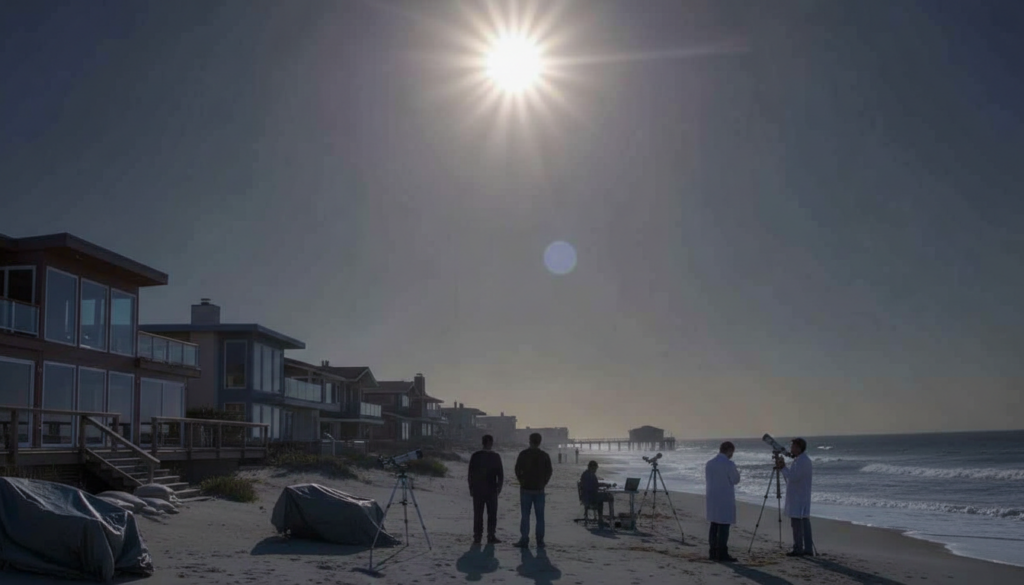
A couple from Boston didn’t say “wow” or “beautiful” while standing on the deck of a cedar-shingled home worth more than $2 million. They whispered about flood maps, insurance letters, and whether six minutes of darkness could be the next thing that scares buyers.
Scientists along the coast were recording every second of the eclipse with military precision. Most of them felt the same quiet anger.

We still look at the sky like tourists, not like people whose lives depend on it.
When the sun goes down and your Zillow estimate goes down
For people who are in the path of totality, a solar eclipse is like a small end of the world. The wind dies down, colours go wrong, and light bleeds away to the side. On barrier islands and low-lying coasts, that strangeness hits a community that is already dealing with another slow-moving darkness: rising seas and storms that change.
Local agents say that during eclipse week, they saw something they had only half-admitted along parts of the East Coast. People who can afford “dream beach houses” are now looking at flood maps between pictures of the eclipse. Those six minutes made them think of storm surges going up stairs instead of just moon shadows crossing the sun.
The sky suddenly seemed less like a backdrop and more like a danger.
Agent Maria Delgado had set up three showings for a newly built, four-bedroom home on pilings in Surf City, North Carolina. It had wraparound decks, stainless steel everything, and a view that real estate agents call “forever oceanfront.” When the eclipse happened, people in the cul-de-sac set up folding chairs and kids put on cardboard glasses.
One couple from Raleigh was very quiet. They saw the horizon get dark, looked back at the narrow evacuation road, and then pulled out their phones. Not for pictures. For the latest NOAA sea-level projection and the FEMA flood map. When the light came back on, they had gone from “We love it” to “We might wait a few years.”
Six minutes of cosmic drama did what months of climate reports couldn’t: it broke the spell.
Scientists who study the coast say that reaction is the right one. An eclipse doesn’t change the risk to your property, but it makes you feel like the sky isn’t fixed. The same forces that make the moon’s shadow move also make tides, storms, and the slow, steady rise of sea level.
The truth is that it’s not easy for homeowners. Your home’s value is now based on more than just school districts and countertop materials. It also depends on orbital mechanics, ocean heat content, and whether or not future buyers trust the sky above your ZIP code.
Stories are just as important as numbers in real estate markets. When the story changes from “eternal summer” to “fragile edge of the continent,” lenders, insurers, and buyers all quietly change the prices of everything.
What coastal owners can really do, from awe to action
There is a small, almost boring habit that sets apart the coastal owners who sleep at night from those who doomscroll during every storm: they keep a “sky and sea” file on their home. It’s not magic. There are three things in one folder, whether it’s digital or paper.

First, a printout of your area’s flood zone and elevation, along with the worst-case surge projections. Second, your complete insurance policies with the exclusions highlighted. Third, a one-page plan for what you would do if your house was unlivable for three months.
Most people took pictures with their phones on eclipse day. The few people who went inside and put new notes in that folder will be less surprised when the next insurance renewal comes.
A lot of people who own property on the coast have a secret deal with the sky: “Don’t change too quickly, and I won’t think too hard.” Then, in the middle of the day, the sun goes away, and that emotional truce breaks down.
This is the time when small, clear-headed actions are more important than big ones. The next morning, walk around your property and look at it like a careful buyer. Where does water already collect after it rains? What do you have in the ground-level areas that would hurt the most to lose? If the main road floods, which exits will work?
To be honest, no one really does this every day. But once or twice a year, like during an eclipse or hurricane season, it can change your vague fear into specific tasks that you can do.
The scientists I talked to keep saying the same thing: we don’t need more data, we need to pay more attention.
Rebecca Hall, a coastal climatologist, told me, “People will travel eight hours to stand under a shadow, but they won’t spend twenty minutes reading the tide gauge that decides their mortgage risk.”
That sentence is the plain truth, and it hurts a little, especially if you own a home that is one storm away from the waterline.
Coastal owners keep this short list taped up in a kitchen cabinet:
Every two years, not just once in a lifetime, check your flood maps and elevation.
Take pictures of the inside and outside of your home before the storm season to record its condition.
Ask your insurance company this uncomfortable question: “What exact situation will leave me with nothing?”
Don’t just sign up for national weather forecasts; also sign up for local tide, surge, and weather alerts.
Talk to your family out loud about when you would rather walk away than rebuild.
Why the sky always wins the argument
You can feel it if you stand on any coastal boardwalk the night after a total eclipse. People talk louder, bars are busier, and kids wave glow sticks at a sky that still seems a little shaky. The big event is over, but something still feels off: the ceiling of your world seems to have moved a little closer.
That feeling can be good or bad for homeowners. It can freeze you in place and make you scroll through the worst-case maps until 2 a.m. Or it can push you to have a more grown-up, quiet relationship with where you live. That could mean getting shutters instead of a new outdoor sofa set. It could mean selling sooner than you planned, while the market still believes in “forever oceanfront.”
| Key point | Detail | Value for the reader |
|---|---|---|
| Sky events change behavior | Eclipses and storms trigger emotional shifts that influence buying and selling decisions | Helps you time moves and conversations about your coastal property |
| Risk lives in fine print | Elevation, flood zones, and exclusions decide if your asset survives a bad decade | Gives you a practical checklist to protect value, not just the building |
| Attention is your real defense | Following local data and planning now reduces panic when the next “sky shock” hits | Replaces vague fear with specific, manageable actions |