The woman in front of the mirror at the salon doesn’t seem sad. I’m just tired. For the third time in two months, she’s putting dark dye on her roots. While she waits for it to set, she’s looking at pictures on her phone. Her 22-year-old self smiles on the screen. She has a messy ponytail and no gray hair. Her current self wonders why this ritual has started to feel like a costume fitting while sitting in the chair.
When the hairdresser says, almost offhandedly, “You know…you could stop coloring and still look younger,” she laughs and then stops.
That idea sounds scary and strangely freeing at the same time.
Why classic hair dye is becoming less popular
You can see it on any street in a big city: gray hair is no longer a rare, rebellious statement. It’s becoming a quiet, elegant norm. Not the harsh, yellowish gray of neglect, but soft, glowing colors that look planned, modern, and yes, surprisingly young.
Dyeing every white strand in opaque dye is starting to feel a little old-fashioned. The heavy roots, flat color, and “helmet” effect make the face look older than a few silver streaks ever could. More and more colorists are saying the same thing these days: hiding gray isn’t the key to looking younger. It’s mixing it.
A colorist in Paris told me that she now sees clients in their late 30s who already feel stuck in their dye schedule. One of them, who was 39, had been hiding a white streak on her temple for years. Every three weeks, without fail. When she missed an appointment because of a work trip, her regrowth line was so clear that her coworkers thought she was sick.
That night in her hotel room, she got sucked into a TikTok rabbit hole and found a whole new wave of “gray blending” changes. There are no harsh lines or painful “grow-out” phases, just soft changes. A few months later, she still looked young. Her face really did look lighter. People began to wonder if she had changed how she took care of her skin. She had just changed her plan.
It’s easy to understand: solid, single-color hair goes against what your hair naturally wants to do. As soon as your roots grow, the fight becomes clear, and the line of contrast draws the eye right to it. That line makes you look much older than the grays do.
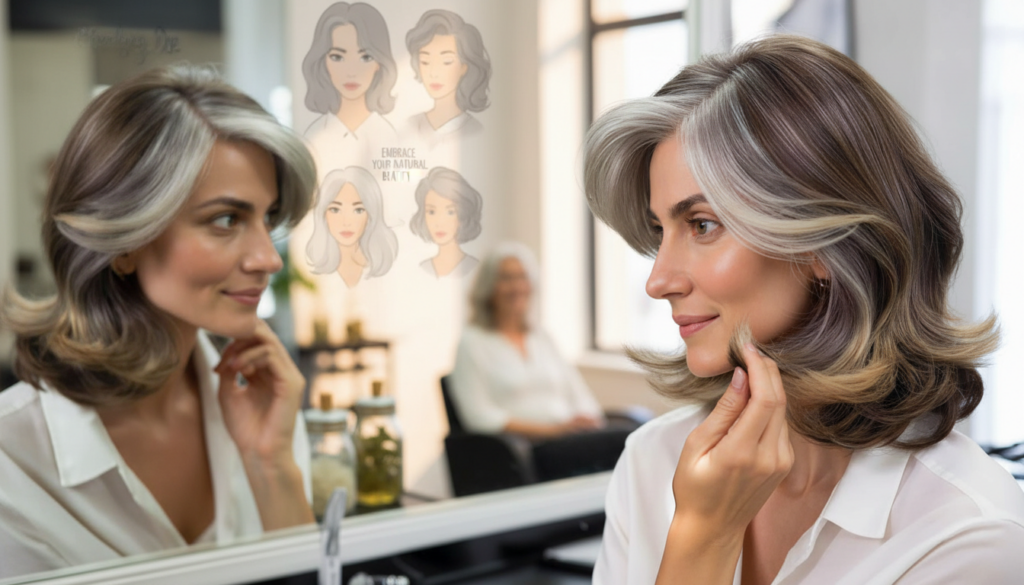
Blending techniques, such as highlights, lowlights, and strategic glosses, break down that barrier. If the sun had all the time and patience in the world, it would do this to your hair. The result isn’t “you ten years ago,” but “you now,” with more depth, softness, and less stress. That small change in how you look at yourself changes everything about your relationship with your reflection.
The new trend is to mix gray instead of covering it up completely.
Gray blending begins with a moment of truth in the mirror. Not “how do I get rid of this?“”Where does the gray actually help my face?” A good colorist will look at where your white hairs are grouped together: at the parting, around the temples, and in the fringe. Then they make a plan that works with the map instead of against it.
There are small, fine highlights throughout the darker areas that meet the grays halfway. To keep the structure and contrast, a few strands that are a little deeper are added near the face. A translucent toner brings everything together by cooling down yellowish tones and warming up dull, flat ones. When you leave the salon, your gray hair is still there, but it’s hidden in a cloud of similar colors.
A lot of people make the mistake of going straight from full dye to “I’ll just let it grow out.” That phase is the one that seems messy, patchy, and, to be honest, tiring. You see the line every day, like a countdown that you didn’t choose. It’s no surprise that so many people give up halfway and go back to their usual color.
We’ve all been there, when the regrowth seems to scream “I’ve lost control” louder than any wrinkle ever did. Gray blending gives you a middle path instead of going cold turkey. Your color changes every three to four months, not every three weeks. It feels less like a breakup with dye and more like a slow, friendly separation.
This is when your mindset is as important as your technique. To be honest, no one really does this every day. Miracle serums, deep hair masks, and scalp massages sit on bathroom shelves collecting dust. Finding one or two habits that you actually stick to is what makes the difference. Once a week, use a soft purple shampoo to make the brassiness go away. Put a light oil on the ends to keep them shiny. That much gray makes it look like it was done on purpose, not by accident.

Laura, 52, who switched to blending after two decades of full dye, says, “My gray hair made me look older when it looked dry and uneven, not when it looked silver and glossy.” “People didn’t notice the exact moment I stopped coloring. They just started saying I looked “rested.”
When you talk to your colorist, use the phrase “gray blending” instead of “going gray.”
Bring pictures of hair with soft transitions, not hair that is all silver, unless that’s what you want.
If you’re nervous, make small changes at first. Next time, you can always go lighter.
Gray reflects more light but is also more fragile, so keep your new tone out of the sun and heat.
Wait at least six months before you decide what you think of the result. Your eyes need time to get used to your real colors.
Gray can make you look younger, but it’s not about hiding it.
When gray blends in with the hair, something interesting happens
the face becomes the main focus again. Dark, flat dyes can make your features look heavier, especially if your skin tone has changed over time. When the hair lightens, the harsh contrast reduces. Fine lines around the eyes and mouth seem less carved, more diffused.
Many women describe a strange relief. They feel more aligned with the person they see in selfies, less like they’re “keeping up” a version of themselves that exists only in their heads. The right gray, customized and luminous, stops being a sign of decline. It becomes a texture, a light, an accessory. Almost like a well-chosen pair of glasses.
This doesn’t mean dropping all color forever. Some of the most flattering looks today are hybrid. A pearl-gray base with warm beige lowlights. Natural white around the temples with a soft, beige-blond halo at the crown. A salt-and-pepper bob with a slightly darker nape for depth. Small, thoughtful tweaks that sharpen cheekbones or bring warmth back to the complexion.
The real shift lies in intention. You’re no longer desperately chasing the shade you had at 25. You’re editing what you have now so that your features, your style, your clothes, and your hair all tell the same story. Not “I don’t age,” but “I age on purpose.” That nuance is subtle on the outside, huge on the inside.
The most powerful part of this trend is social, not technical. The more we see gray-blended hair in meetings, on dates, on Instagram, the more it stops being a headline in itself. It becomes just another option on the menu. You can still love your deep chestnut dye or your copper red. You can also decide that your white streak is your new signature.
There’s a quiet revolution in giving yourself that choice back. Not being ruled by the calendar of your roots. Not planning holidays around your next color appointment. Not panicking at every new silver hair in the bathroom mirror.
Your hair stops being a battle. It becomes a conversation.
Key point Detail Value for the reader
Gray blending over full coverage Uses highlights, lowlights, and toners to merge gray with your base color instead of hiding it Lowers maintenance, softens regrowth lines, and creates a younger, more natural look
Transition in stages Move gradually from solid dye to blended tones over several months Reduces the “awkward phase” and the fear of looking neglected during the change
Care and mindset Simple routine (shine, tone, protection) plus a shift in how you see your gray Helps gray look intentional and elegant, boosting self-confidence instead of anxiety
FAQ:
Question 1Can I try gray blending if I’ve dyed my hair dark for years?Yes, but it usually takes several appointments. Your colorist will first soften the dark base, then add lighter strands and toners to approach your natural gray pattern without shocking contrast.
Question 2Will gray hair always make me look older?Not necessarily. Flat, dull gray can add years, but a luminous, blended gray often looks fresher than a harsh, opaque dye. The key is shine, movement, and a tone that matches your skin.
Question 3How often do I need to go to the salon with gray blending?Instead of every three to four weeks, every three to four months. The blended effect grows out softly, so the small amount of regrowth isn’t obvious right away.
Question 4: Can gray blending be used on hair that is curly or has texture?Yes, for sure. The effect can be even more beautiful on curls because the different tones catch the light on each spiral. The method is just changed to use bigger, more spread-out sections.
Question 5: What if I don’t like seeing my gray after I try it?You can always add more coverage or change the balance of light and dark strands. This is not a door that only goes one way; it is a spectrum. The goal is to find the place where you feel like yourself again.