The classic glass induction hob, once a sign of modernity, now looks strange and heavy next to warm wood, pale stone, and sculpted ceramics. As manufacturers work to get rid of visual clutter, a new type of cooking surface is quietly taking its place.
From a black box to a blank slate
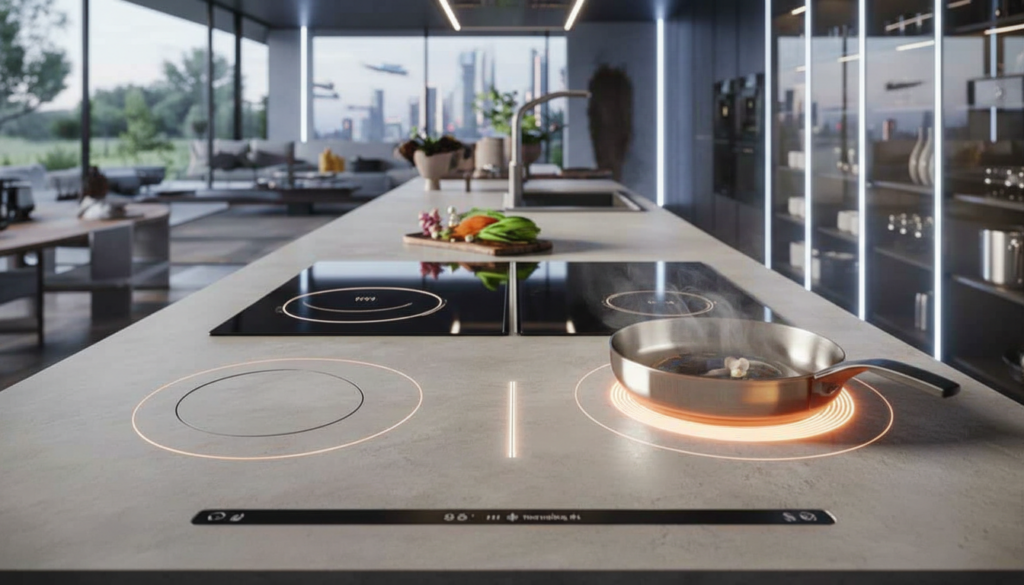
If you go to a high-end kitchen showroom today, you might notice that something is missing. You’d expect to see a black rectangle, but all you see is the worktop. No framed hob, no shiny glass slab, and no rings that you can see. But the staff will gladly fry an egg in front of you.
“Invisible induction” is the idea behind the technology that will push traditional induction hobs to the edges by 2026. The idea is simple but very different. The hob goes away, and the worktop becomes the cooker.

Instead of a glass plate, you get a flat surface made of engineered stone or technical ceramic, with induction coils hidden underneath.
There are only faint engravings or small LEDs to show where the cooking zones are. Controls can be found on a thin touch strip on the front of the cabinet or on a hidden side panel. You put your induction-compatible pan on the marked area and turn it on like you normally would to cook. The worktop only gets a little bit warm; the magnetic field inside the pan makes the heat.
How induction that you can’t see really works
Underneath the smooth, flat slab is a familiar heart: a set of induction coils that are similar to those in a regular hob but are tuned and placed so they can be used with thicker materials.
When you put coils on a stone or ceramic surface, they make a magnetic field that goes through it.
The field makes metal pans heat up right in their base.
The worktop only takes in leftover heat from the pan, so it stays cool.
Manufacturers use materials that are very dense and not porous, like sintered stone, compact ceramics, or technical porcelain, to make this possible. They can handle sudden changes in temperature and won’t break from the heat below or the cold of a wet cloth on top.
The cooking surface becomes a part of the room’s architecture instead of just an appliance that was put in.
The unit has sensors that cut off power if the surface gets too hot and check to see if a pan is in place. Some systems can even tell how big the pan is and automatically change the heating area to use less energy.
Why 2026 is the year when visible hobs will become popular
It’s not just about gadgets that are changing. It’s about how people use kitchens. In open-plan homes, the kitchen is a place to live, not a place to work. People don’t want a patchwork of cut-outs and stainless-steel frames; they want a big, calm table-like surface.
Designers and buyers put aesthetic pressure on each other.
For years, interior designers have been asking appliance companies the same thing: “Can we hide it?” First, there were built-in ovens, fridges that fit into the wall, and cabinets without handles. The next step is induction that disappears into the worktop.
The big black square on pale stone doesn’t look as good next to seamless worktops that go from wall to island without any breaks.
An invisible hob is also a selling point for real estate agents and builders. It makes a small kitchen feel bigger, and property listings and Instagram feeds look cleaner.
Less cleaning, fewer burns
Invisible induction has benefits that go beyond just looks.
| Aspect | Traditional induction hob | Invisible induction surface |
|---|---|---|
| Visible hardware | Glass plate with frame and edges | No hob, just worktop with subtle markers |
| Cleaning | Grime builds around edges and joints | Flat, joint-free surface; wipe like any counter |
| Safety | Glass stays quite hot after use | Surface cools faster, less risk of burns |
| Work surface | Hob area mostly dead space when off | Area can be used for prep, laptop, servin |
Because the heat is focused on the bottom of the pan, spills are less likely to burn on the surface. You can wipe up milk or sauce while the zones are still on, but be careful not to scrape off hardened residue later.
Performance: style with meaning
A lot of early adopters are worried that a hidden hob will make the heating less effective. Independent tests so far show that the performance is similar to that of mid- to high-range visible induction units.
The heating times are still fast, and the water boils in a few minutes. Fine control for melting chocolate or simmering sauces is similar because both use induction technology.

Manufacturers say that energy use is about the same as with regular induction, with small improvements in pan detection and zone sizing.
The tough surface also has a quiet benefit: it makes plates and cracks less likely to break. Anyone who has dropped a heavy pot on a glass stove knows how dangerous it is. Dense ceramics and sintered stone can handle everyday bumps better, but they can still chip if you don’t take care of them.
How will kitchens look in 2026?
The trend is toward “soft tech,” which means homes where the hardware does the work but isn’t the main focus. The kitchen is similar, with appliances that blend in with the furniture.
You can expect worktops that go from the sink to the cooking area in one continuous piece. Sometimes they even go over the edge and into a waterfall-style side panel. The same slab could serve breakfast at 8 a.m., host a video call at 11 a.m., and handle all of dinner prep at 7 p.m., with the hob zones only on when needed.
Island units turn into tables that can be used for many things. They can move from a desk to a buffet table to a kids’ homework station in seconds because there is no visible hob.
Who this change is good for and who it isn’t
Invisible induction will be very appealing to:
People with kitchens that are open to the living room.
People who own flats and small homes and need every square inch of space.
People who like minimalist design and don’t like a lot of visual clutter.
Families who want to keep kids away from hot surfaces.
It might not be as good for people who cook with very large woks, use cookware that isn’t shaped like a normal pot, or like the way gas flames look as feedback. Some invisible systems can handle wide pots, but they still need to be checked for compatibility.
Important words and what they really mean
There is a lot of material science jargon in brochures about this trend. There are a few words that need to be explained:
Sintered stone is a man-made slab made by putting minerals under a lot of pressure and heat. It has a lot of density, doesn’t have many pores, and doesn’t stain easily, like engineered porcelain.
Technical porcelain or compact ceramic: These are ceramic materials that have been designed to be thin but strong, so they can be used for large-format worktops and can handle heat and shock.
Induction coils are copper wires that make magnetic fields that change direction. These are the “burners” that are hidden under your future worktop.
When you compare brands, it’s helpful to know what these words mean. Some surfaces are more resistant to scratches, while others are more tolerant of heat or are thinner. The most important thing for a hidden hob is that the surface and the induction unit below are certified to work together.
Situations and things to think about for homeowners
Think about a typical two-bedroom flat getting a makeover in 2026. The owner picks a worktop that looks like pale stone and has a built-in invisible hob. The island is a place to work during the week, with a laptop and coffee mug sitting right above the cooking areas. The same space is used for a quick pasta dinner at night, and then it becomes a clear surface for board games again. Nobody has to dance around a raised hob or worry about getting their sleeves caught on knobs that stick out.
There are pros and cons. Installing can be harder and usually requires working together with a kitchen fitter, a worktop supplier, and an electrician. Instead of just replacing a standalone hob, repairs might mean working on both the surface and the unit below.
The first models are high-end, but prices should drop as demand rises and more well-known brands enter the market.
Insurance and safety rules are also getting better. Buyers should look for certifications that show the product has features like child locks, overheating protection, and automatic shut-off. Only cookware that works with an induction system will work, so you might have to say goodbye to your favourite aluminium pan.
If you’re planning to build a new kitchen or do a big renovation in the next few years, the choice is no longer just “gas or induction.” It is becoming more and more “visible or invisible.” In a lot of design-led projects, that shiny black slab in the middle of the counter won’t be the first choice anymore by 2026.