When I first saw a kitchen without cabinets, I thought the people who lived there had just moved in. There were bare walls, a long rail with pans hanging like jewelry, and deep drawers that slid out with a soft whoosh. There are no upper cabinets that hang over the worktop, and there are no big boxes that could bend if they get wet. Just space, light, and… peace.
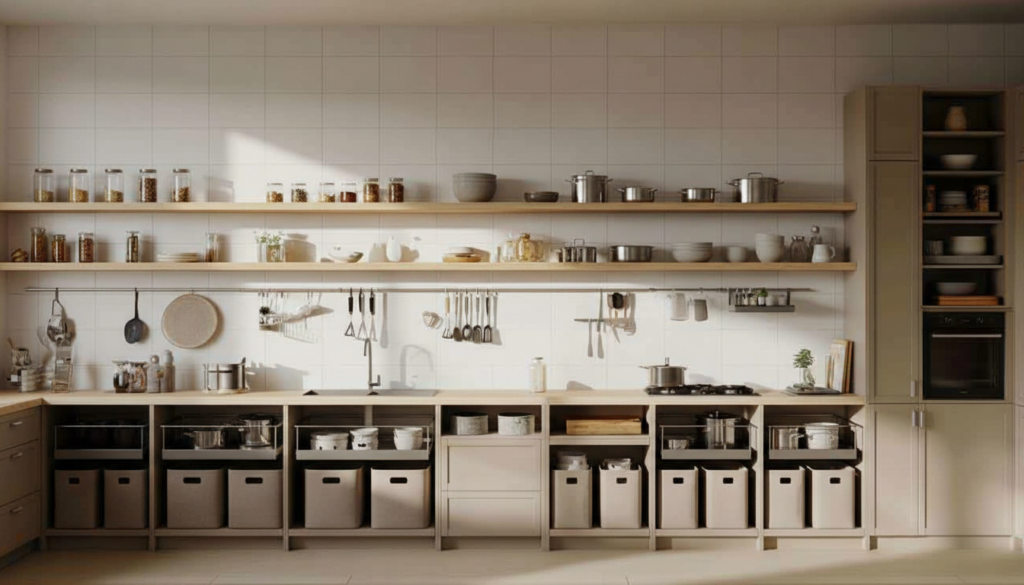
There were open shelves, a few racks that looked like they belonged in a factory, and a wall of a pantry that you could see through a sliding door. The whole room felt more like a studio than a place to store things.
And here’s the twist: it cost less than a traditional fitted kitchen.

Why people are getting rid of upper cabinets without saying anything
Look up in a classic kitchen. Just a line of boxes. Heavy, closed, and sometimes a little swollen at the corners where steam has slowly damaged them over the years. Those cabinets up top that cost you so much? Once real life starts, like boiling pasta, steamy dishwashers, and kids opening doors with sticky hands, they are the first to warp, peel, or turn slightly yellow.
Cabinet-free kitchens take that whole problem off the wall. They trade those big boxes for shelves, rails, and one solid base with deep drawers. It’s not just a surprise to see. The room actually breathes differently.
You can ask any kitchen fitter what they get called back for, and you’ll hear the same things: chipboard that has swelled, hinges that have sagged, and doors that don’t line up right after a few years of steam and humidity. The constant heat and moisture act like a slow-motion hammer, especially in small spaces where the hob is just below the wall cabinets.
One installer in London told me that about 40% of his after-sale visits are for problems with the upper door. Not broken appliances. Worktops that aren’t cracked. Doors. Two out of three kitchens in a rental block he manages needed cabinet repairs within five years. The bodies had soaked up steam like old bread.
There is a simple reason why those boxes don’t get older gracefully. Most “affordable” kitchens are made of particleboard or MDF, which is laminated on the outside but weak around screw holes and edges. Steam finds every little flaw. Over time, everything seeps in: a kettle under a corner cabinet, a pan left to simmer without the extractor on, and a dishwasher that vents hot air straight up.
Layouts without cabinets get rid of the most exposed surfaces. Instead of stacking boxes all the way up to your forehead, they put storage lower, closer to the solid base units and away from the thickest cloud of steam. The laws of physics stay the same. The goals do.
What is taking the place of classic cabinets and why it’s cheaper
The main parts of this new trend are surprisingly simple: strong base cabinets, a clear splashback wall, and smart “exposed” storage. Instead of door-and-shelf combos, think of deep drawers, a rail system that runs the length of the worktop, and one pantry zone that takes over the bulk storage.
You could take all the upper cabinets off of one wall and put in a stainless steel bar with hooks for pans, a narrow open shelf for everyday plates and glasses, and maybe one solid cabinet that goes all the way up to the ceiling in a corner. It looks small on paper. In real life, you get the same amount of space, but it’s arranged differently and has fewer things that could break and warp.
People are surprised by the money angle. Taking out a row of upper cabinets can save you hundreds of dollars on boxes, doors, and hardware alone, not to mention the cost of finishes. I met a couple in Dublin who had a standard L-shaped kitchen with full upper cabinets that cost €7,800. They went back and took out all the overhead units on the window wall. Then they put in two big pine shelves and a good rail. The last price was €6,250, which included the shelves.
They spent their “splurge” money on better drawer runners and a taller pantry unit. Nothing fancy, just parts that can be opened fifty times a day without a problem. That’s the plain truth: sturdy basics always win over flashy doors.

Why is this cheaper trend also less likely to get moldy and warped? Because mold likes dark, damp places. Wall cabinets that are old and have patchy extraction make exactly that behind and above them. When there isn’t a cabinet against the wall, steam can rise, spread, and be pulled out by an extractor or an open window. You can see what’s happening, and surfaces dry faster because spores have less to bite into.
On the outside, there are fewer boxed-in corners, which means there are fewer places for condensation to build up without being seen. It’s easy to clean a splashback that is tiled or painted. The bottom of a cabinet made of chipboard? Not really. Cabinet-free layouts don’t magically fix bad ventilation, but they do stop building little moisture traps over your head.
How to make a kitchen without cabinets that really works
Begin with one question: What do you touch every day? Cups, plates, mugs, pans, knives, oils, and coffee. Put those things in a small “daily zone” that is between your waist and eye level, not at the back of a high cupboard. Deep drawers right under the main prep area are your new best friend because you can see everything from above in one go.
Keep it simple above the worktop. A couple of strong open shelves for the pretty basics, a rail for pans and utensils, and a clear path for steam to rise. Add a tall larder cabinet or a pantry cupboard with pull-out racks if you’re worried about losing storage space. Don’t let the mess show on the walls; put it away.
The worst thing you can do is copy those simple, stark photos and forget that you cook. People who live on delivery apps love how great fully bare walls look. You still need places to put spices, oils, and that jar of lentils you promise you’ll use someday.
We’ve all had that moment when we realize that our beautiful open shelf has become a museum of dusty bottles. The trick is to limit open storage to what you’re happy to see and clean. One shelf is for “pretty and useful,” and the rest is behind a door. And don’t forget: *you can have a junk drawer*. They are in real kitchens.
Laura, who remodeled her 1980s galley kitchen on a tight budget, says, “Once we took down the top cabinets, the room felt a meter wider.” “We used the money we saved to buy a better worktop and a good extractor.” Two years later, nothing is swollen, nothing is moldy, and I don’t hit my head when I get a mug.
- Change doors for drawers. Instead of a double-door cabinet, pick two or three deep drawers. You won’t lose things at the back, so you’ll use the full depth.
- Use materials that don’t let moisture in.Look for plywood, compact laminate, metal shelving, or solid wood that is well sealed where the steam hits most. Cheap chipboard loves to swell up when it leaks.
- Use your vent like you mean it. A good extractor hood that you use a lot does more to stop warping and mold than any “miracle” cabinet coating.
- Keep shelves shallow; 20 to 25 cm deep is enough for plates and glasses. Shelves that are deeper sag more quickly and make you want to fill them with junk.
- Leave space to breatheDon’t stuff every inch with shelves, cabinets, and rail. A little bit of empty wall space helps surfaces dry and gives your eyes a break.
The quiet joy of a kitchen that can breathe
A kitchen without cabinets or with few cabinets is not for purists. It’s for people who want a room they can clean, air out, and live in without seeing the edges ripple every time they boil a pot. The real benefit isn’t just the money you save on doors and hinges. It’s that your walls, tiles, and shelves get older in a way that you can see. You see a mark where something dripped and wipe it. You see a wet spot before it turns into a black mold bloom.
It’s also strangely calming to have fewer boxes hanging over your head. In a kitchen where sound doesn’t bounce off the cabinets, conversations go differently. Light goes along the splashback, not into a line of dark door fronts. Because the space feels less like storage and more like a place to be, you might find yourself cooking more.
Let’s be honest: no one really moves their cabinets around every year to “optimize” them. We all fill them up once and deal with it. That’s why this change is important. It’s less about design and more about self-defense to make it harder for clutter and moisture to hide. And once you’ve lived with a wall that can be wiped clean, it’s hard to go back to chipboard boxes that are too big.
| Key point | Detail | Value for the reader |
|---|---|---|
| Fewer upper cabinets | Replace with shelves, rails and one tall pantry zone | Saves money upfront and reduces warping risk |
| Better materials in key spots | Use drawers and moisture‑resistant surfaces near steam sources | Longer‑lasting kitchen with fewer repairs and call‑outs |
| Open, breathable walls | Allow steam to rise and dry instead of trapping it in boxes | Less mould, easier cleaning, brighter and calmer space |
Questions and answers:
Question 1: If I take down my upper cabinets, won’t I lose a lot of storage space?
Question 2: Do open shelves just collect dust and grease?
Question 3: What materials in a kitchen are least likely to warp and grow mold?
Question 4: Is this trend only for high-end homes, or can I do it on a tight budget?
Question 5: Will a kitchen without cabinets hurt the value of my home when I sell it?