At 7 a.m., the heat hit the city like a wet blanket, not like a wave. People in Madrid were standing in the shade of bus stops on a Tuesday in October, a month that used to mean jackets and boots. They were wearing T-shirts and fanning themselves with supermarket receipts. Kids pulled backpacks that stuck to their arms. The asphalt sparkled like it was August.
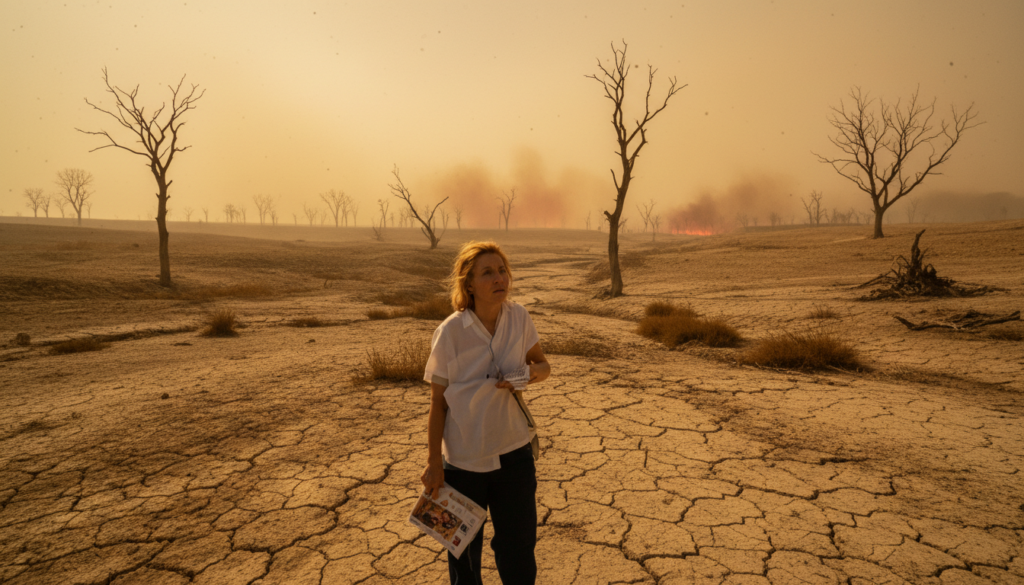
A woman standing by the crosswalk shrugged and said to no one in particular, “That’s just how the weather is now.”
Everyone nodded, and the light turned green.

It was oddly comforting.
That’s what makes climate scientists so scared.
When strange weather starts to seem normal
Go back in your own memory.
You probably thought, “Huh, that’s strange,” about the weather at some point, like Christmas in short sleeves, a thunderstorm in January, or a summer night that never really cooled down. It happened again after that. And again.
The weird thing is how quickly those once-in-a-lifetime days stop being strange.
Your body gets used to it. Your habits start to slip. Your idea of what a “normal year” looks like changes in the background, like a phone update you didn’t ask for.
Scientists call this slow, sneaky change in what we accept “shifting baseline syndrome.”
Look at the UK.
The famous heat wave of 1976, which turned lawns brown and melted asphalt, reached its peak at 35.9°C. People still talk about it years later. Newspapers have photo spreads that make you feel nostalgic.
Britain broke that record by a wide margin in 2022, reaching 40.3°C. The railway lines bent. The runways got softer. Firefighters put out fires on the outskirts of London. Live on TV, meteorologists used words like “unprecedented.”
But by the summer of 2023, that intense heat had already become a new topic of conversation: “those hot days we get now.” What used to be a national shock is now just another point of reference.
This is the hidden risk.
We usually compare reality to our own memories instead of to long-term records and data. Both your kids and you will say that the weather was “normal” when you were a kid if you saw snow every winter and your kids only see it once every three years.
Climate scientists are practically waving red flags, saying that what seems normal to us now would have seemed crazy to people in 1986. These are not just mood swings in the sky: heatwaves that last less than a TikTok, storms that drop a month’s worth of rain in one night, and winters that keep coming late.
They are the fingerprints of a climate that has changed faster than we can feel it.
How to stop walking in your sleep when the sky changes
The first step is almost too easy: start paying attention to numbers, not just how you feel.
Take note of the first night you need a fan. The week you turn on the heat. The month you first see a mosquito.
You don’t need a lab. You don’t need much: a cheap outdoor thermometer, a notebook, or a history of your weather app. Choose one or two things that are important to you, like days when the temperature is above 30°C or nights when you can’t sleep unless you open all the windows. Then, keep track of them for a few years.
All of a sudden, you have backup for your feeling of “this feels normal.”
You can really tell if your summers are getting longer or if your rain is coming in big, heavy bursts instead of light drizzles.
The next step is to talk about how strange it is, even if it feels strange or like you’re saying the same thing over and over.
Say that the river from your childhood gets lower every August. Say out loud that your city now has a “fire season” when it didn’t used to. Tell your parents that the first frost in your town now happens weeks later than it did when they were kids.
We’ve all been in that situation where someone rolls their eyes and says, “The climate has always changed; my grandfather said the same thing.”
A pattern, not a fight, is what quietly changes the room. It’s specific, local, and shared. “Our apple tree used to bloom in April; now it blooms in March.” These are the alarms that go off in our heads every day and are hard to ignore.

To be honest, no one really does this every day.
But even a few real conversations a year can help clear away the fog of “oh well, that’s just how it is now.”
Another mental habit is to not turn every extreme event into “just the new normal.”
When scientists say that climate change made a heatwave five times more likely, they don’t mean we should ignore it. They mean that something has changed in the physics of the air above us, and we are living in that experiment.
“Normalisation of extremes is one of the most dangerous psychological responses to climate change,” says Friederike Otto, a climate scientist known for her quick attribution studies. “Once we get used to deadly heat or huge floods, the pressure to stop even worse things from happening goes away.”
- Pay attention when you or someone else says, “We always get this now” about bad weather.
- Ask: Did we really do that ten or twenty years ago? Or is that just how it feels?
- Find one simple chart for your area that shows the average temperature, rainfall, or days with wildfires.
- Send that chart to a group chat, at work, or to family with a short personal note.
- Once a year is enough, not every day. Consistency is better than being overwhelmed.
The thin line between adapting and denying
Getting used to new weather is good for you on one level.
People have always changed: they wore lighter clothes, took naps, grew new crops, made their homes warmer, and built city parks to cool off the streets. Some communities are already moving work hours to the early morning to avoid the dangerous heat.
We can barely see ourselves crossing a queue on another level.
When flooded subways, smoky skies, or classrooms that are 40°C become just another Tuesday, something in our collective alarm system goes numb. *We don’t ask ourselves what it would take to avoid an even worse “normal” ten or twenty years from now. Instead, we just think about getting through this week.
When scientists say that what feels normal lately isn’t normal at all, they’re really talking about that emotional trap.
| Key point | Detail | Value for the reader |
|---|---|---|
| Shifting baselines | Each generation redefines “normal weather” based on its own memory, not long‑term data | Helps you question your gut feeling and see long‑term change more clearly |
| Track your own climate | Simple notes on heat, frost, rain or local seasons over time | Gives you personal evidence and a deeper sense of what’s really changing |
| Talk about specifics | Share concrete, local examples instead of vague fears | Makes climate change feel real, relatable, and actionable in everyday life |
FAQ:
Isn’t bad weather just a part of the natural cycle?
There are natural cycles, but the changes happening now are too fast and too big to fit into them. Long-term records show that heatwaves, heavy rain, and some droughts are happening more often and with more force, which is closely related to rising levels of greenhouse gases.
How do scientists know that something isn’t normal?
They look at detailed records of the past and run models to figure out how likely an event would be in a world without warming caused by humans. They say that climate change made the event more likely or worse when the odds go up a lot.
Why does it matter if we just get used to the weather?
We need to adapt, but if we treat every new extreme as normal, we stop pushing for cuts in emissions that would stop even worse extremes from happening in the future. Normalising everything quietly increases risk.
What can one person really do about this?
In short, pay attention, speak up, and back policies and projects that lower emissions and keep people safe from floods, fires, and heat. Individual choices are most important when they signal and support bigger changes in the way things are set up.
Can we stop things from getting worse now?
No way. Some warming is already happening, and we have to live with it. But every tenth of a degree we don’t reach still lowers the risk of deadly heat, crop failures, and damage to the coast. That’s why scientists keep saying that **what we do this decade still matters**.