The first thing you notice is how quiet it is.
There are thousands of people in a field, on rooftops, on beaches, and then all of a sudden the noise stops when the light goes out. Shadows get sharper, colours fade, and birds fly into a darkening sky. As the Sun turns into a burning ring and then disappears completely, someone near you whispers “oh my god” without meaning to.
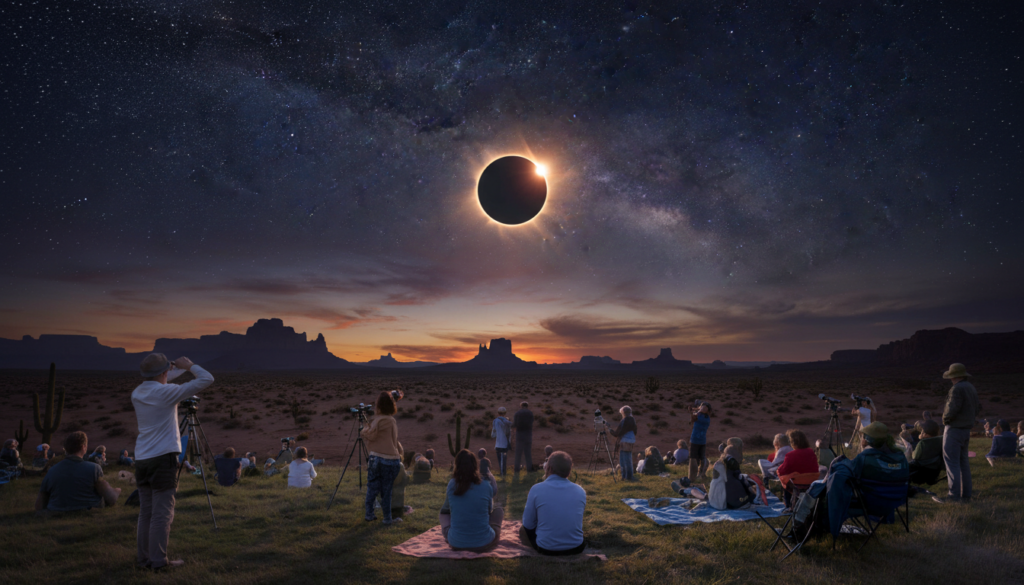
The temperature goes down. In the middle of the day, the streetlights flicker on. For six long, impossible minutes, the world forgets what noon is like.
Then, just as quietly as it started, the light comes back.
And that’s when you know you’ll be telling this story for the rest of your life.
When will the six minutes of darkness fall during the eclipse of the century?
Astronomers are already saying that this is a once-in-a-lifetime event: a total solar eclipse with *around six full minutes of totality* along its central path. Not a minute and a half. Not two and a half minutes. A deep, lasting darkness that will give millions of people time to not only gasp, but also to look, breathe, and notice.
For this kind of long eclipse to happen, the Moon has to be a little closer to Earth than usual, the Earth has to be close to its farthest point from the Sun, and the geometry has to be just right. It doesn’t happen every ten years. It happens very rarely, like once in a hundred years.
Many experts point to the event on July 16, 2186, as the gold standard for the upcoming “eclipse of the century.” It will last an incredible 7 minutes and 29 seconds over parts of South America and the Atlantic. For people reading this today, that’s a long time ago, but it’s the standard that current missions and simulations keep going back to.
Astronomers are keeping an eye on a number of unusually long eclipses that will happen between 2040 and 2060. Some of these paths may give people in parts of the Pacific and Asia more than five minutes of darkness. These are the ones that are already getting a lot of attention in observatories and on travel forums.
Why is there so much fuss over a few extra minutes? The magic of a total solar eclipse really starts when the Moon completely covers the Sun’s bright disc. That’s when the ghostly solar corona shows up, stars and planets cut through the daytime sky, and the landscape changes into a spooky twilight.
Most eclipses end just as your brain starts to understand what your eyes are seeing. That changes with a six-minute window. It lets scientists get more information, photographers change the frame and adjust the picture, and regular people just enjoy being there without having to keep an eye on their watch. More darkness means more memory, plain and simple.
The best places on Earth to see six minutes of totality
The first step in planning the best eclipse of your life is to follow the path of totality, not just “somewhere nearby.” The center line of the eclipse path is where those long minutes are, stretching like a thin ribbon across oceans, deserts, and cities.
Early predictions for long eclipses in the middle of the 21st century say they will happen over parts of the central Pacific Ocean, Southeast Asia, and maybe the western coasts of South America. Think of big skies, steady weather, and low horizons. Places where clouds aren’t as big of a deal and light pollution is almost nonexistent.
A more concrete example from recent history is the total solar eclipse that happened on July 11, 1991. It passed over Hawaii and Mexico, and in some places, the maximum totality lasted almost seven minutes. Veteran chasers still talk about beach towns on the Baja California peninsula where the day turned into a rich, almost movie-like dusk and the corona flared overhead like white fire.
Fishermen in the area stopped what they were doing to look. Kids screamed when it got dark all of a sudden. Many amateur astronomers, some with tripods held together with duct tape and handwritten exposure charts, took some of the most famous eclipse photos before the Internet. That event showed coastal towns how to turn into open-air observatories on the fly.

There is a lot of logic behind choosing a viewing spot, even if it is romantic. You need three things: historical cloud data that works in your favour, a clear view of the horizon, and infrastructure that can handle a lot of visitors who want to see the sky. Eclipse tour companies are already keeping an eye on mountain plateaus in dry areas like the Atacama in Chile and high ridges in central Asia because they are high and dry.
Coastal areas can be beautiful but are more dangerous for clouds. Big cities are comfortable, but they are often just off the longest-duration center line. Let’s be honest: no one really does this every day. That’s why it’s best to rely on astronomers’ maps and weather data. In the end, your dream spot is where the map’s thin line of maximum totality quietly crosses a place you can get to, stand, and look up from.
How to get ready (in your mind and in real life) for the best eclipse ever
You should treat this eclipse like a concert that only happens once in a lifetime. You wouldn’t just show up without a ticket, would you? Begin with the basics: choose a place along the path of totality and then work your way back from there. Check the rough timing, travel visas, the seasons in the area, and how far you’re willing to go off the beaten path.
Then think about how your body feels that day. A hat, layers, water, and a place to sit or lie down so you don’t have to deal with cramps while the sky puts on its best show in hundreds of years. You don’t need a suitcase full of gear to feel the hair on your arms stand up when the lights go out.
People often make the mistake of treating the eclipse like a photo shoot instead of a real-life event. They go hundreds of miles, bring two cameras and a drone with them, and then spend the whole six minutes looking at their settings menu. When the light comes back, they realise they didn’t really see it with their own eyes.
The safety issue is also there. People wear cheap sunglasses during totality instead of putting them on before and after, or they look up without the right filters for “a second.” Your retinas don’t care that you’re happy. They still burn. We’ve all been there: when you’re so excited that you forget common sense.
A veteran chaser who has seen more than ten totalities says, “Pick one or two things you really want from the eclipse.” “Maybe it’s one great picture. Maybe it’s the sound of the crowd gasping. Maybe it’s just the way the temperature drops. Then let everything else go.
Get there early, at least a few hours before the first contact, so you can get used to the area and look at the sky.
For all partial phases, wear certified eclipse glasses or solar viewers. Take them off only during full totality.
Set the cameras to simple, pre-tested settings, then leave and really watch the sky.
If clouds come in at the last minute, have a backup plan a few kilometres away.
While they’re still fresh, write down a few thoughts right after totality—fragments, feelings, strange details.
A shadow that generations share
It’s a little scary to think that the longest eclipse of this century will outlive almost everyone who reads this. People we will never meet will tell the story of the 2186 mega-eclipse while standing under the same star and the same Moon.
But that’s what makes eclipses so strange and comforting. They remind us that our lives are short, but the sky is patient. Kids who see a “short” three-minute totality today might have grandkids who travel the world looking for the next great shadow. Families plan things years in advance. For an event that lasts less than a coffee break, whole towns practise their traffic plans.
When you stand in that sudden, shared darkness, you’re not just watching; you’re part of a long line of people who have screamed, prayed, kissed, or just stared when the Sun went missing. The best thing you can do is show up ready enough that logistics don’t matter and loose enough that wonder can find a place to land.
You might even travel halfway around the world. The path of totality might one day go right through your neighbourhood. That short, impossible night at noon changes what you thought an ordinary day could be, no matter what.
| Key point | Detail | Value for the reader |
|---|---|---|
| Long totality eclipses are rare | The “eclipse of the century” concept comes from events with around six or more minutes of darkness, requiring perfect Sun‑Earth‑Moon alignment | Helps set expectations and explains why early planning and realistic goals matter |
| Location is everything | The longest darkness lies along the center line of the path of totality, often over remote or weather‑favored regions | Guides readers to prioritize geography and climate over convenience alone |
| Experience beats equipment | Simple safety gear, basic comfort, and being present in the moment often trump complex photo setups | Encourages a more human, less stressful way to live the event |