At 11:57 a.m. in Shenzhen, the street-level delivery rush is already a mess. Scooters weave in and out of traffic, and insulated bags are stacked like Tetris blocks. But the real race is up and down inside a 70-story glass tower. An elevator door opens on the 63rd floor, and a young man in a blue jacket steps out, a little out of breath and with a phone buzzing in his hand. He is not just any delivery person. His job is to live between floors 40 and 80, riding elevators like a cloud miner and giving boxed noodles to people who almost never touch the ground.
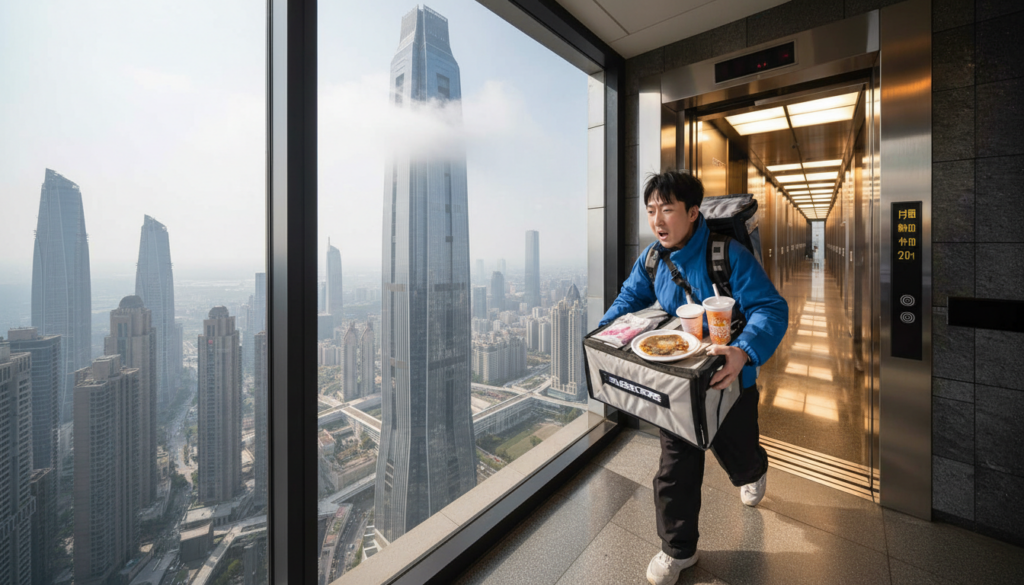
The building is a universe. There is a supermarket in the basement, a clinic on the fifth floor, shared offices, co-living, gyms, and kindergartens. There were thousands of people stacked in the sky. And in between the lobby and the penthouse, a strange, very modern job has shown up.
Someone has to take lunch all the way up.

When tall buildings turn into small cities
If you stand at the base of some Chinese towers, your neck will start to hurt. They don’t just build tall buildings in Chongqing, Guangzhou, and Shanghai anymore. They build thick, full of life, and packed. These are neighborhoods that go up and down and have their own smells and rhythms. There is steam from hotpots on level 3, printer ink on level 29, and perfume and coffee on the top level.
You can only see glass and steel from the street. Delivery apps keep going off inside, and people order milk tea from their desks and late-night congee from their beds. The demand doesn’t end in the lobby. It goes up, one floor at a time.
The classic delivery driver on an electric scooter can only go so far. He can leave the food at the entrance, maybe at the security desk. But when there are 80 floors, six elevator banks, face-scan gates, and hallways that all look the same, the last 300 meters can take longer than the whole ride across town. That’s when a new character shows up: the “building runner,” who is an expert in one tower or complex.
For example, Chengdu’s Tianfu New District is a huge residential area. Local news crews filmed young runners who spend their whole shift inside the same three towers. Instead of giving them orders by street, their app gives them orders by floor range. 41–50, 51–60. They know all the tricks for getting around in the elevator, all the short cuts through the fire stairs, and which security guards are in a bad mood that week.
There is a simple economic reason for this strange specialization. Elevators are a problem. One late elevator, a busy lunch hour, and your hot noodles turn into a lukewarm complaint. Meituan and Ele.me are obsessed with the last few minutes that decide ratings. So they made jobs that were very local, breaking up the old “one person does everything” model into two: the street rider and the tower climber.
These vertical couriers save a lot of time, but they cost less distance money. In the time it takes for one mixed-role courier to get lost in the maze of levels, a building runner can make dozens of short trips up and down.
How vertical delivery really works in a Chinese mega-tower
It looks easy on the screen: tap, order, and wait. The system is like a tiny dance on the inside. A traditional courier rushes in from downstairs, phone already open to the order number. He puts the plastic bag in a heated locker or hands it to a building runner at a small handover counter. The timer keeps going. The duty just moves to someone else.
The runner scans the QR code, the app gives them a floor, and the race goes up. He scans his face or a temporary code to get into the elevator area. On busy days, they group orders by “elevator trip” and try to deliver three or four meals in one trip. Sometimes they have to hold drinks in one hand and tap the floor button with the other.
Some of these complexes have a saying that they say half-jokingly: “We live on level 50, but our legs live on level 1.” One runner from Guangzhou told a local news outlet that he had set a record by getting 200 orders in one building during a rainy-day sale. He walked the same distance as a half-marathon without ever going outside. He just paced between elevator banks and doorbells.
He remembers a client on the 72nd floor who ordered bubble tea three times a day for a week and never came down to the lobby. He worked in tech, lived in the same building, lifted weights in the gym on level 6, and said he “had no reason to touch the street.” The runner laughed when he said it, but there was something off about the laugh. He added, “If the elevator breaks, half of this building will panic.”
You can feel how architecture changes habits behind the story. When everything you need is stacked up around you, the ground starts to feel like it’s not even there. Delivery apps take this logic to the next level. They make each door an endpoint on a huge digital map and give people legs to fill in the gaps that the system can’t automate yet.

*Skyscrapers used to be a symbol of ambition; now they also make very real delivery routes in the sky.*
The tricks that people use to keep food hot… 70 floors up
If you spend a morning following a vertical courier, you’ll quickly see that they rely more on their instincts than on GPS. Timing is the first trick. They find out which towers get crowded around noon, which office floors empty out at 6 p.m., and which elevators always skip mid-levels when full. A good runner plans his stops almost like a bus driver plans a route, starting with the highest floor and letting gravity take him down.
They also make a weird mental map of doors. The walls are made of marble, the carpets are the same, and the numbers are the same. But they’ll say, “Oh, 5803?” That one has a plant in the hallway. Good dog, always barks twice.
And of course, things go wrong. Wrong entrance to the tower, wrong floor reading, and an elevator that stops on every level when you’re already late. We’ve all been there: when you’re hungry and waiting and your patience runs out. For the runner, the worst part of the job is ringing the doorbell when they already know the customer is upset about something that happened 20 minutes ago and 3 kilometers away.
So they change. They call ahead when they think there will be a wait. They say little things like “sorry, elevator jam today” or give a quick smile. Let’s be honest: no one really reads every push notification or checks the rider dot on the map every day. The person at the door is the one who gets the blame or the thanks.
Some of them talk about their job with a simple, down-to-earth pride that cuts through the flashy tech story.
A runner in Shenzhen told a vlogger, “I’m not changing the world; I’m just the guy who climbs so other people don’t have to.” But when I see someone on a night shift who is tired and I give them hot food, that feels like something real.
To get through these vertical mazes, they talk about “rules of the tower” that aren’t official:
- If the elevator breaks down, you should always know at least one way to get to the stairs.
- Sort orders by elevator bank, not just by floor.
- Bring extra straws and napkins. People forget, but they complain a lot.
- Never fight at the security gate; you’ll waste valuable time every day.
- Compression sleeves and good shoes are a must if you want to protect your knees.
What these sky couriers say about our lives today
When you see vertical couriers, you start to see them as small signs of a bigger change. They don’t just move food; they also bridge the gap between the comfort of digital life and the reality of physical life. Every “deliver to door” box and every tower with a gated lobby quietly adds to this hidden work in the stairwells.
These skyscrapers are honest about the choices we have to make. We are okay with longer waits for elevators so we can fit more people on prime land. We let invisible workers move around in zigzag patterns through hallways so we can finish a meeting, a spreadsheet, or a video call without having to walk down 40 floors.
| Key point | Detail | Value for the reader |
|---|---|---|
| Vertical cities reshape work | New roles like building runners appear inside mega-towers | Helps you see how architecture quietly creates or erases jobs |
| Last meters matter | The hardest part of delivery is often from lobby to door | Explains why delays happen even when the restaurant is nearby |
| Hidden systems support daily comfort | Elevators, access controls, and human couriers interlock | Invites you to notice – and maybe value – the people behind each “order delivered” |
Questions and Answers:
Are vertical delivery couriers jobs that are legally recognized in China?They are often hired as “internal logistics” staff by property management or through big platforms like Meituan or Ele.me.
Do they make more money than regular street-level couriers?Not all the time. They usually get paid for each order, with small bonuses during busy times. In dense towers, the work can be more steady, but it can also be harder on the legs and knees.
Why don’t buildings just have robots or delivery lockers on every floor?Some high-end towers test robots and smart lockers, but in many places, access control, complicated elevators, and the need for flexibility still make human couriers the better choice.
Is this kind of living in a tall building common in all of China?It mostly happens in big cities like Shenzhen, Shanghai, Guangzhou, Chongqing, and parts of Chengdu, where land is scarce and towers are built to serve many purposes.
Could this model be used in other countries?Yes, especially in cities where high-rise neighborhoods are growing quickly. The need for “last-vertical-meter” delivery jobs is likely to grow as more people live and work in tall buildings that serve more than one purpose.