At exactly 1:16 p.m., the streetlights blinked on one after another, as if the city had mistaken midday for midnight. Conversations slowed. Phones lowered. A child tightened their grip on their mother’s hand while a dog barked nervously at the dimming sky. A car alarm briefly screamed, then cut off as its owner stepped outside, eclipse glasses tilted awkwardly, staring upward.
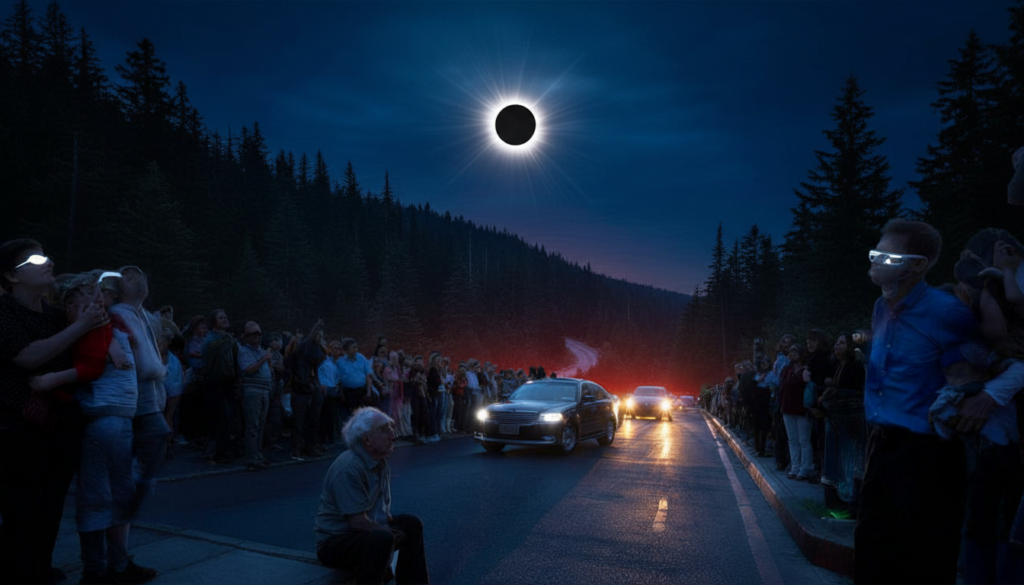
During the longest total solar eclipse of this century, daylight didn’t simply fade — it seemed to pause. The air shifted. The brightness thinned. And when the Moon finally covered the Sun, the world felt suspended, like time had inhaled and forgotten to exhale.
“It doesn’t feel natural,” someone murmured nearby.

“It feels exactly as it should,” another replied.
For more than six minutes, the middle of the afternoon resembled deep evening. Wonder and unease stood side by side beneath a sky that no longer looked familiar.
When the Sun Disappears Too Long
Across the path of totality, people described the same strange threshold — that precise second when the light stopped feeling like an overcast day and started feeling like something was off-balance. Birds fell silent. Shadows sharpened into thin, uncanny shapes. Buildings and faces lost their warmth, as if color had quietly drained away.
In some regions, totality stretched to 6 minutes and 23 seconds — the longest of the 21st century. On paper, it’s a tidy statistic. Beneath it, those minutes felt elastic, almost uncomfortably extended. Cameras recorded. Children gasped. A few adults wiped away tears without knowing exactly why.
The darkness didn’t just settle. It pressed in.
In a coastal city in Mexico, traffic halted as the shadow rolled over rooftops. Weeks of warnings had prepared residents — posters, radio segments, school briefings about eye protection. Still, some stepped outside without glasses, squinting for a final glance before totality.
In the main plaza, someone played cinematic music from a speaker, turning the moment into an impromptu celebration. Vendors sold eclipse glasses alongside churros and tamales. On a bench, an elderly man refused to look up at all, quietly insisting eclipses “invite what shouldn’t be invited.”
That tension — between geometry and inherited fear — surfaced everywhere. To scientists, it was alignment and orbit. To others, the phrase “longest eclipse of the century” sounded less like achievement and more like omen.
Astronomy explains it cleanly: the Moon, at just the right distance, perfectly masks the Sun from our perspective. The shadow sweeps across Earth in a narrow band. Stand within it, and day collapses.
What made this eclipse unforgettable wasn’t only its length. It was the symbolism people layered onto those extra minutes. More time for temperatures to drop. More time for animals to react. More time for a quiet question to form in the back of the mind: what if the light doesn’t return?
The physics never changed. The stories did — and in the age of endless scrolling, those stories traveled faster than the shadow itself.
Facing a Sky That Forgets Its Color
There is a surprisingly simple way to steady yourself before an eclipse: step outside the night before and observe your surroundings. Notice how the streetlights glow. How tree lines soften. How windows shimmer in the dark. Then imagine that same scene unfolding at midday.
Some seasoned eclipse watchers even plan their emotional response. “First I’ll just look,” they decide. “Then I’ll take one photo. Then I’ll stop and breathe.” It may sound dramatic, but when afternoon turns black, having a small plan can anchor you.
Afterward, many admit their biggest regret wasn’t technical — it was emotional. They either avoided looking altogether or filmed every second and felt they missed the moment itself.
Fear hides in subtle ways. Sometimes it disguises itself as distraction. “I’ll watch through my screen,” someone tells themselves, believing distance equals safety. Others lean into bravado, ignoring advice and staring upward without protection, as if caution were weakness.

The truth is simple: none of us regularly practice watching daylight vanish. Feeling unsettled is natural. Feeling moved is natural too.
In a field lined with telescopes, a young astrophysicist stepped away from her instruments as totality began. She closed her eyes briefly before looking up.
Later she explained, “I’ve spent years turning the sky into data. For those minutes, I wanted it to just be the sky.”
Beside her notes was a quiet checklist:
Protect your eyes before and after totality
Choose one feeling to focus on
Accept that fear is human
Remember the Sun remains
Talk about it afterward
Not flashy. Not viral. But steady.
Between Science and Story, the Shadow Passes
Throughout history, long eclipses have stirred more than curiosity. Ancient cultures carved them into stone as warnings or turning points. Today we have livestreams, simulations, and precise measurements — yet the emotional undercurrent feels familiar.
When officials confirmed this as the longest total solar eclipse of the century, some treated it like a festival. Flights were booked. Campsites filled. T-shirts marked the path of totality. Others circled the date quietly, unsure why it made them uneasy.
Both reactions share the same sky.
What lingers after the Sun resumes its steady brightness isn’t only the image of the corona flaring around a dark disk. It’s how people behaved when the ordinary rules of daylight bent. A neighbor sharing spare glasses. Family chats filling with conspiracy links. A friend insisting something shifted inside them during those six minutes — unable to explain it, yet unwilling to forget it.
Headlines will archive the statistics. Photos will circulate in curated lists. Beneath that is a softer memory: how we balance awe with anxiety, knowledge with superstition, when the most dependable presence in our lives briefly disappears.
Some will leave reassured by the clockwork precision of the universe. Others will leave unsettled, as though the sky briefly looked back at them.
There is no single correct reaction when day transforms into night. There is only this shared truth: the Sun went dark, and each person decided for themselves what that meant.
And when the next rare alignment arrives, people will gather again — carrying lenses, laughter, doubt, curiosity, and quiet prayers. The shadow will cross, indifferent as ever.
What remains afterward is how we tell the story to one another.
| Key point | Detail | Value for the reader |
|---|---|---|
| Record-breaking eclipse | Longest total solar eclipse of the 21st century, over six minutes of totality | Helps you grasp why this event felt so intense and historically charged |
| Human reactions | Blend of fear, celebration, superstition, and scientific curiosity across the eclipse path | Lets you recognize your own feelings in a wider, shared experience |
| Preparing emotionally | Simple gestures, from planning your reaction to talking about it afterwards | Gives you tools to live future eclipses as experiences, not just spectacles |