Two plastic chairs, a dying rosemary plant, and a view of 40 identical windows on the balcony on the fifth floor. At first, that’s all you can see. Then you see the neighbor’s railing, which is a messy jungle of terracotta pots, thrift-store containers, and an old metal toolbox that is now full of marigolds. Bees move back and forth between a broken mug full of thyme and a tall pot of tomatoes, like little people going to work.
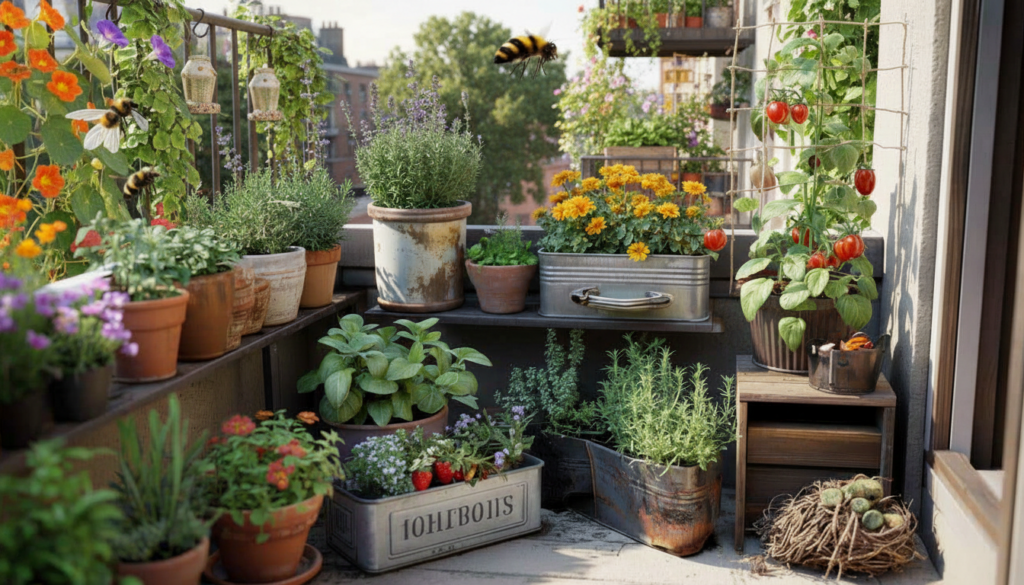
You lean on your own empty railing and feel that quiet, nagging question come up.
What could this tiny, rented space turn into?

Why having a lot of different things is important when you don’t have much room to move
This is a good place to start: a small garden that only grows one thing is like a conversation with one word. It sounds better than silence, but it doesn’t really sing.
When you put a lot of different things in a balcony box or a narrow strip of yard, you’re not just filling in spaces. You’re adding layers to your life. The same small square of ground has different root depths, leaf shapes, flowering times, and scents, with each plant using a slightly different “floor” of the space.
That’s when the magic starts to build.
You can feel it right away when you walk through an urban courtyard that has only one plant in it. A hedge that is all the same, geraniums in every pot, or grass that has been cut down to the same height. It looks like it’s under control, but it’s also strangely tired.
Then you trip over one of those postage-stamp front yards that an older neighbor has been taking care of for years. Lavender touches your knees. Under a rose bush, strawberries sneak out. A pot of mint is too big for a cracked step. Bees fly by, ladybugs show up, and birds land instead of just flying by.
Same number of square meters. A totally different kind of energy.
There is a reason for that buzz. Each species has its own guests. For example, some flowers attract certain pollinators, some leaves protect tiny predators that eat aphids, and some roots make tunnels that let water in. A mixed balcony box is like a high-rise building for tiny life forms.
Monoculture, even on a small scale, is not very strong. One heat wave, one bug, or one missed watering can hurt everything at once. When there is diversity, the strengths of one plant quietly support the weaknesses of another.
Your small space gets stronger than it looks.

How to make your balcony and windowsill more diverse
Instead of thinking in square meters, think in layers. Top, middle, and ground. If you use those three levels on purpose, you can grow a lot of different things.
Climb up to the top “floor” to see a cherry tomato on a string, a pole bean around a bamboo stick, and a vertical trellis with peas. The middle layer has bushy herbs, small peppers, and dwarf dahlias. On the ground: strawberries that trail, creeping thyme, and salad mixes that are low and spill over the edge of a box.
You’re not making more room. You’re putting it on top of something else.
A lot of people freeze at the garden center, looking at all the labels, and leave with two safe geraniums. A very human response. The key is to choose only three roles: one that feeds you, one that feeds pollinators, and one that calms your eye.
It could be lettuce, basil, and calendula. Or a cherry tomato, some lavender, and some trailing ivy. Don’t think too hard about the Latin names. Don’t put off making a plan until you have the “perfect” one. *Plants are more forgiving than they seem on social media.
To be honest, no one does this every single day. Sometimes you will forget to water. At least a few things will shrug and keep growing if there is variety.
A city horticulturist once told me, “People think they need a big garden to help biodiversity,” as she brushed dirt off her hands. “But what if there was only one diverse balcony on each floor of a building? That’s a whole ecosystem in the air.
- Mix up the times of bloom
Plants that bloom early, in the middle, and late keep bees coming from spring to fall. - Use pots with different depths
Use shallow boxes for lettuce, deeper pots for tomatoes or roses, and small cups for micro-herbs. - Mix things that are good to eat with things that look nice.
Tomatoes and marigolds, nasturtiums and lettuce, and chives around the edges of flower pots. - Invite “helpful” bugs
Plant yarrow, dill, or fennel to attract lacewings and ladybugs that eat bugs. - Leave one wild area.
A pot that hasn’t been used, a pile of twigs, or a tray of fallen leaves can all be places for hidden helpers to hide.
The quiet strength of a small, varied area
When you pay attention, you can see how even the tiniest, messiest spaces can come to life. One borage plant that survives ends up hosting half of the bees on the street. A window box with different kinds of herbs becomes a late-night snack bar for moths. A pot of native flowers brings in a butterfly you haven’t seen since you were a kid.
Your garden stops being “decor” and turns into a small way to get involved. You don’t just live in the city anymore. You’re writing the living margins of it.
| Key point | Detail | Value for the reader |
|---|---|---|
| Layer your space | Use vertical supports, mid-height pots, and trailing plants | Grow more species without needing more square meters |
| Blend roles | Combine edible, pollinator-friendly, and calming plants | Enjoy food, beauty, and wildlife in one tiny space |
| Let it be imperfect | Keep one “wild” corner or scruffy pot | Create shelter for insects and boost resilience with almost no effort |
Frequently Asked Questions:
Question 1: Can one balcony really help biodiversity?
Answer 1: Yes. A lot of birds and insects move in short hops, using balconies, small gardens, and trees on the street as stepping stones. A varied balcony is an important place to stop for gas in that chain.
Question 2: How many different kinds of plants do I need to have “real” diversity?
Answer 2: A good place to start is with 5–8 plants that have different shapes and functions. These should include at least one herb, one flowering plant, one edible plant, one “wild” or native species, and one climber or trailer.
Question 3: Isn’t it harder to take care of a lot of plants?
Answer 3: It can be easier, in fact. When you plant a lot of different plants close together, they shade the soil, keep it from drying out, and attract natural pest controllers. This means you don’t have to water or spray as much.
Question 4: What if my balcony is in the shade all the time?
Answer 4: Look for plants that can grow in the shade, like mint, chives, ferns, hostas, and woodland flowers. Diversity still works; you’re just picking plants from a different group of people.
Question 5: Do I need to buy expensive pots or special soil?
No, answer 5. Most balcony gardens only need good potting mix and good drainage. Containers that have been upcycled and have holes drilled in the bottom can hold a lot of different types of plants.