On a dull Tuesday evening, just minutes before her guests were set to ring the bell, Clara froze in front of her dining table. The tulips she had picked up that morning to add “a touch of cheer” were already sagging, their heads bowed like tired performers after a long rehearsal. She had trimmed the stems carefully, washed the vase until it sparkled, and even muttered a soft apology to the bouquet, as though remorse alone might revive them.
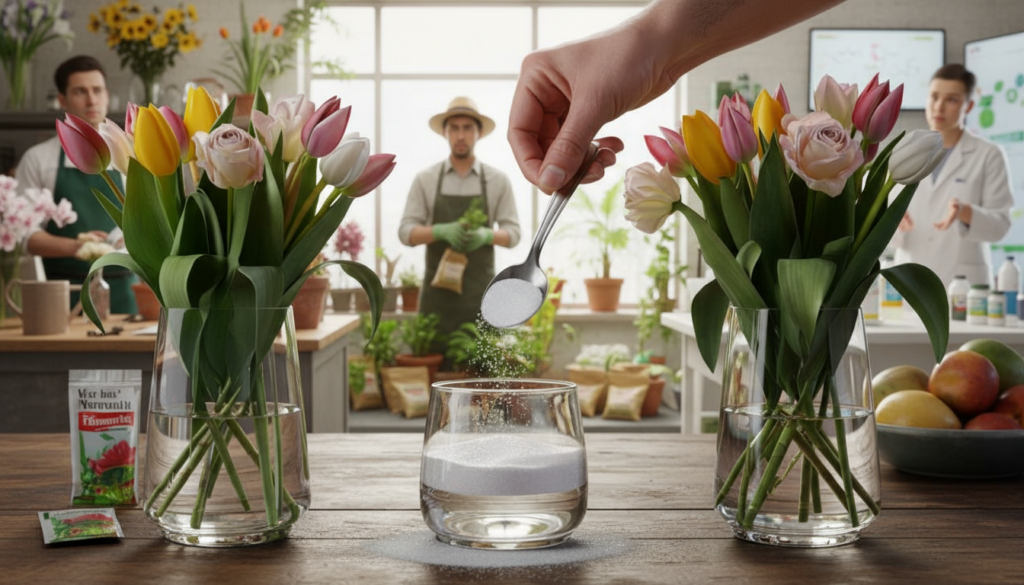
Just then, her neighbor walked past with a tray of lasagna and the calm confidence of someone who always seems to know things. She paused, glanced at the drooping flowers, and offered a simple suggestion: “Add a spoonful of sugar to the water. They’ll perk right up.”
Clara held the spoon above the vase, hesitating. Was this a time-tested florist secret or just another kitchen myth dressed up as wisdom?

Why a Spoonful of Sugar Can Help Flowers — or Hurt Them
The theory behind the sugar trick sounds almost too perfect. Once flowers are cut, they’re separated from their natural food supply. Since blooms rely on sugars for energy, adding a bit to the vase water seems logical. In theory, it gives them extra fuel to hold their petals firm and remain upright instead of wilting into a sad slump.
Across gardening blogs, family advice, and viral TikTok clips, the promise spreads fast. You’ll see dramatic before-and-after videos of roses that look revived, almost magically restored. But florists often respond with caution, and scientists raise skeptical eyebrows.
Consider Marc, a young florist in Lyon, who tested the idea ahead of Valentine’s Day. He arranged two identical sets of red roses. One sat in fresh water mixed with professional flower preservative. The other stood in plain tap water sweetened with a generous teaspoon of sugar.
On the first day, the sugar-treated roses looked nearly identical to the others — perhaps even slightly more open, as though nudged awake.
By the third day, the difference was unmistakable. The sugary vase water turned cloudy. The lower stems felt slippery. A faint sour smell lingered around the arrangement. Meanwhile, the roses in treated water remained fresh and clear, proudly displayed in the shop window. Customers never knew a quiet experiment had unfolded behind the counter.
What happened there highlights the core issue. Sugar can offer a short burst of energy, encouraging water absorption and bloom opening. But it also feeds bacteria and fungi. These microbes multiply quickly, clogging the tiny vessels inside the stems that transport water. Once blocked, hydration slows dramatically, and drooping follows, no matter how much water is added.
In short, sugar feeds both the flower and the microorganisms competing against it. That’s why some professionals use it only when combined with disinfecting agents, while many gardeners insist that clean, cool water alone works best for daily arrangements.
How People Actually Use Sugar in Vases — and How Professionals Do It
Watch an experienced florist preparing arrangements before a wedding, and you’ll notice something important. They don’t casually place flowers into a vase and hope for the best. They trim stems at an angle, remove leaves that would sit below the waterline, and use measured doses of flower food.
That preservative typically contains three components: sugar for nourishment, an acidifier to balance pH levels, and a biocide to limit bacterial growth. The sugar is present, but never by itself.
When home gardeners copy only the sugar part, skipping the rest of the formula, they often see a brief improvement followed by a faster decline. It’s like fueling an athlete with candy alone — energy spikes, then crashes.
Many people experiment with whatever is available: white sugar, lemonade, soda, even crushed aspirin. The reasoning stays the same — “I’m feeding the flowers.” Social media is full of clips showing droopy gerberas seemingly revived with a dramatic sugar cube drop. Comment sections overflow with testimonials from users claiming it saved special bouquets.

Yet florist training programs quietly discourage these shortcuts, especially in warm environments. Warm water mixed with sugar becomes an ideal breeding ground for bacteria. Professionals often emphasize something far simpler: change the water daily and recut stems regularly. Of course, most of us forget to do this consistently.
There’s also a practical health angle. Small children or pets sometimes sip from vases left within reach. Sugary or chemically treated water isn’t meant for drinking, and accidents happen faster than we expect.
From an environmental perspective, some gardeners question pouring bacteria-heavy sugary water down drains repeatedly. Others argue the quantities are negligible. What remains undeniable is this: whatever you add to vase water alters the miniature ecosystem inside it — sometimes positively, sometimes not.
Finding the Balance: When Sugar Helps and What Works Better
So what’s the sensible approach when you’re standing in your kitchen with fading flowers and a jar of sugar nearby? Many florists recommend moderation. If you choose to try sugar, use a very small amount — roughly half a teaspoon per liter of water — and combine it with something that limits bacterial growth.
Commercial flower food packets are formulated for this balance. Some gardeners discreetly add a drop of bleach or a splash of white vinegar to help control microbes and lower the water’s pH.
Equally important are the basics. Recut stems every couple of days. Rinse the vase thoroughly instead of simply topping up old water. Remove submerged leaves that would rot quickly. Keep arrangements away from direct sunlight and fruit bowls, as ripening fruit releases ethylene gas that speeds up wilting. Cooler room temperatures help slow both flower aging and microbial growth.
Sugar should be seen as a small supplement, not a miracle solution. Many times, flowers fail not because sugar was missing, but because fundamental care steps were overlooked.
As Ana, a florist from Lisbon with two decades of experience, once said with a smile, “Sugar alone is like dessert without hygiene. It can be useful for short events when you want blooms to open fast. But for longer vase life at home, I’d rather see clean water and regular maintenance.”
Why Such a Small Spoonful Sparks Big Debate
There’s something deeply human about adding sugar to flowers. It feels nurturing — a gesture of sweetness meant to stretch a beautiful moment. For many, it echoes advice from grandparents or family traditions passed down over time.
Florists, however, see the behind-the-scenes reality: murky water, slimy stems, and customers disappointed when bouquets fade too soon. Health professionals think about curious toddlers or pets. Environmental voices weigh small everyday habits and their cumulative effects.
The ongoing debate isn’t just scientific; it’s emotional. It reflects how we care for temporary beauty inside our homes. Some people will always trust the sugar trick. Others will rely on sharp scissors and clean water.
Perhaps the truth lies somewhere in between — where thoughtful care, balanced ingredients, and a little curiosity come together in the quiet experiment of keeping flowers alive just a bit longer.
| Key point | Detail | Value for the reader |
|---|---|---|
| — | Small amounts of sugar can energize cut flowers but also feed bacteria | Helps you decide when the trick is worth trying or skipping |
| — | Best results come when sugar is paired with disinfectants and good stem care | Gives you a practical, pro-level way to keep bouquets fresher |
| — | Debate touches health, environment, and personal habits at home | Invites you to adapt the method to your own family and priorities |