On a cold morning outside of Beijing, a physics student scrolls through her phone. Her thumb hovers over a headline that seems too good to be true: China quietly stops working on the dream of building the world’s largest particle accelerator. She looks up at the grey sky, which is somewhere between smog and winter light, and imagines a tunnel that is so big it would go around 100 kilometers underground. It’s bigger than anything Europe has ever dug. It’s even bigger than CERN’s pride and joy, the Large Hadron Collider.
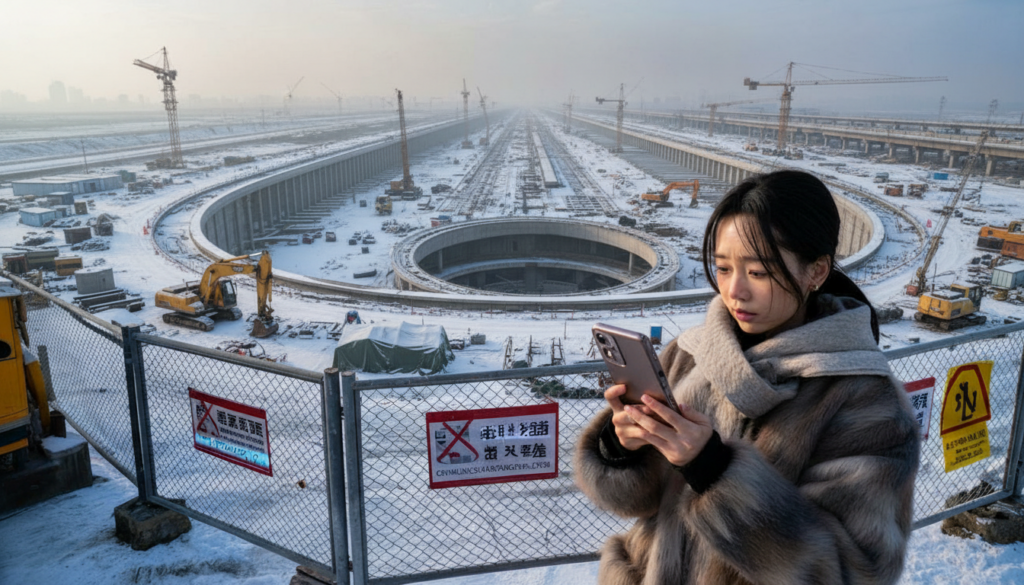
For a long time, this project was sold as a sign of national ambition, scientific achievement, and soft power. Now it’s being put on hold with some careful words about “budgetary priorities” and “economic context.”
People on social media are reacting in a range of ways, from anger to acceptance.

What do you do when even a superpower decides that being curious costs too much?
When the dream machine stops working all of a sudden
For ten years, the idea of a Chinese “super-collider” sparked conversations in university labs and on nationalist websites. The Circular Electron Positron Collider, or CEPC, was the name of the machine.
Physicists imagined a ring underground that was more than three times the size of CERN’s Large Hadron Collider in Europe. The kind of huge science tool that lets you peel back the layers of reality. The kind of structure that tells the world that we are at the very top of the league.
Then there was a quiet announcement that the project was being put on hold.
Not canceled on paper. Just frozen, for an unknown amount of time.
Researchers had already begun to change their careers inside institutes from Beijing to Shanghai. Some people had come back from postdocs in the U.S. or Switzerland just to work on this machine, which only comes around once in a generation. A young researcher said it was like “moving home for a future that just disappeared.”
On paper, China’s plan was simple: build a collider that could act as a “Higgs factory,” making a lot of Higgs bosons. This would go beyond what the LHC at CERN can do right now. The projected bill was in the tens of billions of dollars, which only seemed fair during years of rapid economic growth.
As GDP growth slowed, housing worries grew, and local governments fell deeper into debt, the CEPC started to look less like a proud bet and more like a luxury.
When countries spend money on big projects, they’re not just buying concrete and magnets. They’re buying stories. “We are the future.” “We are in charge of humanity’s search for knowledge.”
China already has a space station in orbit, a fleet of high-speed trains, and quantum labs that are at the cutting edge. But this time, the political math changed. Not only would the world’s largest particle accelerator have needed money, but it would also have needed patience, careful diplomacy with Europe, and the willingness to pay for something that mostly gives you knowledge, not cash.
Let’s be honest: no one really does this every day.
CEPC was one of those projects that scientists love but are hard to explain to a middle-class family that is having trouble paying their mortgage.
How to put a big dream on hold without making a sound
There is a way for a government to back out of a bold promise without causing a national identity crisis. You don’t say, “We’re done.” You say things like “we are reevaluating timelines” or “aligning with strategic priorities.”
That’s about what’s going on with the CEPC. Official communication talks about “phased planning,” feasibility studies, and “further evaluation.” Most experts hear the same thing: not now, and maybe not ever.
The first real step is easy. Funding lines move more slowly. Young researchers stop getting jobs that are only related to CEPC. International workshops are slowly getting smaller.
We’ve all been there: the moment when you stop talking about a dream because it hurts too much to say it out loud. You can feel that same energy on Chinese science forums. Less successful fake models of shining underground tunnels. More questions like “Should I switch to AI?” or “Is it better to go abroad?”
The European factor is also there. CERN is not being polite. Europe is already pushing for its own successor to the LHC: the Future Circular Collider (FCC), which is another huge ring that costs a lot of money. The two mega-rings, one in Europe and one in China, always sounded like two different worlds.

As Beijing cuts back on its spending, Brussels and Geneva suddenly seem less like competitors and more like the last two big players still betting on basic physics.
There is something more fragile than the budget lines: the morale of scientists. These projects mean a lot to me. They are the kinds of goals that students talk about at 2 a.m. in their dorm rooms, the kinds that make years of hard work worth it.
When the CEPC is frozen, it shows that even a wealthy, ambitious state has limits when curiosity and cost come together. It also suggests that priorities are changing: from basic science that might pay off in decades to AI, defense tech, and industrial self-reliance that pay off in elections and growth numbers.
*In that way, China’s reluctance says as much about our time as it does about a tunnel that may never be built.*
This break is both a relief and a warning for European scientists. The race is less crowded, but the world is losing interest in big, slow, and uncertain science.
What this means for the rest of us, who are far away from any tunnel
You don’t need to know what a Higgs boson is to feel the effects of this choice. When a country as big as China stops doing ultra-long-term research, it changes the kinds of futures that seem possible.
One surprisingly down-to-earth answer is to protect and support the small, human-scale science that is all around you. There are public labs in your city. Physics departments at colleges and universities. Local events where kids can touch a real detector or talk to a researcher who still believes in long shots.
If mega-colliders become less common, the smaller connections between science and everyday life will be even more important.
Many of us also fall into a personal trap when we read about these big problems. We shrug and say to ourselves, “This is way above my pay grade.” Or we treat it like a game: Europe vs. China, who wins and who loses.
That way of thinking quietly cuts us off from choices that are, at their core, political choices made in our name with our tax money, which will affect the tools our kids will or won’t have.
A more honest answer is to stay curious and a little pushy. Don’t just read the headline. Find out why a collider is funded or frozen, and what else gets money instead. Scientists in lab coats aren’t the only ones who are curious. It’s for people who want to know what kind of world is being built right under their feet.
One European physicist I talked to by video call said, “Huge scientific tools like colliders aren’t just about particles.” “They show what people think is worth waiting 30 years for.”
- Go after the money
If you hear that a project is on hold, check the official budget papers to see what new spending goes up at the same time. - Speak with real people
Look for interviews, podcasts, or Q&A sessions with researchers who were actually there. You can learn more from their tone than from any press release. - Don’t give in to the “it’s too hard for me” urge
Plain and simple: you don’t need a PhD to have an opinion on how public money is spent. - Think about the long term.
Find out what your country is still willing to pay for that might not pay off until your grandchildren are adults. - Tell the story
Talking to a friend or child about these choices can be a quiet way to fight the idea that only experts should care.
What future are we choosing when the biggest machines stop working?
China’s decision to pull out of the world’s largest particle accelerator is more than just a number on a budget sheet. It’s a picture of a world that’s a little more worried, a little more focused on the short term, and a lot more cautious with big plans that don’t promise quick returns.
Europe still wants to understand the universe, but it feels like a race that is over. Now that the FCC at CERN is over, it looks less like a competition and more like a test case: can any democracy still convince its people that a multi-billion-euro ring in the ground is worth decades of work?
The question is quieter and more personal for the rest of us. In our societies, how much room do we still have for things that are beautiful, uncertain, and very expensive in the short term?
When money is tight, we cut dreams first and use spreadsheets to make it look like we did the right thing. But history keeps reminding us that what was once “useless” basic research is now an MRI scanner, GPS, or smartphone chip.
You might feel a flash of recognition the next time you see a headline about a collider, a telescope, or a lab experiment with an awkward name. That’s not just “news about science.” That’s a small vote about what kind of future we can still afford, even when the numbers look bad and a big country like China quietly steps aside.
| Key point | Detail | Value for the reader |
|---|---|---|
| China’s collider pause | Beijing has effectively frozen plans for the CEPC, a 100 km particle accelerator meant to surpass CERN’s LHC | Helps you grasp how global priorities are shifting away from ultra-long-term basic research |
| Impact on global science | The decision reshapes the race with Europe’s planned Future Circular Collider and signals tighter budgets for “slow” science | Gives context for future headlines about CERN, EU science funding, and big physics projects |
| What you can do | Follow funding choices, listen to scientists, and stay engaged with local research and public debate | Turns a distant mega-project into something you can respond to as a citizen, not just as a spectator |
FAQs
Question 1 What did China want to do with the CEPC?
Answer 1: The CEPC was built as a huge circular collider that is about 100 km long. Its main purpose was to study the Higgs boson in much more detail than the Large Hadron Collider does now. Later, it will host even more powerful proton-proton collisions.
Question 2: Is the project really over?
Answer 2: No, officially. It is said that it is still being studied and re-evaluated, but in reality, it feels like an indefinite pause because of less money, changing priorities, and unclear timelines.
Question 3: Why is this collider thought to be “too expensive” even for China?
Answer 3: Because it would cost tens of billions of dollars over decades, and China is already having trouble growing, has a lot of local debt, is under pressure from its aging population, and needs to invest in technologies that are more useful right away, like AI, chips, and defense.
Question 4 What does this mean for Europe’s plans to build its own collider?
Answer 4 It gets rid of a direct competitor, but it also makes things harder for European leaders. They now have to explain why they need their own giant collider in a world that doesn’t like long, uncertain payoffs.
Question 5: Why should regular people care about particle accelerators?
Answer 5: Big physics facilities have historically led to breakthroughs in computing, medicine, and materials science, and they show how much a society still believes in funding ideas that don’t fit into next quarter’s earnings report.